Keto-oriented everyday shoppers
If you use almond drink in cereal or smoothies, compare carbohydrate per 100ml or 100g and account for your usual pour. The word ‘almond’ does not tell you the carbohydrate content of a particular carton.


For a mild almond drink in a keto-oriented routine, start with the exact carton’s carbohydrate figure and the amount you usually pour, rather than relying on its flavour description or a ‘no added sugar’ label. Tesco Groceries lists 0.7g carbohydrate per 100ml for Tesco Unsweetened, while Marks & Spencer lists 0.8g per 100g for M&S Unsweetened; check those different measurement bases before comparing drinks.
If you use almond drink in cereal or smoothies, compare carbohydrate per 100ml or 100g and account for your usual pour. The word ‘almond’ does not tell you the carbohydrate content of a particular carton.
If you want a less sweet-tasting drink, look at the exact unsweetened or no-sugars variant and its ingredients. Rude Health describes its No Sugars drink as subtly nutty and light, but its standard Almond Drink contains rice for sweetness.
Consider how you will use the drink as well as how it tastes cold. Tesco advises adding its unsweetened drink before hot liquid and avoiding boiling water; Plenish describes its separate Barista Almond M*lk as foamable for coffee.
Choose the exact variant first, then compare its nutrition panel, ingredients and directions against the way you will use it.
| Priority | What to check | Your needs |
|---|---|---|
| Carbohydrate | Read carbohydrate and sugars on the exact variant’s panel. Note whether values are per 100ml or per 100g, then use your actual serving size. | I need a figure I can use for my usual pour. Tesco Groceries lists 0.7g carbohydrate per 100ml for Tesco Unsweetened; Marks & Spencer lists 0.8g per 100g for M&S Unsweetened. |
| Flavour | Check whether the variant is unsweetened, has no added sugar or contains an ingredient used for sweetness. Treat brand flavour descriptions as descriptions, not taste-test results. | I would rather have a subtle nutty flavour than a distinctly sweet one. Rude Health describes No Sugars as subtly nutty, while saying its separate standard Almond Drink contains rice for sweetness. |
| Ingredients | Compare the ingredient list and any added calcium, iodine or vitamins on the particular carton. A short ingredient list does not establish its carbohydrate value. | I may want a fortified drink, or I may prefer fewer ingredients. Tesco lists calcium, iodine and vitamins in its Unsweetened drink; Plenish describes its standard Almond M*lk as containing water, almonds and salt. |
| Allergens | Read the almond declaration and any precautionary allergen statement on the individual pack. | With a relevant nut allergy, I need to check the pack rather than assume a plant-based drink is suitable. Tesco’s Unsweetened drink contains almond and carries a ‘may contain peanuts and other nuts’ statement. |
| Opened life | Check refrigeration instructions and how soon the carton must be used after opening. Match the pack quantity to how often you use it. | If I only add a little to drinks, I need a carton I can finish in time. Tesco Groceries says to use Tesco Unsweetened within five days of opening; Marks & Spencer gives three days for M&S Unsweetened. |
Marks & Spencer lists 1.9g carbohydrate and 1.7g sugars per 100g for its Sweetened Almond Drink, compared with 0.8g carbohydrate and 0.2g sugars per 100g for its Unsweetened variant.
Compare the panel on the exact carton, then calculate the amount in the portion you normally use.
A no-added-sugar statement describes added sugar, not the drink’s total carbohydrate per serving.
If you track carbohydrate, use the current carton’s carbohydrate figure and your serving size rather than the front-of-pack wording alone.
Rude Health says its standard Almond Drink contains rice for sweetness. Its separate No Sugars Organic Almond Drink has a different, four-ingredient recipe.
Check the full variant name and ingredients before choosing a carton for a less sweet-tasting routine.
Opened-life instructions differ: Tesco Groceries specifies five days for Tesco Unsweetened, while Marks & Spencer specifies three days for M&S Unsweetened.
Check the pack’s storage directions and choose a quantity that fits how often you pour it.
These examples show why the variant matters: ingredient lists, nutrition panels and directions can differ even within one brand.
Tesco Unsweetened Almond Drink is an everyday unsweetened option with a published nutrition panel.
M&S has separate Unsweetened and Sweetened Almond Drinks; their labels should not be used interchangeably.
Rude Health describes its No Sugars Organic Almond Drink as subtly nutty, with a light mouthfeel.
Plenish describes its standard Almond M*lk as smooth and nutty, and markets a separate Barista Almond M*lk for coffee.
Alpro has distinct No Sugar, Original and Barista Almond variants listed by Tesco Groceries.
These Alpro almond-drink listings offer two variants to consider for a mild-flavoured routine. Check each carton’s carbohydrate information and the stated pack quantity before deciding which fits your use.
 No image available
The listing describes a subtle almond flavour for everyday uses such as cereal and smoothies. The product name specifies eight 1L cartons; check the carton’s carbohydrate panel against the amount you pour. Contains almond.
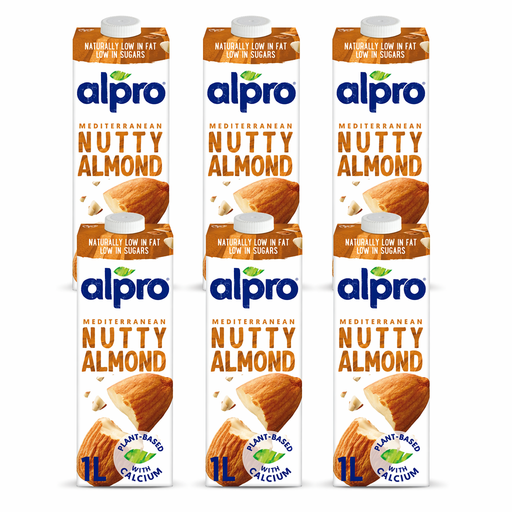 No image available
The listing describes a subtle nutty flavour for cold drinks, cereal, tea and coffee. Check the carton’s carbohydrate and sugar figures for your usual serving. The listing title suggests six cartons but its description states a net quantity of 1L, so confirm the pack quantity before ordering. Contains almond.
No. Read the total carbohydrate figure on the exact variant’s nutrition panel and account for your serving size. For example, Tesco Groceries lists 0.7g per 100ml for Tesco Unsweetened, while Marks & Spencer lists 0.8g per 100g for M&S Unsweetened; those figures use different measurement bases.
Rude Health describes its No Sugars Organic Almond Drink as subtly nutty and light, while Plenish describes its standard Almond M*lk as smooth and nutty. These are the brands’ flavour descriptions, not independent taste-test results. Check the exact variant’s ingredients if you want to avoid ingredients used for sweetness.
Check the directions for the drink you choose. Tesco advises adding its Unsweetened Almond Drink before hot liquid and not mixing it with boiling water to avoid curdling. Plenish separately describes its Barista Almond M*lk as foamable for coffee; that description does not establish how its standard drink will foam.
Almond-containing drinks are not suitable for someone with an almond allergy. The Food Standards Agency identifies almonds as nuts, and Tesco’s Unsweetened drink also carries a ‘may contain peanuts and other nuts’ statement. Read the individual pack’s allergen information when making an allergy-related choice.
Follow the directions on the individual carton. Tesco Groceries says to refrigerate Tesco Unsweetened and use it within five days of opening; Marks & Spencer says to refrigerate M&S Unsweetened and use it within three days.