Students stocking a new room or shared kitchen
Unopened cupboard storage can help while you organise fridge space. You will still need room to refrigerate a carton once it is open.


Choose an ambient, long-life almond drink if unopened cartons need to wait in a cupboard while you settle in; after opening, follow the storage and use-by instructions on that carton. If you regularly use almond drink instead of dairy, compare the declared added nutrients rather than assuming all recipes are alike. A barista blend is worth considering when coffee foam matters to you, but its recipe may differ from a standard drink.
Unopened cupboard storage can help while you organise fridge space. You will still need room to refrigerate a carton once it is open.
If almond drink often replaces dairy in your routine, compare the added nutrients on each carton. Recipes and fortification differ between products.
If you make coffees with a milk frother, a barista-labelled recipe may be relevant. Check its ingredients separately from the brand’s standard almond drink.
Start with where the unopened carton will go, then check what happens after opening. Compare the recipe and pack size against how you expect to use it.
| Priority | What to check | Your needs |
|---|---|---|
| Storage | Look for long-life or UHT wording and the unopened storage instructions. Check the required fridge temperature and use-within period after opening. | I need unopened cartons to wait outside the fridge, but I can make room for one once it is open. |
| Fortification | Read the exact carton’s ingredients and nutrition panel for added calcium, vitamin D, vitamin B12 and iodine where these matter to your choice. Do not assume every almond drink contains the same additions. | If I use almond drink regularly instead of dairy, I want to know which nutrients this particular carton lists. |
| Recipe and flavour | Compare original and no-sugars recipes using their ingredient lists and nutrition panels. For a short ingredient list, check the specific product rather than the brand alone. | I would rather try a carton I expect to finish than commit to several before I know whether I like its flavour. |
| Quantity | Confirm the number and size of cartons, available cupboard space and the opened-carton instructions. Check the current price per litre when comparing packs at the same point of purchase. | Shared-kitchen storage is limited, so a multipack only works for me if I have somewhere to put it. |
| Coffee use | Look for a product explicitly formulated for foaming, and compare its ingredients with the standard version. A barista label does not establish its suitability for other uses. | Foam matters to me if I regularly make espresso-style coffees; it matters less for cereal or tea. |
Plenish’s standard Almond M*lk lists water, organic almonds and salt, while M&S lists added calcium, iodine and vitamins D and B12 in its Unsweetened Almond Drink. The recipes serve different ingredient preferences.
Compare the exact ingredient list and nutrition panel if fortification matters to your choice.
An 8 x 1L pack needs room for eight cartons and commits you to a flavour before you have tried it.
Check the carton count and storage instructions; consider a smaller quantity if you are still deciding which drink you will use.
Long-life storage before opening does not mean the drink can stay in a cupboard afterwards. Marks & Spencer instructs buyers to refrigerate its Unsweetened Almond Drink at 0°C to +5°C and consume it within three days of opening.
Follow the instructions on your own carton and choose a size you expect to finish within its stated period.
Plenish markets its Barista Almond M*lk for coffee foam; that does not make it the same recipe as its standard Almond M*lk.
Choose based on how you will use the drink, and compare ingredients if you also want it for cereal or smoothies.
An option to examine for a long-life, no-sugars move-in shop.
Its standard and barista almond drinks address different recipe preferences.
Its Pure Almond and standard Almond Drink should be compared as separate products.
A retailer reference for comparing own-label and branded almond-drink listings.
Its Unsweetened Almond Drink provides an example of declared fortification and specific opened-carton instructions.
These Alpro options include an 8 x 1L long-life, no-sugars pack and a separate Almond Drink 1L listing. Check each pack’s storage instructions and carton count when planning space for your move.
 No image available
The UHT long-life format is relevant if you need to store unopened cartons while settling in. Joybuy lists an 8 x 1L pack with no sugars or sweeteners and added calcium and vitamins B2, B12 and D2. Allow space for all eight cartons and follow the pack’s refrigeration instructions after opening.
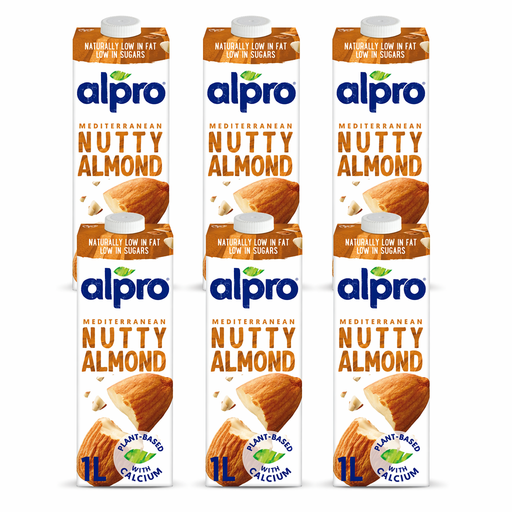 No image available
Consider this 1L almond drink when comparing an alternative to the no-sugars long-life pack. Before planning cupboard space around the listing, confirm the carton count and the exact pack’s unopened and after-opening storage instructions.
An ambient long-life carton is useful if you need to store it unopened before fridge space is organised. Check the exact pack: opened-carton rules still apply, and Marks & Spencer specifies refrigeration at 0°C to +5°C and use within three days for its Unsweetened Almond Drink.
No. Marks & Spencer lists added calcium, iodine and vitamins D and B12 for its Unsweetened Almond Drink, while Plenish lists a three-ingredient recipe for its standard Almond M*lk. If almond drink is a regular dairy alternative in a vegan diet, the NHS advises checking fortified alternatives as part of the wider diet; compare the label of the product you intend to buy.
No. The Food Standards Agency identifies almonds as tree nuts. Read the current pack’s allergen information rather than relying on an online listing.
Not for the sake of a foamable recipe. Plenish markets its Barista Almond M*lk for coffee, so compare a standard almond drink first if coffee foam is not important to you.
Check the carton before using it. Marks & Spencer warns that product information can change; the current pack is particularly important for ingredients, allergens and storage instructions.