Home coffee makers
If you make lattes or cappuccinos, an explicitly foamable barista drink is a more relevant starting point than assuming a general-purpose carton will froth.


For lattes and other drinks where foam matters, look for an almond drink explicitly described as foamable; for tea, cocoa and cooking, compare standard and unsweetened cartons by their ingredients and nutrition labels. If you are stocking up for winter, check whether a listing is for one carton or a multipack: a 6 × 1L pack is six separate cartons, not a single 6-pint bottle. Allow for storage space and follow each carton’s instructions after opening.
If you make lattes or cappuccinos, an explicitly foamable barista drink is a more relevant starting point than assuming a general-purpose carton will froth.
For repeated warm drinks, compare the number and size of individual cartons with your storage space and how quickly you use a carton once opened.
If you use almond drink in tea, cocoa, cereal or cooking, check the exact carton’s sugars and added nutrients rather than assuming all unsweetened products have the same label.
Start with the drink you plan to make, then compare the carton label and the pack format you can realistically store and use.
| Priority | What to check | Your needs |
|---|---|---|
| Foam and hot drinks | Check whether the exact product is described as foamable. Read its preparation guidance: Alpro advises warming almond drink before adding it to coffee, while Sainsbury’s advises letting hot water cool slightly for its Unsweetened Almond Drink. | I want foam for a latte, or I need to know how to add a standard carton to a hot drink without it separating. |
| Sugars and added nutrients | Compare sugars per 100 ml and the listed calcium, iodine and vitamins on the exact carton. Do not assume that unsweetened, organic and standard drinks have identical ingredients or fortification. | For everyday tea or cocoa, I may prefer an unsweetened drink; if added nutrients matter to my household, I want to compare their labels too. |
| Pack size and storage | Distinguish a 1L carton from a 6 × 1L or 8 × 1L multipack. Check space for unopened cartons and the storage and use instructions for each carton after opening. | We make warm drinks regularly, but I want a stock-up that fits in the cupboard and lets us open one carton at a time. |
| Almond and other nut information | Read the ingredient and precautionary allergen statements on the exact product. The Food Standards Agency identifies almonds as tree nuts; other nut warnings can vary by product. | If someone in the household has a relevant nut allergy, I need to check the specific carton rather than treating dairy-free as nut-free. |
| Drinks for children | Check the exact product’s age guidance and nutrition label before using it as a child’s main milk drink. Sainsbury’s says its Unsweetened Almond Drink is not suitable as a main milk alternative for children under 3. | If the drink is for a young child, I need advice appropriate to that child rather than choosing solely by the words ‘plant-based’ or ‘unsweetened’. |
A 6 × 1L listing describes six separate cartons. Plenish also lists an 8 × 1L standard-almond pack, so the number at the front of a listing does not tell you the size of one container.
Check the carton size, carton count and opened-storage instructions before ordering for the household.
Alpro notes that almond drinks can curdle in coffee. A general-purpose carton should not be assumed to behave like a barista product described as foamable.
For a foam-dependent latte, check the exact product’s barista description. Otherwise, follow its maker’s hot-drink instructions.
Sugars and added nutrients differ between almond drinks; a short ingredient list does not establish the same calcium, iodine or vitamin content as another carton.
Compare the nutrition panels of the products you are considering. Seek appropriate professional advice if a child’s main milk drink or a medically restricted diet is involved.
Almond is a tree nut. Precautionary statements about other nuts can also differ between products.
Check the full allergen information on the exact carton before buying for someone with a relevant nut allergy.
These product-line references help distinguish formats and labels; they are not a list of products available from Joybuy.
Alpro lists Original, No Sugars and Barista Almond drinks in 1L formats.
Plenish lists a standard Almond M*lk 8 × 1L multipack and a Barista Almond M*lk 6 × 1L multipack.
Rude Health presents its standard Almond Drink for uses including coffee and cocoa.
Sainsbury’s lists an own-label Unsweetened Almond Drink in a 1L carton.
Tesco’s almond-drinks category lists own-label and other branded 1L options, including Tesco Unsweetened Almond Drink.
These Alpro cartons cover an 8 × 1L No Sugars stock-up and a general-purpose 1L almond drink listing. Check the second listing’s carton count before treating it as a multipack; neither listing establishes that the drink is foamable.
 No image available
For repeated warm drinks, this listing describes eight separate 1L cartons and use in hot drinks.
It lists 0.0 g sugars per 100 ml, calcium and vitamins B2, B12 and D. Allow space for the pack, refrigerate each carton after opening and follow its listed five-day use window. Check the exact allergen information; foamability is not established by this listing.
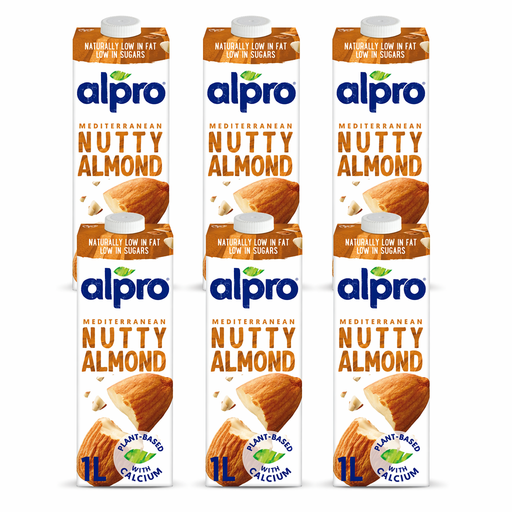 No image available
For general-purpose warm drinks, the listing describes use in tea and coffee as well as cooking.
It states a net quantity of 1L and lists calcium, iodine and vitamins B12, D2 and E. Confirm the number of cartons before buying for a stock-up: the leading ‘6’ in the listing title does not establish the pack contents. Check the nutrition panel if the exact sugar amount matters, and check suitability separately if you need foam for coffee.
Do not assume it does. Plenish describes its barista multipack as 6 × 1L: six individual cartons, not one large bottle. Check both the carton size and the number of cartons on any listing before ordering.
Start with a barista variant explicitly described as foamable: Alpro describes Barista Almond that way, and Plenish describes its Barista Almond multipack as suitable for micro-foam. For a standard drink, follow the specific product’s hot-drink guidance rather than assuming it will froth.
Almond drinks contain almonds, which the Food Standards Agency identifies as tree nuts; do not assume they are suitable for someone with an almond allergy. Read the exact carton’s ingredient and precautionary allergen statements for other relevant nut information.
Do not assume a general almond drink is suitable. NHS guidance on milk-free diets for babies distinguishes use in cooking from use as a main milk drink, and Sainsbury’s says its Unsweetened Almond Drink is not suitable as a main milk alternative for children under 3. Seek advice appropriate to the child before making a change.