Households buying for cereal and muesli
If almond drink goes over cereal or into smoothies most mornings, plan the total volume in litres and consider how quickly each opened carton will be used.


For a continental breakfast shop of about six imperial pints (3.41 litres), compare the total litres: four 1-litre cartons exceed that amount, while a six-carton multipack holds 6 litres. If almond drink regularly replaces dairy, check an unsweetened option’s calcium declaration and wider nutrient label; choose a barista drink when frothing coffee matters, rather than assuming it suits every breakfast use.
If almond drink goes over cereal or into smoothies most mornings, plan the total volume in litres and consider how quickly each opened carton will be used.
For a regular dairy alternative, compare the sugars declaration and check for added calcium and other listed nutrients on the particular carton.
If frothing almond drink is part of the morning routine, a product made for coffee may be worth considering alongside an everyday cereal option.
Start with the volume you will use, then compare labels for your usual breakfast and any regular dairy replacement.
| Priority | What to check | Your needs |
|---|---|---|
| Pack volume | Six imperial pints is about 3.41 litres. Check both carton size and carton count: 6 x 1L means 6 litres, not six pints. | I want enough for the household’s breakfasts without mistaking the number of cartons for the volume I need. |
| Sugars | Compare declarations on the same basis. Marks & Spencer lists 0.2g sugars per 100g for its unsweetened almond drink and 1.7g per 100g for its sweetened version. | For cereal most mornings, I would compare unsweetened and sweetened cartons by their labels rather than their flavour descriptions. |
| Fortification | Check added calcium and the other nutrients declared on the exact carton. The NHS discusses unsweetened calcium-fortified plant alternatives in its dairy-and-alternatives guidance. | If this drink regularly takes the place of dairy, I want to know what the particular product contains, not assume all almond drinks are fortified alike. |
| Coffee use | Look for a stated frothing use if making foam-based coffee. Plenish presents its Barista Almond M*lk as a coffee product in a 6 x 1L pack. | Coffee foam matters in my household; otherwise, I would choose for the cereal and drinks we make more often. |
| Allergens and storage | Read the current allergen statement and post-opening directions. Marks & Spencer instructs shoppers to refrigerate its unsweetened drink at 0°C to +5°C and use it within three days of opening. | In a shared household, I need to account for nut allergies and open only as many cartons as we can use within their stated storage period. |
Plenish’s 6 x 1L barista pack contains 6 litres, considerably more than six imperial pints (about 3.41 litres).
Work out the amount needed in litres, then check the number and size of cartons before choosing a pack.
Marks & Spencer lists added calcium, iodine and vitamins D and B12 for its unsweetened drink. A short ingredient list alone does not tell you whether another drink is similarly fortified.
If almond drink regularly replaces dairy, compare the current calcium and nutrient declarations on the products you are considering.
Marks & Spencer’s sweetened and unsweetened drinks list different sugars per 100g. Plenish presents its barista drink for frothing coffee, a distinct use from pouring a drink over cereal.
Decide whether sweetness or coffee foam matters at breakfast, then check the corresponding product label.
Almonds are tree nuts. Marks & Spencer labels its sweetened almond drink unsuitable for people with nut or peanut allergy; its unsweetened drink also has a three-day post-opening use instruction.
Do not select almond drink for someone who must avoid almonds. Read each carton’s allergen and storage statements before planning a larger shop.
These product-line examples show why pack format, ingredients and label details are worth comparing; they do not indicate which brands are stocked on Joybuy.
Its 1-litre sweetened and unsweetened almond drinks offer a direct label comparison for breakfast use.
Offers a plain 8 x 1L almond-drink multipack and a separate 6 x 1L barista pack for coffee.
Its organic Almond Drink is presented for uses including coffee and cocoa.
Tesco lists Alpro Almond No Sugar, Almond Original and Barista Almond in 1-litre formats.
Tesco’s almond-drink category includes its own-label Unsweetened Almond Drink 1L alongside branded options.
These Alpro almond-drink listings are relevant to cereal-led breakfasts. Compare their stated carton sizes and confirm the total quantity before shopping for roughly six pints.
 No image available
An almond-drink option for cereal or smoothies. The stated 8 x 1L pack totals 8 litres, well beyond a six-imperial-pint shop; consider storage space and how quickly the household will use each opened carton. Check the carton’s fortification and post-opening directions if those details affect your choice.
 No image available
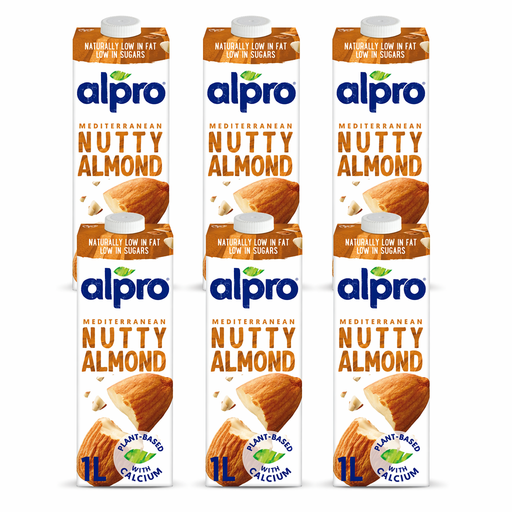
An almond drink described for cereal and hot or cold use. Its name states 1L and begins with “6”; confirm the carton count rather than treating that number as a six-pint volume. If sugars matter to your choice, compare the current nutrition panel on the same per-100ml or per-100g basis as other drinks.
Not necessarily. Plenish’s 6 x 1L barista pack contains 6 litres, whereas six imperial pints is about 3.41 litres. Check the stated volume per carton and the carton count separately.
Start with the sugars declaration and, if the drink regularly replaces dairy, its calcium declaration. Marks & Spencer describes its unsweetened almond drink for cereal and lists 0.2g sugars per 100g alongside added calcium, iodine and vitamins D and B12.
Follow that carton’s instructions. Marks & Spencer says to refrigerate its unsweetened almond drink at 0°C to +5°C after opening and consume it within three days; do not apply that period to every brand.
Do not choose almond drink for someone who must avoid almonds. Almonds are tree nuts, and the Marks & Spencer sweetened almond drink is labelled unsuitable for people with nut or peanut allergy. Check the current allergen statement on each product.
You cannot tell from “organic” or the ingredient count alone. If almond drink regularly replaces dairy, check added calcium and the full nutrient declaration on the exact product; the NHS guidance on dairy alternatives specifically discusses unsweetened calcium-fortified plant drinks.