Who is this choice for?
The right carton depends on whether almond flavour, regular dairy replacement or coffee preparation is your main reason for buying it.
Shoppers planning high-protein meals
If you like almond drink in cereal or smoothies, check its protein per 100ml before counting it towards the meal. The Alpro and Sainsbury's examples listed by Sainsbury's provide 0.5g and 0.6g respectively per 100ml, so plan a separate protein-containing food.
Vegan shoppers replacing dairy regularly
Fortification deserves a look alongside flavour and ingredients. The NHS advises people following a vegan diet to consider fortified dairy alternatives; check the carton for the particular nutrients you want to account for.
Coffee drinkers seeking foam
If coffee texture is the priority, look for a product designated for barista use. Alpro and Plenish describe their barista almond drinks as foamable, but that description does not establish their protein content.
What should you check before buying?
Start with protein per 100ml and the amount you will use, then check fortification, ingredients and intended use against the rest of the meal.
| Priority | What to check | Your needs |
|---|
| Protein |
Read protein per 100ml on the exact carton; consider how much drink goes into a serving. Sainsbury's lists 0.5g per 100ml for Alpro Almond No Sugars and 0.6g for its own Unsweetened Almond Drink. |
I like almond flavour in a smoothie, but need to plan its protein-containing ingredients separately rather than assuming the drink supplies them. |
| Fortification |
Check whether the carton lists calcium, iodine, vitamin D and vitamin B12, and compare the amounts if they matter to your choice. UK government scientific advice says nutrient content varies between plant-based drinks and that UK organic plant-based drinks cannot be fortified. |
If I use almond drink regularly instead of dairy, I want to know which nutrients it actually contains. |
| Sugars and ingredients |
Compare the sugars figure per 100ml and read the ingredient list; an unsweetened label does not tell you the drink's protein content. A short ingredient list does not establish a protein advantage. |
For everyday cereal or cooking, I may prefer an unsweetened drink or a particular ingredient list, without treating either as a protein claim. |
| Coffee use |
Look for an explicit barista or foamable description if foam is important. Check protein and fortification on that formulation separately; coffee suitability does not establish either. |
I want almond drink to foam in coffee, so I would choose for that use rather than assume my usual cereal drink behaves the same way. |
| Allergens |
Read the current ingredient and allergen information, including any cross-contact warning. GOV.UK explains that allergens present in prepacked food or drink must be clearly identified in the ingredients list. |
For anyone with an almond allergy, I would not choose an almond drink; other nut warnings also need checking on the exact pack. |
Which brands offer relevant options?
These brand examples show different formulations to compare; a brand name alone does not establish the nutrients or intended use of every carton.
Alpro
Offers Original, No Sugars and Barista Almond variants.
- Sainsbury's lists added calcium, iodine and vitamins for Alpro Almond No Sugars, with 0.5g protein per 100ml.
- Alpro Barista Almond is described as foamable; that coffee-use description is not a protein claim.
Rude Health
Offers organic almond drinks with different ingredient lists.
- Rude Health lists water and organic Italian almonds (5%) for Pure Almond; its No Sugars Organic Almond Drink lists four ingredients, including 3% almonds.
- Ingredient simplicity does not establish protein content or fortification. Compare the current carton with your priorities.
Plenish
Offers an everyday almond drink and a separate Barista Almond formulation.
- Plenish describes its everyday drink as water, organic almonds and salt, and markets Barista Almond for coffee.
- A Plenish article from 2021 gave 1.3g protein per 100ml for its almond milk. Check the current carton before using that historical figure to compare products.
Tesco
Lists an own-label unsweetened almond drink alongside branded options.
- The Tesco almond-drink listing includes its own-label option as well as Alpro, Plenish and Rude Health products.
- The listing alone does not establish a protein advantage for Tesco's own-label drink; compare nutrition panels.
Sainsbury's
Offers unsweetened, fortified almond drinks in chilled and long-life formats.
- Sainsbury's lists calcium, iodine, vitamin D and vitamin B12 for its Unsweetened Almond Drink.
- Its listed 0.6g protein per 100ml should not be treated as the meal's main protein contribution.
M&S
Offers an unsweetened almond drink with added nutrients.
- M&S lists added calcium, iodine, vitamin D and vitamin B12 for its Unsweetened Almond Drink.
- M&S lists 0.5g protein per 100g, so check serving size and units before comparing it with per-100ml labels.
Almond drinks on Joybuy
These Alpro almond drinks are options for cereal, smoothies and other everyday uses when you plan the meal's protein separately. Check the exact pack for the nutrients and serving details that matter to you.
 No image available
Alpro Almond No Sugars Long Life Drink 8 x 1L
An almond-drink base for cereal or smoothies when the meal's protein comes from other ingredients.
The listing states 0.0g sugars and 0.5g protein per 100ml, with added calcium and vitamins B2, B12 and D. It contains almond; check the current pack for allergen and storage instructions.
View on Joybuy
 No image available
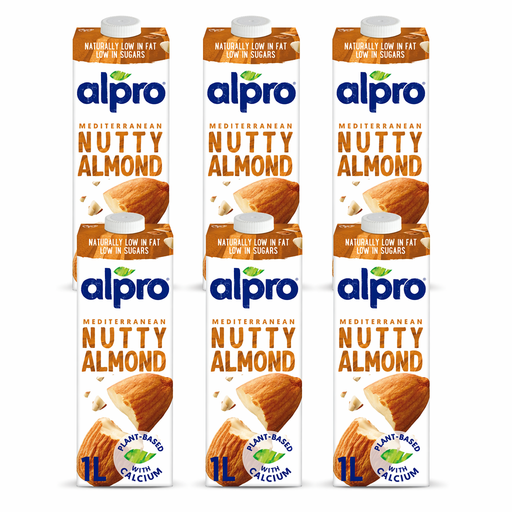
Alpro Almond Drink 6 x 1L
An almond-drink option for smoothies, cereal, hot drinks or cooking; plan protein-containing ingredients separately.
The listing names added calcium, iodine and vitamins B12, D2 and E. Check the current carton's protein per 100ml before counting it towards a meal, and read its almond allergen information.
View on Joybuy
Frequently asked questions
Can almond milk be the main protein source in a high-protein meal?
Do not assume it can. Sainsbury's lists 0.5g protein per 100ml for Alpro Almond No Sugars and 0.6g for its own Unsweetened Almond Drink. Read the carton you buy and plan a separate protein-containing food for the meal.
What if almond drink regularly replaces dairy in a vegan diet?
Check whether the drink is fortified with the nutrients relevant to your wider diet. The NHS advises considering fortified dairy alternatives and identifies vitamin D, vitamin B12, iodine and calcium among nutrients needing attention in vegan diets. UK government scientific advice notes that plant-drink nutrients vary and that UK organic plant-based drinks cannot be fortified.
Is almond drink suitable for someone with an almond allergy?
No: a drink containing almonds is not suitable for someone with an almond allergy. Read the current ingredient list and any cross-contact warning for other nuts. GOV.UK says allergens present in prepacked food and drink must be clearly identified in the ingredients list.
Should I buy a barista almond drink for coffee?
Choose a barista-labelled formulation if foam is your priority: Alpro and Plenish describe their barista almond products as foamable or made for coffee. Check the specific carton separately for protein, sugars and fortification.
How should I store almond drink after opening?
Follow the instructions on the exact carton, including refrigeration and the stated time for using it after opening. Storage instructions can differ between products and formats.


