Families preparing dairy-free school breakfasts
Almond drink may be an option for cereal, porridge or smoothies at home when the child can safely have almonds. For food or drink taken to school, check the school’s allergy arrangements too.


Choose an almond drink for school use only if the child can safely have almonds and the school permits nut-containing products. If it regularly replaces dairy for a child who cannot have dairy, check the carton for calcium and iodine fortification; Kingston and Richmond NHS Foundation Trust highlights both nutrients in its guidance for parents. Compare sugars on the exact carton if that matters to your choice, rather than assuming every dairy-free or unsweetened drink has the same formulation.
Almond drink may be an option for cereal, porridge or smoothies at home when the child can safely have almonds. For food or drink taken to school, check the school’s allergy arrangements too.
If a child cannot have dairy, the nutrients on the carton matter alongside its dairy-free label. Kingston and Richmond NHS Foundation Trust’s guidance for parents highlights calcium and iodine fortification in dairy substitutes.
A no-sugars formula or a short ingredient list may suit a particular preference. Check fortification separately, especially if the drink will be a regular dairy replacement.
Start with almond allergy and school use, then compare fortification, sugars and the intended use on the exact carton.
| Priority | What to check | Your needs |
|---|---|---|
| Allergens and school rules | Read the almond allergen statement and any precautionary warning. Confirm the school’s current arrangements before sending the drink or food made with it. | I need a dairy-free option that the child can safely have and that is permitted where it will be eaten or drunk. |
| Fortification | Look for both calcium and iodine on the current label. Kingston and Richmond NHS Foundation Trust’s guide for parents suggests 120 mg calcium per 100 ml as an ideal level for a dairy substitute when a child cannot have dairy. | If this regularly replaces dairy for a child, I want to check its nutrients, not rely on the words “dairy-free” or “organic”. |
| Sugars | Compare sugars using the stated quantity and unit. Alpro UK lists 0 g per 100 ml for its Roasted Almond No Sugars drink and 2.4 g per 100 ml for Almond Original; these are different formulations. | For regular breakfasts, I may prefer a no-sugars version, but I still need to check its allergens and fortification. |
| Ingredients and use | Check the ingredient list and the uses stated for the particular drink. Plenish lists almonds, spring water and salt for its almond drink; Rude Health lists four ingredients for its No Sugars Organic Almond Drink. | Whether I am making cereal, smoothies or a hot drink affects which stated uses matter. A shorter recipe alone does not answer the fortification question. |
Almond drink contains almond. Marks & Spencer labels its Unsweetened Almond Drink unsuitable for people with nut or peanut allergy, and a school may restrict nut-containing products.
Read the carton’s allergen information and check the school’s current arrangements before buying it for school use.
A drink made with few ingredients does not necessarily provide the calcium and iodine highlighted in Kingston and Richmond NHS Foundation Trust’s guidance for children who cannot have dairy.
If almond drink will regularly replace dairy, check both nutrients on the current carton.
Alpro UK lists 0 g sugars per 100 ml for Roasted Almond No Sugars and 2.4 g per 100 ml for Almond Original. Their names alone do not give you a like-for-like account of the formulations.
Read the sugars value and its unit on the exact product you intend to buy.
Ingredients and allergen information can change. Sainsbury’s advises checking product packaging before purchase or consumption rather than relying on previously viewed information.
Use the pack in hand for the final allergen, nutrition and storage checks.
These brand examples show different formulations; check the exact variant rather than extending one product’s details to the whole range.
Alpro UK lists Original and Roasted Almond No Sugars drinks with different sugar values.
Its Almond Drink and No Sugars Organic Almond Drink have different recipes.
Plenish describes an almond drink made with spring water, almonds and salt.
Tesco lists an Unsweetened Almond Drink with added calcium, potassium iodide and vitamins.
Marks & Spencer lists an Unsweetened Almond Drink enriched with calcium, iodine and vitamins D and B12.
These Alpro almond drinks are options for home preparation of school-day breakfasts and drinks. Check almond allergy and school arrangements first; if the drink regularly replaces dairy for a child, confirm calcium and iodine on the carton of the chosen pack.
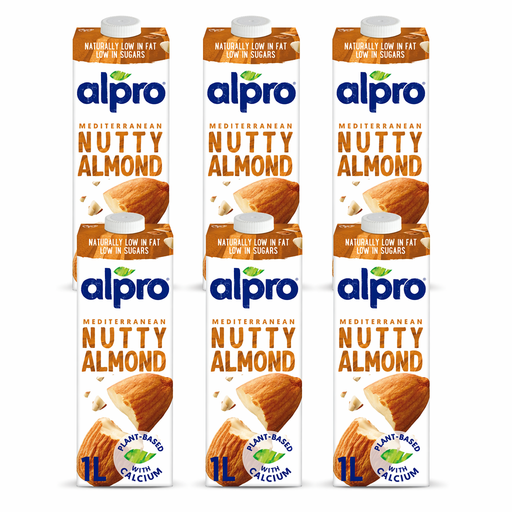 No image available
A six-carton option for preparing cereal, smoothies or hot drinks. It contains almond; check the current carton for allergens, sugars, calcium and iodine if those details affect its use as a regular dairy replacement.
 No image available
An eight-carton no-sugars option for cereal, smoothies or hot drinks. It contains almond; if it will regularly replace dairy for a child, confirm calcium and iodine on this pack’s current carton.
Do not send it if the school restricts almonds or other nut-containing products. Almond drink contains almond even when it is dairy-free, so check the child’s allergies, the carton and the school’s current arrangements before packing it.
Check the current carton for calcium and iodine fortification. Kingston and Richmond NHS Foundation Trust’s guide for parents highlights both when a child cannot have dairy and suggests an ideal calcium level of 120 mg per 100 ml for a substitute. A drink’s dairy-free label or short ingredient list does not establish its nutrient content.
Choose according to the formulation you need, then check allergens and fortification as well as sugars. Alpro UK lists 2.4 g sugars per 100 ml for Almond Original and 0 g per 100 ml for Roasted Almond No Sugars; those figures describe those two named products, not every Original or no-sugars drink.
Follow the refrigeration and use-after-opening instructions on the carton you bought. Check them for each product and pack rather than assuming different almond drinks have the same storage directions.