Dairy-free lunch planners without nut restrictions
Almond drink is an option when dairy needs to be avoided and almonds are tolerated. Check the current carton and any school or childcare policy before serving or packing it.


Almond milk can be a dairy-free lunch drink when the child can have almonds and no relevant allergy restriction or school or childcare nut policy rules it out. If it regularly replaces dairy, check the carton for calcium, iodine and vitamins D and B12 rather than assuming every almond drink is fortified. HWE Clinical Guidance’s NHS checklist advises against almond drinks as the main milk replacement for young children with cow’s-milk-protein allergy because they are low in energy and protein.
Whether almond milk fits a school-holiday lunch depends on the child’s allergens and whether the drink is an occasional choice or a regular milk replacement.
Almond drink is an option when dairy needs to be avoided and almonds are tolerated. Check the current carton and any school or childcare policy before serving or packing it.
If a drink will be the child’s main milk replacement, choosing an almond product for its dairy-free label alone is not enough. HWE Clinical Guidance’s NHS checklist advises against almond alternatives for young children in this situation because of their low energy and protein; discuss an appropriate replacement with the child’s clinical team.
Almond milk is not a nut-free alternative: the Food Standards Agency identifies almonds as tree nuts. For a child with an allergy, follow their individual allergy plan and the NHS advice to avoid a food when its allergen content is uncertain.
Check allergy compatibility first. Then decide whether the drink needs to serve as a regular dairy replacement or simply fits a particular lunch.
| Priority | What to check | Your needs |
|---|---|---|
| Allergens and setting rules | Read the current ingredients and allergen information for almond and other relevant allergens. Check the child’s allergy plan and any school or childcare nut policy. | I need a dairy-free drink that the child can have and that the setting permits. Dairy-free does not mean nut-free. |
| Regular milk replacement | Look for calcium, iodine and vitamins D and B12 on the carton. For a young child with cow’s-milk-protein allergy who needs a main replacement, follow individual clinical advice on energy and protein; HWE Clinical Guidance’s NHS checklist advises avoiding almond alternatives for this use. | If this drink will replace dairy regularly, I need to assess more than its plant ingredient. For a young child needing a main replacement, I need advice on an age-appropriate alternative. |
| Sugars and ingredients | Compare the ingredient list with the sugars figure on the nutrition panel. Check fortification separately: Alpro UK lists calcium and iodine for Almond No Sugars, while Plenish Drinks describes its Almond M*lk as almonds, water and salt. | I may want a no-sugars formulation or a short ingredient list for lunch. Neither preference, on its own, tells me whether the drink meets a regular replacement need. |
| After-opening storage | Follow the refrigeration and use-within instructions on the exact carton. Marks & Spencer says its Unsweetened Almond Drink should be kept at 0°C to +5°C and used within three days of opening. | When I open a carton for several lunches, I need to know its own storage instructions rather than applying another brand’s timetable. |
Almond is a tree nut, according to the Food Standards Agency. Marks & Spencer also marks its Unsweetened Almond Drink as unsuitable for people with nut or peanut allergy.
Check the child’s allergy plan, the setting’s policy and the current carton before comparing almond drinks on other features.
HWE Clinical Guidance’s NHS checklist advises avoiding almond alternatives as the main replacement for young children with cow’s-milk-protein allergy because they are low in energy and protein.
Ask the child’s dietitian, GP or allergy team about a suitable replacement, and check its fortification, energy and protein information.
Plenish Drinks describes its Almond M*lk as containing almonds, water and salt. That ingredient preference is a separate consideration from choosing a fortified drink.
If iodine matters because the drink regularly replaces dairy, check for it on the current ingredients or nutrition information.
Marks & Spencer specifies refrigeration and use within three days for its Unsweetened Almond Drink. Other products can carry different instructions.
Note when you open the carton and follow that product’s refrigeration and use-within directions.
These brand examples illustrate different formulations; check the exact product and current carton before using one for a child’s lunch.
Alpro UK’s Almond No Sugars is an almond drink with listed calcium and iodine for shoppers comparing fortified formulations.
Marks & Spencer’s Unsweetened Almond Drink has product-specific fortification, allergen and storage information.
Plenish Almond M*lk is a short-ingredient-list option for shoppers who prioritise that formulation.
Rude Health’s Almond Drink has a different ingredient formulation, including rice and sunflower oil alongside almond.
These Alpro almond-drink multipacks are options to consider for dairy-free lunches where almond is tolerated and any relevant nut policy permits it. Check the exact carton before serving, particularly if the drink will regularly replace dairy.
 No image available
This 8 x 1L almond-drink pack is an option for a lunch where almond is tolerated and a no-sugars formulation is wanted. Check the current carton for iodine if the drink will regularly replace dairy; HWE Clinical Guidance’s NHS checklist advises against almond drinks as the main milk replacement for young children with cow’s-milk-protein allergy.
 No image available
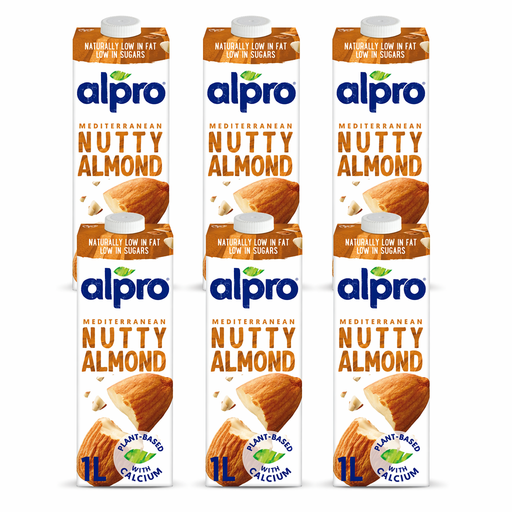
This six-pack of 1L almond drinks is another option where almond is tolerated. It is a different Alpro formulation from No Sugars: check its current ingredients if added sugar matters to you, and its nutrition panel if you need particular added nutrients.
No. The Food Standards Agency identifies almonds as tree nuts, so a dairy-free almond drink is not suitable for someone with an almond or tree-nut allergy. Check the exact product for other relevant allergen warnings: Marks & Spencer also marks its Unsweetened Almond Drink as unsuitable for people with peanut allergy.
Not by default. HWE Clinical Guidance’s NHS checklist advises avoiding almond alternatives as the main replacement for young children with cow’s-milk-protein allergy because they are low in energy and protein. Ask the child’s dietitian, GP or allergy team about an appropriate fortified alternative.
Check the current carton for calcium, iodine and vitamins D and B12 rather than assuming all almond drinks have the same fortification. For a young child needing a main replacement because of cow’s-milk-protein allergy, HWE Clinical Guidance’s NHS checklist also makes energy and protein part of the decision and advises against almond alternatives for that use.
Follow the instructions on that carton. Marks & Spencer says its Unsweetened Almond Drink should be refrigerated at 0°C to +5°C after opening and consumed within three days; do not apply that period to a different product without checking its label.