Batch cooks with limited fridge space
If you make several breakfasts or dishes at once, check whether unopened cartons can go in a cupboard. Once opened, the carton’s refrigeration instructions determine how to plan the remaining drink.


If you need to keep unopened cartons in a cupboard for batch cooking, start with an almond drink labelled long-life or UHT, then plan opened cartons around their own refrigeration instructions. Choose an unsweetened formulation when added sweetness would affect a recipe, and compare fortification with ingredient lists according to what matters to you. Do not treat “filtered” on its own as a promise about storage life or cooking performance.
If you make several breakfasts or dishes at once, check whether unopened cartons can go in a cupboard. Once opened, the carton’s refrigeration instructions determine how to plan the remaining drink.
For savoury dishes, porridge or baking, compare unsweetened labels and ingredient lists. Rice, oil and stabilisers distinguish some formulations from shorter water-and-almond recipes.
If labelled calcium, iodine or vitamins matter to your choice, read the nutrition and ingredient information on the exact carton rather than assuming every almond drink contains the same additions.
Start with storage and recipe requirements, then compare the ingredients and labelled additions of cartons that meet them.
| Priority | What to check | Your needs |
|---|---|---|
| Storage | Check whether the unopened carton is labelled long-life or UHT. Read its refrigeration temperature and use period after opening; check freezing instructions separately. | I have cupboard space for unopened cartons, but need to use each opened carton within its stated period. |
| Recipe flavour | Compare unsweetened wording, the sugars figure on the same stated basis, and ingredients such as rice, oil or salt. Do not assume different formulations behave alike when cooked. | For a savoury batch, I want to know whether the drink brings sweetness or other ingredients into the recipe. |
| Fortification and ingredients | Read the exact carton for added calcium, iodine and vitamins. Compare almond content only where the products disclose it on a comparable basis. | I may prioritise labelled additions for regular use, or prefer a shorter ingredient list for a particular recipe. |
| Allergens | Read the exact pack’s allergen declaration and any precautionary statement. Keep that information with portions prepared for other people. | If someone eating the batch has a nut allergy, I need to avoid serving them food containing almond drink. |
The word alone does not tell you whether a carton is long-life, chilled or suitable for a particular cooked dish.
Use the exact pack’s storage directions, ingredients and nutrition panel to make those decisions.
Marks & Spencer directs users of its Unsweetened Almond Drink to refrigerate it at 0°C to +5°C after opening and consume it within three days.
Plan when to open each carton around its own instructions, not its unopened best-before date.
Rude Health lists rice and sunflower oil in Almond Drink, while its Pure Almond lists water and 5% organic Italian almonds. Marks & Spencer lists added nutrients and stabiliser E418 in its Unsweetened Almond Drink.
Compare the exact ingredients when changing cartons, especially for a recipe in which sweetness or other additions matter.
The Food Standards Agency identifies almonds as tree nuts and nut-containing food as a risk for people with a nut allergy.
Do not serve a batch containing almond drink to someone with a nut allergy; keep the product’s allergen information with food prepared for others.
Tesco lists Alpro Almond No Sugar, Original and Barista long-life drinks. Check the individual carton when choosing between their formulations.
Rude Health lists different formulations for Almond Drink and Pure Almond.
Plenish describes its Almond M*lk as containing water, organic almonds and salt, and lists baking and porridge among its intended uses.
Tesco lists its Unsweetened Almond Drink as UHT, with added calcium, potassium iodide, vitamin E, vitamin B12, riboflavin and vitamin D2.
Marks & Spencer lists calcium, iodine, vitamin D and vitamin B12 in its Unsweetened Almond Drink, alongside specific storage directions.
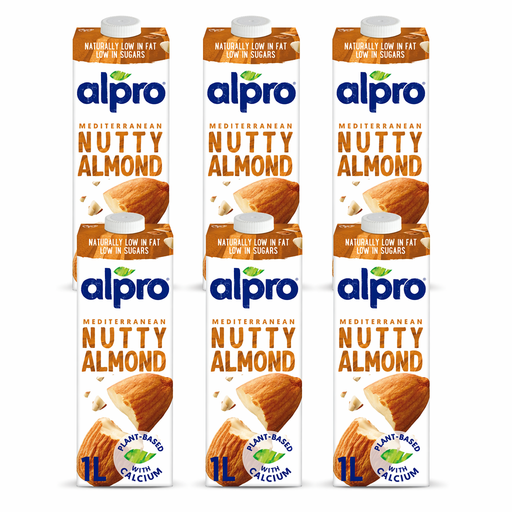
These Alpro options cover a No Sugars long-life multipack and an almond drink described for cooking. Check the exact variant and pack format against your recipes and storage plan.
 No image available
The long-life format suits a plan built around unopened cupboard stock. This listing identifies an 8 x 1L pack; after opening, its stated directions call for refrigeration and use within five days, and say not to freeze the drink. Check the carton before using it in a particular cooked recipe.
 No image available
This drink is described for cooking, but sugar is listed as an ingredient, so check its nutrition label if recipe sweetness matters. Its stated directions call for refrigeration after opening and use within five days. Confirm the supplied pack quantity and unopened-storage instructions before buying for a batch plan.
No: the word alone does not establish unopened storage conditions, ingredients or cooking performance. Check the exact carton for long-life or chilled storage directions, its recipe and nutrition information, and its instructions after opening.
Follow the exact carton’s unopened-storage directions. Tesco identifies its Unsweetened Almond Drink as UHT, while Marks & Spencer directs users to keep its Unsweetened Almond Drink in a cool, dry place away from sunlight before opening; neither instruction applies to every almond drink.
Use the period and refrigeration temperature stated on that carton. Marks & Spencer instructs users to keep its Unsweetened Almond Drink at 0°C to +5°C after opening and consume it within three days; plan a longer sequence of portions around separate cartons if needed.
Check the particular drink and recipe separately. Marks & Spencer labels its Unsweetened Almond Drink not suitable for freezing; that statement does not determine the instructions for other drinks or prepared dishes containing them.
No. The Food Standards Agency identifies almonds as tree nuts and warns that nut-containing products may pose a risk to people with a nut allergy. Read the exact product’s allergen declaration and do not serve food containing almond drink to someone with a nut allergy.