Students avoiding dairy who can eat almonds
For cereal, tea or cooking, compare the carton’s sugar information and calcium fortification. Check its allergen statement even if dairy is the main ingredient you avoid.


Choose an almond drink only if almonds and the carton’s other allergen warnings suit your needs; dairy-free does not mean nut-free. For regular use in place of milk, look for an unsweetened, calcium-fortified option, as described in NHS guidance, and check the carton for any other nutrients important to you. A shorter ingredient list or a barista label serves a different preference and does not establish the same fortification or allergen suitability.
For cereal, tea or cooking, compare the carton’s sugar information and calcium fortification. Check its allergen statement even if dairy is the main ingredient you avoid.
A dairy-free or gluten-free label does not make an almond drink nut-free. Check almonds in the ingredients and any separate warnings about peanuts or other nuts against your own requirements.
If foaming is the main use, compare a barista carton with a plain almond drink. The recipes can differ, so read the ingredients and allergen information before choosing one for the shared fridge.
Check allergen suitability first, then compare fortification, sugar information and the recipe for the way you will use the drink.
| Priority | What to check | Your needs |
|---|---|---|
| Allergens | Read the ingredients for almond and check separate precautionary warnings for other nuts or peanuts. Follow any explicit “not suitable for” statement on the carton. | I need a drink that fits the allergens I avoid, not just one labelled dairy-free or gluten-free. Marks & Spencer states that its Unsweetened Almond Drink is unsuitable for people with nut or peanut allergy. |
| Everyday use | Check whether the drink is unsweetened and calcium-fortified. Read the current carton for iodine and vitamins D or B12 if those features matter to your choice. | If this will regularly replace milk in my cereal or drinks, I want to compare its listed nutrients. The NHS includes unsweetened, calcium-fortified plant alternatives in its dairy-and-alternatives guidance; that does not describe every almond drink. |
| Recipe and coffee | Compare ingredients rather than treating a short list as proof of fortification. If you want coffee foam, look for a product described for that use and check its separate recipe. | A simple recipe matters to me more than coffee foam, or I mainly need a carton for coffee. Plenish describes its standard almond drink as having three ingredients and its Barista Almond M*lk as foamable. |
| Shared-kitchen use | Read the physical carton at each purchase, including allergen and after-opening storage instructions. Keep your own carton identifiable in a shared fridge. | I do not want to rely on an old product page or a housemate’s carton when deciding what I can use. Marks & Spencer advises shoppers to read the pack because product information can change. |
Almond is an ingredient in almond drink. Other nut or peanut warnings may matter too: Marks & Spencer, for example, labels its Unsweetened Almond Drink unsuitable for people with nut or peanut allergy.
If you must avoid almonds, choose a different type of drink and assess its own allergen label. Check any precautionary warning against your allergy-management advice rather than relying on a front-of-pack free-from claim.
A minimal recipe does not, by itself, establish calcium or vitamin fortification. Rude Health lists water and organic almonds for Pure Almond, while Marks & Spencer lists added calcium and other nutrients for its Unsweetened Almond Drink.
If the carton will regularly replace milk, compare its nutrition and ingredient panels with what you need from a dairy alternative.
Plenish describes its Barista Almond M*lk as foamable for coffee. That use does not establish that its recipe or nutrition matches a plain almond drink.
Choose it for coffee preparation if its ingredients and allergens suit you; compare the carton with a standard version if you also want it for everyday drinking or cereal.
Ingredients and allergen information can change. A familiar-looking carton or an online description is not a substitute for the label on the one you have bought.
Check each new carton’s ingredients, allergen warnings, date and after-opening storage directions, especially when several people use the same fridge.
An almond-drink range to check when comparing a regular dairy alternative.
Offers almond drinks with different short recipes, including No Sugars Organic Almond Drink and Pure Almond.
Has a standard almond drink and a separate barista version intended for coffee.
An own-label unsweetened almond drink to compare when calcium fortification matters.
Tesco Groceries lists an own-label unsweetened almond drink alongside branded almond drinks in its category.
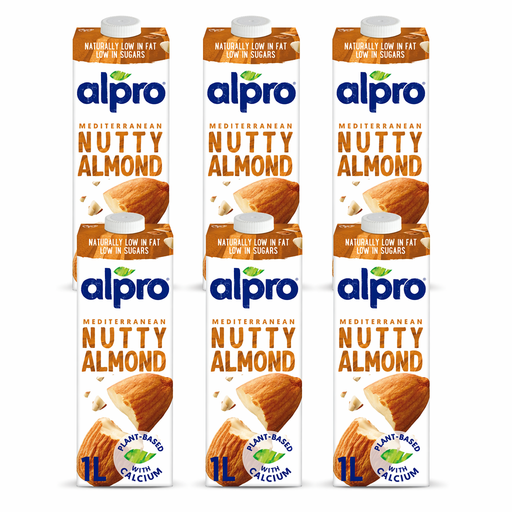
These Alpro multipacks are almond-drink options for students who can consume almonds. Compare the No Sugars variant with the other Almond Drink using the current cartons’ sugar, fortification and allergen information.
 No image available
The No Sugars variant is one to compare for regular cereal, tea or coffee use if almonds suit you. This is an 8 x 1L long-life pack; check its current carton for fortification, other allergen warnings and instructions after opening.
 No image available
This 6 x 1L almond-drink pack is an option for everyday hot or cold uses if almonds suit you. Sugar is listed as an ingredient for this variant, so do not treat it as the No Sugars option; check the current carton for its sugar amount, fortification, allergen warnings and storage directions.
Not if you must avoid almonds: almond is an ingredient, regardless of a dairy-free or gluten-free claim. Check other nut and peanut warnings too. Marks & Spencer, for example, states that its Unsweetened Almond Drink is unsuitable for people with nut or peanut allergy.
Start with the current carton’s sugar information and calcium fortification, then check any other listed nutrients that matter to your choice. NHS guidance includes unsweetened, calcium-fortified plant alternatives in the dairy-and-alternatives food group, but you should not assume every almond drink has those features.
No. Almond in the ingredients is deliberately part of the drink; a “may contain” warning concerns possible cross-contact. GOV.UK guidance describes precautionary allergen labelling as a warning where an identified cross-contamination risk cannot be controlled. Read both parts of the label if they affect your requirements.
Use it to narrow your choices, but read the physical carton before use. Marks & Spencer warns that ingredient, dietary and allergen information can change and advises shoppers to check the pack.
Choose a barista version when foaming coffee is your priority, provided its ingredients and allergens suit you. Plenish describes its Barista Almond M*lk as foamable; compare its own carton with a standard almond drink rather than assuming their recipes or nutrition match.