For a child who regularly has almond drink instead of dairy at home, compare unsweetened fortified cartons rather than choosing by flavour or a short ingredient list alone. Royal Devon University Healthcare NHS Foundation Trust advises checking for added calcium, iodine and vitamins B2 and B12 in milk alternatives for children. Before putting almond drink in a lunchbox, check the school’s allergy arrangements: almonds are tree nuts, and permission cannot be assumed.
Who is this for?
Families choosing a dairy-free breakfast drink
If almond drink is regularly served with cereal or used in smoothies, compare the exact carton’s fortification, sugars and allergens. Plant-based drinks do not all have the same ingredients or nutrient declarations.
Families packing food for school
An almond drink contains a tree-nut ingredient. Check the individual school’s current allergy and packed-lunch arrangements before sending one in a school bag.
Shoppers who prefer short ingredient lists
Some almond drinks list only a few ingredients, while others add calcium, iodine or vitamins. Check the nutrition panel if the drink will regularly replace dairy for a child.
What to check before buying
Start with where the drink will be used, then compare the exact variant’s allergens, nutrition panel and storage instructions.
| Priority | What to check | Your needs |
|---|
| School allergy arrangements |
Read the almond allergen declaration. Check the school’s current allergy and packed-lunch policy before packing the drink; dairy-free does not mean nut-free. |
I need to know whether an almond-containing drink is allowed at this school, or choose a different type of drink for the lunchbox. |
| Fortification |
For regular use instead of dairy by a child, compare calcium per 100 ml and check for iodine and vitamins B2 and B12. Royal Devon University Healthcare NHS Foundation Trust advises looking for added calcium at 120 mg per 100 ml, alongside those other nutrients. |
If this will be a regular dairy alternative at home, I want to assess its declared nutrients rather than rely on the words ‘plant-based’ or ‘organic’. |
| Sugars and ingredients |
Compare sugars per 100 ml and read the ingredient list on the exact chilled, long-life or flavoured variant. Alpro UK declares 0 g sugars per 100 ml for its Roasted Almond No Sugars drink; that figure does not describe every Alpro carton. |
For breakfast, I want to compare the sugar declaration without assuming every unsweetened-sounding or almond-labelled drink is identical. |
| Pack and storage |
Confirm how many cartons are included, their size and the instructions after opening. Match the pack to how quickly the household uses an opened carton. |
A multipack suits my routine only if I can store it and use opened cartons within their stated period. |
Common buying mistakes
-
Assuming dairy-free means suitable for school
Almond is a tree nut, as classified by the Food Standards Agency. A dairy-free label does not address nut exposure, and a school may restrict products brought onto its premises.
Read the allergen statement and ask the school about its current arrangements. If almonds are restricted or the rules are unclear, choose a different type of drink for school.
-
Choosing by a short ingredient list when replacing dairy
A simple or organic formulation does not establish that calcium, iodine or vitamins have been added. Royal Devon University Healthcare NHS Foundation Trust notes that organic milk alternatives are not usually fortified.
For regular use by a child instead of dairy, check the current nutrition panel for calcium, iodine and vitamins B2 and B12. Consider the child’s wider diet and seek individual professional advice where needed.
-
Comparing only the front-of-pack sugar wording
Sugar declarations and added ingredients belong to specific variants, not an entire brand’s almond-drink range.
Compare sugars per 100 ml and the ingredients on the carton you intend to buy, particularly when switching between chilled, long-life, barista and flavoured versions.
-
Overlooking storage when buying several cartons
Opened cartons have product-specific refrigeration and use-by instructions. An unfamiliar pack size can be awkward for a household that uses almond drink only occasionally.
Check the carton count and storage directions, then choose a quantity that fits the breakfast routine.
Cartons left open beyond their stated storage period may have to be discarded.
Almond-drink brand references
These examples show why the exact product matters: fortification and ingredient lists can differ even within one brand.
Tesco
Tesco Unsweetened Almond Drink 1L is an own-label fortified option for comparing home-breakfast cartons.
- Tesco lists added calcium, potassium iodide and vitamins E, B12, B2 and D2 for this product.
- It contains almond and may contain peanuts and other nuts. Its formulation also includes stabilisers and lecithin; check the current carton.
Alpro
Alpro Roasted Almond No Sugars is a named fortified variant, rather than a description of every Alpro almond drink.
- Alpro UK declares 0 g sugars, 120 mg calcium and 22.5 µg iodine per 100 ml for this variant, as well as vitamins D2 and B12.
- It contains almond, plus stabilisers, flavouring and lecithin. Check school rules before considering any almond drink for a lunchbox.
Plenish
Plenish Almond M*lk is a short-ingredient option to consider for home use.
- Plenish describes the product as almonds, spring water and a pinch of salt.
- If it will regularly replace dairy for a child, check the current carton’s nutrition panel for added nutrients rather than inferring them from its ingredient list.
Rude Health
Rude Health has almond-drink variants with different ingredients and fortification.
- Rude Health lists water and 5% organic Italian almonds for Pure Almond; its Chilled Almond Drink with Calcium lists calcium carbonate.
- The chilled calcium variant also lists rice and sunflower oil. Do not transfer either variant’s ingredients or fortification to the other.
Almond drinks on Joybuy
These Alpro almond drinks are options to inspect for a home breakfast routine. Check the exact carton’s nutrition and allergens, and confirm school rules separately if a drink would go in a lunchbox.
 No image available
Alpro Almond No Sugars Long Life Drink, 8 x 1L
A long-life, no-sugars-labelled almond drink for a home breakfast routine. The Joybuy ingredient declaration lists almond and calcium carbonate; check the current carton for nutrient amounts and its instructions after opening. It contains almond, so confirm the school’s policy before packing it.
View on Joybuy
 No image available
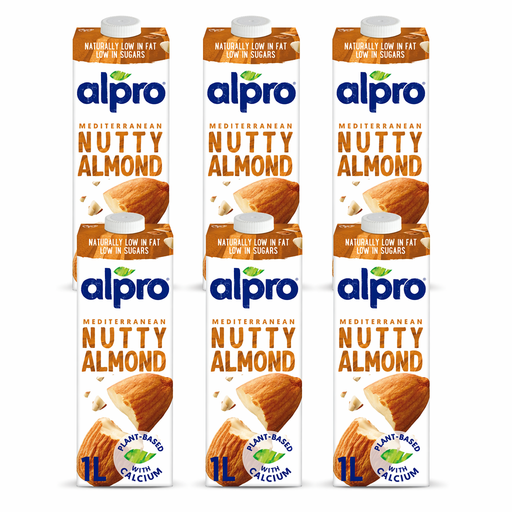
Alpro Almond Drink 1L
An almond drink to compare for home breakfast use. Check the exact carton’s sugars and fortification if either matters to your choice, and confirm whether this offer contains one 1L carton or a pack of six. Almond-containing drinks also require a school-policy check before being packed for school.
View on Joybuy
Frequently asked questions
Can I put almond drink in my child’s packed lunch?
Check the individual school’s current allergy and packed-lunch arrangements before doing so. Almond is a tree nut, and England’s Department for Education guidance requires schools to publish an allergy safety policy; that does not establish a single packed-lunch rule for every UK school.
What matters if almond drink regularly replaces dairy for a child?
Check the current carton for added calcium, iodine and vitamins B2 and B12. Royal Devon University Healthcare NHS Foundation Trust advises choosing milk alternatives with calcium at 120 mg per 100 ml alongside those nutrients. Seek individual professional advice where an allergy, restricted diet, growth concern or diagnosed condition affects the child’s diet.
Is almond classed as a nut allergen?
Yes. The Food Standards Agency lists almonds among tree nuts. An almond drink is therefore not an alternative for someone who needs to avoid almonds.
How long can I keep almond drink after opening?
Follow the instructions on the exact carton. Tesco’s Unsweetened Almond Drink listing says to refrigerate it after opening and consume it within five days and by its use-by date; other products may have different directions.


