
24/7 Customer Support

Free returns

Same-day & Next-day Delivery

Quality Guaranteed

Unlock Your Welcome Offers: FREE Delivery | Up to 80% OFF | Free 30-day JoyPlus trial
Download the APP
Aluminium foil trays can simplify batch cooking, baking, entertaining and takeaway service. However, choosing by pack size or a promising product description alone can lead to wasted money. A shallow tray may overflow, a flexible base can be difficult to carry when full and a lid may not be suitable for oven use.
This guide explains the practical details to check before buying aluminium foil trays, with options for UK home cooks, caterers, meal-prep customers and event organisers.
A tray labelled “large” may still be too shallow for a roast, lasagne or casserole. Check the length, width and depth rather than relying only on the stated capacity. A 45–50mm-deep tray is generally more suitable for layered dishes and larger portions than a shallow foil serving platter.
Also consider oven and freezer space. Extra-large aluminium catering trays can be useful for gatherings but may not fit comfortably in a compact UK oven.
Many disposable foil trays are designed for cooking or reheating, but the product instructions should confirm this. Lids are a separate concern: plastic or coated lids should normally be removed before placing a tray in the oven unless the packaging specifically states otherwise.
Avoid placing foil trays on open flames, directly on heating elements or in a microwave unless the manufacturer explicitly confirms compatibility. Aluminium conducts heat, so use oven gloves and allow the tray to cool before handling or sealing.
Aluminium is widely recyclable, but acceptance varies between UK councils and collection schemes. Food residue, sauces and mixed-material lids can affect whether a tray is accepted. Scrape off excess food and follow local recycling guidance. A tray described as reusable may be suitable for careful repeated use, but thin foil can crease, tear or lose rigidity after handling.
Match the tray to the job:
For transporting liquid or heavy food, place the foil tray on a rigid baking sheet or board. This provides support when moving food in and out of the oven.
Look for clear information confirming whether the tray is ovenable, freezer-safe or suitable for both. Avoid sudden temperature changes where possible: allow hot food to cool before placing it in the freezer and follow the product’s instructions for reheating.
A freezer-safe foil tray can be useful for meal preparation, but food should be covered appropriately. Foil trays with lids are convenient for storage and transport, although the lid should be checked for its own temperature limitations.
A two-pack may suit occasional family cooking, while 18-, 30- or 50-piece packs can be more practical for caterers, bake sales and large events. Compare the price per tray rather than the headline pack price. Also check whether the pack includes lids, as buying separate covers can change the overall cost.

Why This Fits Their Persona: A compact two-pack suits occasional home cooking, small gatherings and cooks who want ovenable trays without committing to a large catering quantity.
The stated 227 x 227 x 38mm dimensions and 60oz capacity make the available space clearer than a vague “large” description.
Ovenable square format, recyclable foil and a two-tray pack for cooking, serving or reheating.
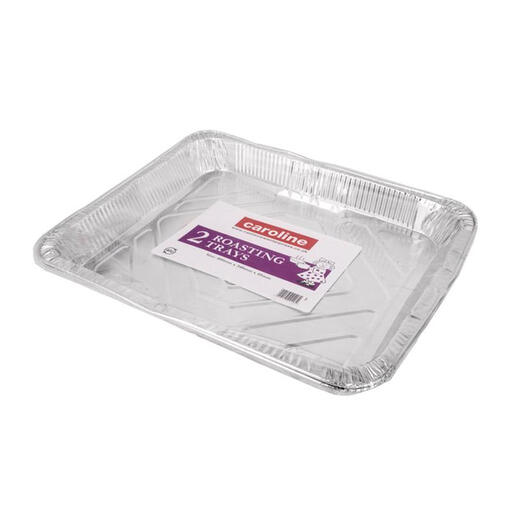
Why This Fits Their Persona: Suitable for households preparing generous Sunday roasts, family meals or food for gatherings where tray dimensions and depth matter.
The 400 x 340mm footprint and 45mm depth give more useful information for checking oven fit and portion requirements.
Pack of two; listed as oven-safe and freezer-safe, with a deep rectangular design for roasting and storage.
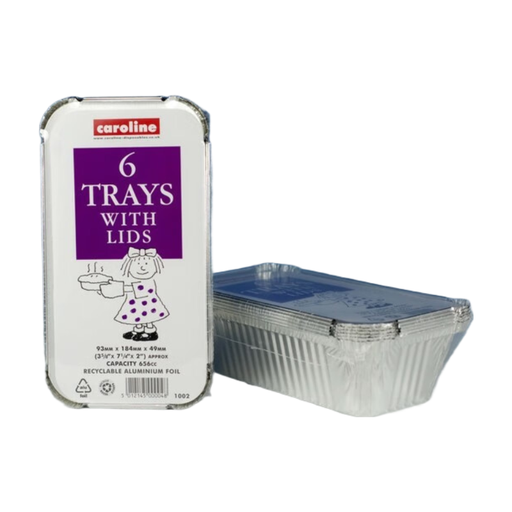
Why This Fits Their Persona: Handy for meal-prep portions, takeaway businesses, packed lunches, leftovers and catering where covered transport is important.
The 23oz capacity, 49mm depth and included lids are specified, helping avoid buying shallow trays or separate covers.
Six ovenable, recyclable trays with matching lids for storage, refrigeration and transport. Remove lids before oven use.
We have compiled a complete, real-time list of products that fully satisfy these strict selection criteria and UK safety regulations.
Ovenable aluminium trays are designed for cooking or reheating within the stated product instructions. Use oven gloves, support the tray from underneath and keep it away from direct flames and heating elements. Always check the packaging for temperature and usage guidance.
Some products are listed as freezer-safe, while others are intended only for oven or serving use. Check the product specification before freezing. Use a suitable lid or covering, label the food and allow hot contents to cool before placing them in the freezer.
Many local authorities accept clean aluminium foil trays, but collection rules differ. Remove as much food residue as possible and check your council’s guidance. Lids and heavily soiled trays may need separate handling.