
24/7 Customer Support

Free returns

Same-day & Next-day Delivery

Quality Guaranteed

Unlock Your Welcome Offers: FREE Delivery | Up to 80% OFF | Free 30-day JoyPlus trial
Download the APP
An American fridge freezer can provide the storage space and convenience that a busy UK household needs, but the large format also creates costly buying traps. A model may fit your food shop yet fail to fit through the front door, or offer an attractive dispenser that becomes inconvenient because it requires plumbing.
The most useful approach is to compare measurable details rather than rely on appearance or headline features. The following guide explains what to check before choosing an American-style fridge freezer, followed by recommendations matched to different household needs.
A figure such as 600L or 650L sounds impressive, but total capacity is divided between the fridge and freezer compartments. A household that cooks mainly with fresh ingredients may need more fridge space, while batch cooks and bulk-buyers may prefer a larger freezer.
Always check the separate figures. For example, a 652L model may provide approximately 409L for fresh food and 243L for frozen items. Also consider shelf width, drawer access and door balcony layout. A wide side-by-side fridge freezer is convenient for visibility, but vertical compartments may not accommodate wide trays as easily as a French-door design.
A plumbed American fridge freezer connects to a mains cold-water supply. It can provide a continuous supply of chilled water and ice, but installation requires suitable pipework, access to a stop tap and enough room behind the appliance.
A non-plumbed American fridge freezer uses an internal tank. It is easier to position in a kitchen without nearby plumbing, although the tank needs regular filling and cleaning. Check whether the dispenser provides cubed ice, crushed ice, chilled water or only one of these options.
UK fridge freezers use the A to G energy label, with A being the highest class in the current scale. The rating is useful for comparison, but it does not by itself tell you the exact annual running cost. Check the label’s annual kWh figure and multiply it by your electricity tariff.
Smart functions can monitor temperatures, activate fast cooling or show usage information. They add convenience, but a Wi-Fi connection and compatible app may be required. Do not pay for connected features you will rarely use.
Many American-style fridge freezers are around 90–91cm wide, 177–180cm high and 65–75cm deep. Measure more than the kitchen gap:
A 50mm rear or side gap is common for some models, while others require more space. Confirm the installation guide before ordering. Doors that open only to a limited angle can restrict access to shelves and drawers, so check hinge design and the position of adjacent units.
A 500L fridge freezer can suit a large family, frequent entertainer or household that shops less often. Smaller models around 430–440L may be more practical for everyday groceries where kitchen space is limited.
Consider the fridge-to-freezer split as carefully as the total figure. A home that stores frozen meals, batch-cooked food and ice may benefit from more than 200L of freezer capacity. Home cooks should also check for adjustable shelves, crisper drawers, humidity zones and space for large containers.
A Total No Frost fridge freezer circulates cold air to help prevent frost accumulation, reducing the need for manual defrosting. Multi-airflow systems distribute air around the cabinet, while separate cooling systems can help reduce the transfer of odours between fridge and freezer sections.
Useful everyday functions include Super Cool, Super Freeze, holiday mode, open-door alarms and independently adjustable temperatures. These features are more practical than decorative displays if you regularly load a large shop or leave the home for extended periods.
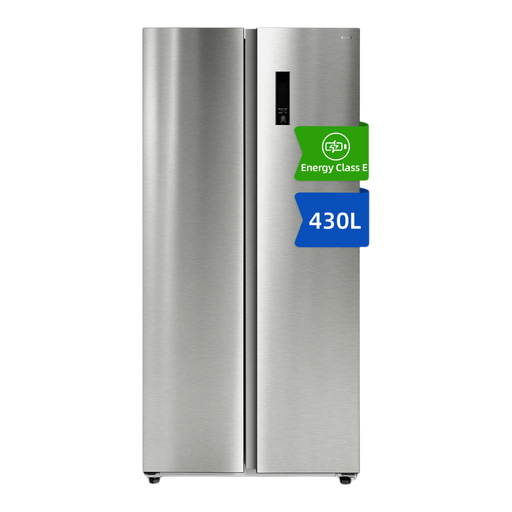
Why This Fits Their Persona: Its 84cm width and 430L capacity provide a practical entry point for households that want side-by-side storage without moving to a 90cm-plus appliance.
The listed 430L total capacity is clearly split into 261L fridge and 169L freezer space, while Frost Free cooling avoids manual defrosting.
Dual inverter technology, six adjustable glass shelves, two crispers and an E energy class.
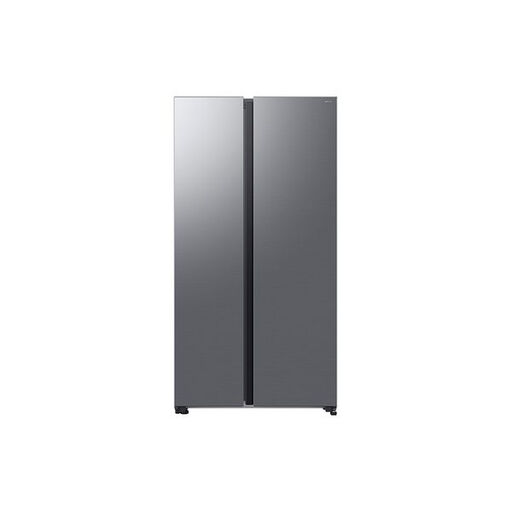
Why This Fits Their Persona: This 652L model combines high storage capacity with app connectivity for households that value a coordinated smart kitchen.
The product specification identifies a non-plumbed internal ice maker, so buyers do not need to arrange a mains water connection for ice-making.
652L SpaceMax capacity, C energy class, Twin Cooling Plus and SmartThings connectivity.

Why This Fits Their Persona: Frequent entertainers and large families can use the 601L capacity and mains-fed dispenser for regular chilled water and ice.
Its plumbed configuration is stated clearly, allowing buyers to arrange qualified installation rather than discovering the requirement after delivery.
601L capacity, cubed and crushed ice, Total No Frost, D energy class and a 36dB noise rating.

Why This Fits Their Persona: Households without a convenient water pipe can still access chilled water and ice while choosing where to position a large appliance.
The 4L internal tank removes the need for fixed plumbing, while the dispenser type is specified as non-plumbed.
635L capacity, InstaView door panel, cubed and crushed ice, Total No Frost and Wi-Fi via the LG ThinQ app.
We have compiled a complete, real-time list of products that fully satisfy these strict selection criteria and UK safety regulations.
No. A non-plumbed American fridge freezer uses a refillable internal tank. A plumbed model needs a mains cold-water connection and should be installed according to the manufacturer’s instructions, generally by a suitably qualified installer.
Running cost depends on the appliance’s annual electricity use in kWh and your tariff. Use the energy label rather than capacity alone when comparing models. Holiday mode may reduce consumption during extended absences, but the freezer should remain at its recommended temperature.
Lifespan depends on installation, ventilation, cleaning and daily use. Keep air vents clear, level the appliance, clean dispenser tanks or replace filters as instructed and avoid blocking internal airflow. Always retain the warranty information and follow the manufacturer’s maintenance guidance.