Teams working on active projects
Several artists need access to current scenes, textures, renders or review exports. Their choice depends on the storage system and the network connections used by the workstations.


For a studio mainly retaining growing animation libraries, start by considering a multi-bay HDD NAS. If several artists repeatedly work with active projects on shared storage, consider an SSD working tier or an all-flash NAS instead. Before choosing, check the entire network path, compatible drives, protected usable capacity and an isolated backup.
Several artists need access to current scenes, textures, renders or review exports. Their choice depends on the storage system and the network connections used by the workstations.
Retained source files and completed projects need space alongside current work. These studios should plan protected usable capacity and room for later expansion, not just count the empty drive bays.
Operators need a way to restore projects after deletion, hardware failure or a compromised account. A shared NAS and its accessible snapshots should not be the only recovery points.
Choose the storage layout around the work the studio does most often, then check whether its network and recovery arrangements can support that choice.
Consider when: Retained projects and source assets are the main reason for adding shared storage.
Trade-off: Bay count helps with capacity planning, but it does not establish how responsive active projects will feel to several users.
Consider when: The studio retains a large library but repeatedly accesses the same active project files.
Trade-off: An SSD cache or working tier adds configuration and drive-compatibility checks; it is not a separate recovery copy.
Consider when: Concurrent access to active work is the priority rather than retaining a large HDD-based archive on the same system.
Trade-off: Its network and storage layout still have to match the workstations; published throughput figures do not guarantee studio performance.
| Concern | What to check | Who this matters to |
|---|---|---|
| Concurrent project access | Check NAS and switch ports, workstation connections and the storage configuration used for any stated throughput. | When several artists open active files at once, I need the shared path to keep up with our work. Around 36% of consumers put concurrent access first. |
| Recovery and access control | Check versioning, backup destinations, separate credentials and whether a representative project can be restored. | If a project is deleted or an account is compromised, I need a recovery copy that remains usable. For around 29% of consumers, recovery is the primary concern. |
| Usable capacity and drives | Calculate capacity after the intended protection layout and growth allowance; check exact drive and firmware compatibility. | As completed work accumulates, I need space for retained projects without overlooking the room used by protection. Capacity is the leading need for around 21% of consumers. |
| Ongoing administration | Confirm who will manage permissions, updates and drive replacement, and check support for planned components. | Without a dedicated storage administrator, I need a setup the team can maintain. Around 14% of consumers prioritise that responsibility when choosing. |
Drive protection does not provide an isolated copy of a deleted or compromised project. The National Cyber Security Centre advises that on-premises backups should be capable of isolation and recovery from earlier versions.
Plan a separate recovery copy, restrict backup-management access and test restoration with a representative project.
Allow for separate backup storage and regular restore-testing time.
A NAS port rating does not describe the speed available to each artist. Synology notes that link aggregation increases total network throughput, not the speed of an individual transfer.
Trace the workstation adapter, cabling, switch port and NAS port used by the active workflow before choosing network upgrades.
A network change may also require suitable adapters, cabling and installation time.
The space available for animation files depends on the installed drives and protection layout. Current projects, retained work and future growth all need room.
Work out usable capacity for the intended drive configuration and leave expansion headroom before choosing an enclosure.
Compatibility and support depend on the exact NAS and component. QNAP directs customers to its compatibility list, while Synology's drive policies vary by model and drive scenario.
Check the drive model, relevant firmware, intended SSD role and any network card against the manufacturer's guidance for that NAS.
Synology offers shared-storage models with versioning and expansion options. Its DS1823xs+ has two built-in 10GbE ports; the DS1825+ provides two 2.5GbE ports and an optional faster-network upgrade path.
QNAP offers NAS and network equipment for shared media workflows, including the creator-oriented TVS-h874T and high-speed switches.
ASUSTOR offers multi-gigabit and all-flash NAS models. The FLASHSTOR 12 Pro Gen2 (FS6812X) has twelve M.2 slots and dual 10GbE ports.
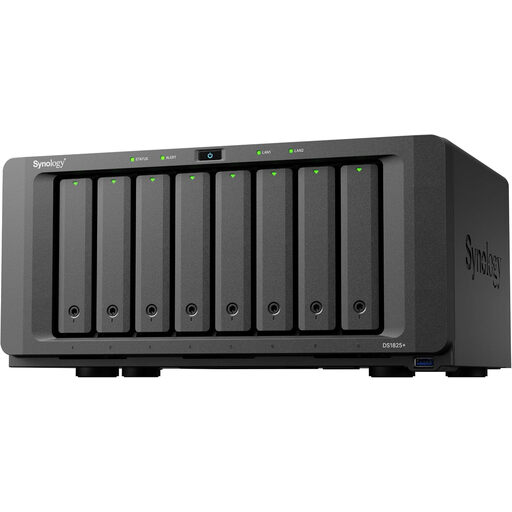
This multi-bay, diskless NAS is relevant to studios planning shared storage for a growing project library. Choose drives and a network configuration for the work it will actually handle.
 No image available
Consider this model when a growing library makes drive-bay capacity and later expansion important to the studio.
It has eight drive bays and is sold diskless, so compatible drives must be chosen separately. Synology says the DS1825+ supports up to 18 drives with two optional DX525 expansion units.
Calculate usable capacity for the intended protection layout, and confirm the network configuration needed by each workstation. Keep an isolated recovery copy separate from the NAS.
No. Each workstation's adapter, cabling and switch connection must suit the intended network path, as must the NAS connection. Synology also notes that link aggregation can increase total throughput without making an individual transfer faster.
No. RAID addresses some drive-failure scenarios, while snapshots or versioning can help with some unwanted file changes; neither alone provides an isolated recovery copy. The National Cyber Security Centre advises protecting backups from destructive actions and retaining the ability to restore an earlier version.
Check the policy for the exact NAS before choosing drives. QNAP advises using listed devices and limits technical support for unlisted ones; Synology's policies vary by series, model generation and drive scenario. Check the drive model and relevant firmware as well as its capacity.