
24/7 Customer Support

Free returns

Same-day & Next-day Delivery

Quality Guaranteed

Unlock Your Welcome Offers: FREE Delivery | Up to 80% OFF | Free 30-day JoyPlus trial
Download the APP
Keeping a home clean and hygienic is a priority for many of us, but navigating the world of cleaning products can be a challenge. You want an antibacterial surface cleaner that is effective against germs, yet you may also be concerned about harsh chemicals, especially in a home with children or pets. Finding a product that aligns with your values, whether that's using eco-friendly cleaning products or choosing vegan cleaning products, adds another layer to the decision.
This guide is designed to help you understand the key features to look for in a surface cleaner. We will break down what makes a product effective and safe and provide a few recommendations to help you find a suitable match for your household's needs.
Making an informed choice comes down to understanding a few key factors. Here’s what to consider before you buy.
In the UK and EU, disinfectants are tested against specific standards to verify their claims. When you see codes like EN 1276 or EN 14476 on a label, it provides assurance of the product's performance.
Looking for these codes on the packaging is a reliable way to confirm a product's disinfecting power without relying on marketing jargon.
For many households, especially those with young children, pets or individuals with sensitivities, the ingredients list is just as important as the germ-killing capability. Many modern cleaners now use active ingredients derived from natural sources.
A plant-based disinfectant often uses active ingredients like lactic acid (from corn or beetroot) to disinfect surfaces. These formulas are typically bleach-free and alcohol-free, making them a gentler choice for everyday use on highchairs, toys and kitchen worktops. If you are looking for a baby-safe surface cleaner, checking for these features is a good starting point.
Your cleaning routine and storage space can influence which format is right for you.
Here are a few antibacterial surface cleaners that cater to different needs, from budget-conscious deep cleaning to gentle, everyday use.
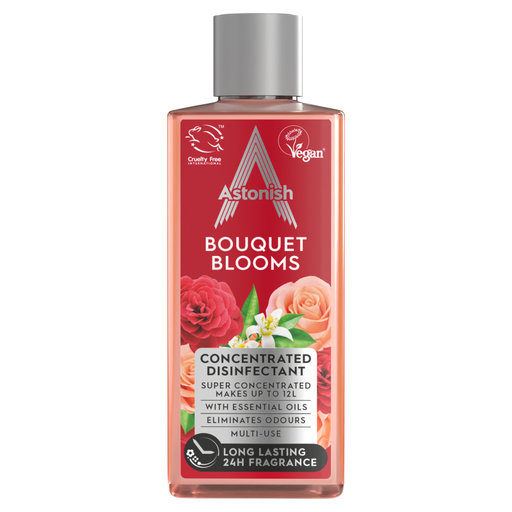
Why It Stands Out: This formula offers impressive value and performance. As a concentrated disinfectant, a single 300ml bottle can be diluted to make up to 12 litres of cleaning solution. It complies with both EN 1276 (antibacterial) and EN 14476 (antiviral) standards, providing confidence in its ability to handle germs and viruses. The addition of essential oils leaves a pleasant floral scent that lasts.
Pros:
Who is it for? This is an ideal choice for budget-conscious households that require a powerful, versatile disinfectant for regular, large-scale cleaning tasks. It's also a great option for anyone looking for effective vegan cleaning products.
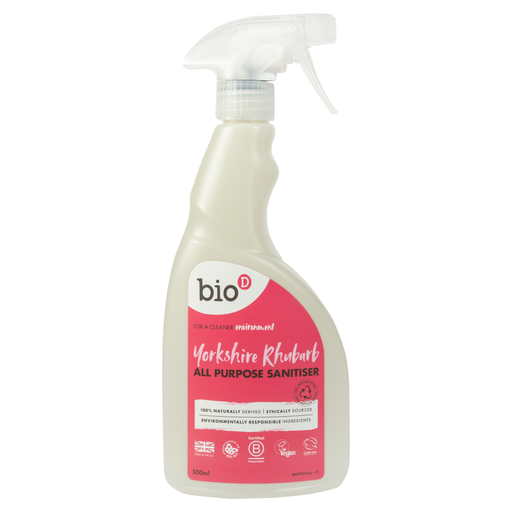
Why It Stands Out: This ready-to-use sanitiser combines convenience with eco-friendly cleaning products principles. Made with naturally derived ingredients, it is formulated to neutralise 99.9% of harmful bacteria. Its standout feature is the fresh, tangy scent of Yorkshire Rhubarb, which offers a pleasant alternative to traditional chemical smells.
Pros:
Who is it for? This sanitiser is well-suited for those who prioritise convenience and natural ingredients for daily cleaning. It's a great multi-purpose cleaner for kitchen surfaces, bathrooms and other hard areas around the home.

Why It Stands Out: For homes with little ones, safety is paramount. The Milton spray is specifically formulated with this in mind. Its active ingredient is 100% plant-based lactic acid, and the formula is free from bleach and alcohol. It is effective against bacteria, yeasts and enveloped viruses, making it a reliable baby-safe surface cleaner for highchairs, potties and changing mats.
Pros:
Who is it for? This is a top consideration for parents and caregivers looking for a gentle yet effective disinfectant. Its formulation provides peace of mind when cleaning surfaces that children frequently touch.
If these recommendations aren't quite what you're looking for, or if you need a cleaner for a specific task, there are many other options available. From heavy-duty formulas to specialised sprays, you can find a solution that fits your home.
[Explore our full range of all in one disinfectant spray products here.](https://www.joybuy.co.uk/explore/all-in-one-disinfectant-spray/6WjnlERJ)
1. What is the difference between antibacterial and antiviral surface cleaners? An antibacterial cleaner is formulated to kill bacteria. An antiviral cleaner is formulated to act against viruses. Some products, often labelled as disinfectants or sanitisers, are effective against both. To be sure, check the product label for efficacy standards like EN 1276 for bacteria and EN 14476 for viruses.
2. Are plant-based disinfectants as effective as traditional chemical ones? The effectiveness of a disinfectant depends on its active ingredients and formulation, not just whether it is plant-based. A plant-based disinfectant that meets official standards (like the EN standards mentioned above) has been tested to be effective. Ingredients like lactic acid have proven disinfecting properties. Always check the label for performance data.
3. How long should I leave a disinfectant on a surface? This is known as the "contact time" or "dwell time," and it varies by product. It is the amount of time the surface must remain visibly wet with the product to ensure proper disinfection. This can range from 30 seconds to 10 minutes. Always read and follow the directions on the product label for correct usage and maximum efficacy.