
24/7 Customer Support

Free returns

Same-day & Next-day Delivery

Quality Guaranteed

Unlock Your Welcome Offers: FREE Delivery | Up to 80% OFF | Free 30-day JoyPlus trial
Download the APP
Keeping our homes and workplaces clean and hygienic is a constant priority. Yet, with so many products on the shelves, finding the right antibacterial surface spray can feel overwhelming. Whether you're running a busy commercial kitchen, managing a household with young children or simply seeking an effective daily cleaner, your needs are specific. This guide is designed to cut through the clutter, offering practical advice to help you select a product that delivers on its promises.
We will explore what to look for in a quality disinfectant spray and highlight a few standout options suited for different environments, from professional settings to family homes.
Before you add a cleaner to your basket, consider these key factors. Understanding them will help you find a spray that is both effective and appropriate for your specific needs.
In the UK and Europe, cleaning products that claim to disinfect are often tested against specific standards, known as EN (European Norm) standards. Seeing these on a label provides assurance of the product's efficacy. Key ones to look for include:
A product that meets these standards offers a reliable level of disinfection.
Not all cleaners are created equal. A kitchen cleaner spray designed to tackle grease will have a different formulation from a gentle spray for a child's highchair.
If you are cleaning areas that come into contact with food, using a food safe disinfectant is essential. Even with these products, it is good practice to rinse the surface with clean water after disinfection. Always check the product label for instructions and any materials it should not be used on, such as unsealed wood, aluminium or certain plastics, to avoid damage.
Here are our recommendations, selected to meet a range of common cleaning challenges across UK homes and businesses.

Flash Professional K6 Disinfecting Power Degreaser Cleaning Spray 750ml
Why It Stands Out: This spray combines powerful degreasing action with rapid disinfection. It is specifically designed for professional environments where speed and efficacy are paramount. Its formula is certified to kill 99.99% of bacteria and enveloped viruses in just 15 seconds, meeting EN 1276, EN 13697, EN 14476 and EN 16777 standards.
Pros:
Who is it for? This is an excellent choice for small business owners in catering, hospitality and food service. It is also ideal for home cooks who want a professional-strength kitchen cleaner spray to tackle tough grease and ensure surfaces are hygienically clean.
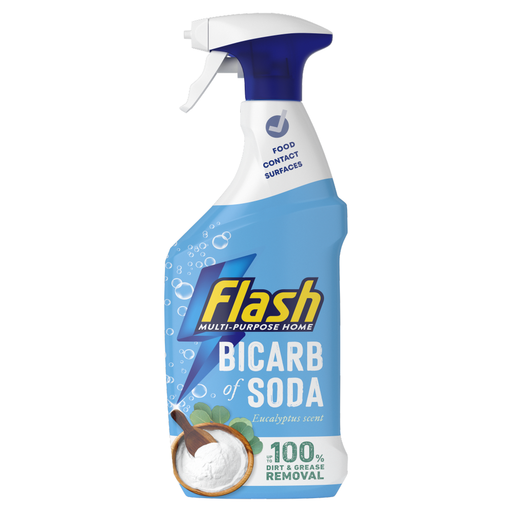
Flash Traditional Cleaning Spray Bicarbonate Soda & Eucalyptus 800ml
Why It Stands Out: This multi-purpose cleaner draws on the traditional cleaning power of bicarbonate of soda. It offers a gentler approach to lifting everyday grime, food residue and limescale without relying on harsh chemicals. The natural eucalyptus scent provides a refreshing aroma, neutralising cooking and stale odours.
Pros:
Who is it for? This spray is well-suited for households looking for an effective all-rounder for daily cleaning tasks. It is a great option for those who prefer products with familiar ingredients and a pleasant, natural scent over chemical odours.

Milton Antibacterial Surface Spray 500ml
Why It Stands Out: For decades, Milton has been a trusted name in sterilisation for babies. This antibacterial surface spray continues that legacy with a formula designed for homes with little ones. Its active ingredient is 100% plant-based lactic acid, derived from corn or beetroot. It is a baby safe cleaning spray that is free from bleach and alcohol.
Pros:
Who is it for? This is the go-to choice for parents, guardians and childcare providers. If you need to disinfect surfaces that children frequently touch, this plant-based cleaner provides effective cleaning with a formula designed for peace of mind.
While these three products cover many common needs, the world of cleaning solutions is vast. If you are looking for a different type of formula or a spray for a more specific task, there are many other choices available.
For a wider selection of cleaning solutions, from heavy-duty degreasers to specialised formulas, explore our full range of essential kitchen cleaning spray.
1. What is the difference between an antibacterial and a disinfectant spray? The terms are often used interchangeably, but there is a subtle difference. 'Antibacterial' specifically means a product is effective against bacteria. 'Disinfectant' is a broader term for a chemical agent that destroys or inactivates a range of microorganisms, which can include bacteria, viruses and fungi. Always check the label for the specific EN standards it meets to understand its full capabilities.
2. Do I need to rinse surfaces after using a food safe disinfectant? Yes. For any surface that will come into direct contact with food, such as chopping boards or kitchen worktops, it is always recommended to rinse the surface with fresh water and wipe it dry with a clean cloth after the disinfectant's contact time has elapsed. This removes any chemical residue.
3. Can I use a multi-purpose cleaner on all surfaces? While a multi-purpose cleaner is very versatile, it is not suitable for everything. You should always read the label before use. Most are not recommended for unsealed surfaces like natural wood or stone, and some may cause damage to aluminium, painted or polished surfaces with prolonged contact. When in doubt, test on a small, inconspicuous area first.