
24/7 Customer Support

Free returns

Same-day & Next-day Delivery

Quality Guaranteed

Unlock Your Welcome Offers: FREE Delivery | Up to 80% OFF | Free 30-day JoyPlus trial
Download the APP
Buying Anycubic 3D printer resin looks straightforward until different formulations, wavelengths and cleaning methods enter the picture. A bottle may be labelled as standard, high precision, ABS-like or water-washable, but the most suitable choice depends on your printer, the model you are making and the post-processing facilities available at home or work.
For UK makers, hobbyists and small businesses, three common buying traps deserve attention:
A suitable 405nm UV resin should match the light source of your printer. Many current LCD 3D printer resin, DLP 3D printer resin and SLA 3D printer resin products support a range of 365–405nm, but compatibility should still be confirmed against the printer manual.
The Anycubic products listed here are specified for 365–405nm operation, which covers many mainstream resin machines. However, wavelength compatibility alone does not guarantee a successful print. Exposure time, bottom exposure, layer height and lift speed also affect adhesion and detail.
Use the resin manufacturer’s settings as a starting point, then make small adjustments. A resin profile intended for one Photon model may not transfer directly to another machine with a different screen, build volume or light intensity.
The label “standard photopolymer resin” generally indicates a balanced option for models, prototypes and display pieces. The Anycubic Standard Resin specifications list a hardness of 84–86 HD, tensile strength of 40–50 MPa and volume shrinkage of 4.5–5.5%.
For parts that may be dropped, flexed or handled frequently, an ABS-like resin may be more appropriate. Anycubic ABS-Like Resin 2.0 lists 20–25% elongation at break, a volume shrinkage range of 3.9–4.9% and an Izod impact strength figure of 109 J/m in the supplied product information. These figures are reference values rather than a guarantee of performance in every print, as curing and printer settings influence the final result.
For small text, miniature details and dimensional prototypes, look for a high-precision resin with a clearly stated low-shrinkage specification. Low shrinkage can help reduce dimensional changes, but it does not eliminate the need for correct supports, orientation and post-curing.
A resin’s practical cost includes cleaning fluid, gloves, filters and waste handling. Standard and ABS-like formulations typically require at least 95% IPA for cleaning. Water-washable resin can be rinsed with water or IPA, which may simplify routine clean-up.
The Anycubic Water Washable Resin 2.0 lists a viscosity of 190–230 mPa·s at 25°C, a wavelength of 365–405nm and a stated shrinkage range of 2.2–5.5%. Its recommended printing environment starts at around 20°C, a useful consideration for unheated garages, sheds and workshops during colder UK months.
Liquid photopolymer resin should be handled with nitrile gloves and protective eyewear in a well-ventilated area. Keep bottles away from children, pets and direct sunlight. Fully cure resin waste before disposing of it as solid waste, and follow the product documentation and local waste guidance. For water-washable products, allow contaminated water to settle and cure rather than releasing it into drains.
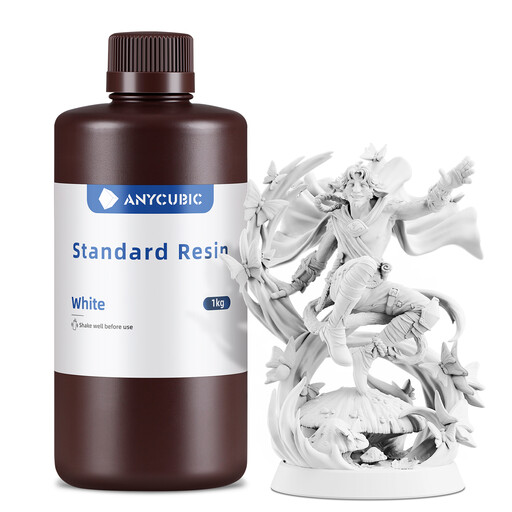
Why This Fits Their Persona: A balanced 1kg 3D printer resin for first projects, display models, figurines and general home printing on compatible LCD, DLP or SLA machines.
Its stated 365–405nm range helps buyers check compatibility before assuming that a generic resin profile will work.
365–405nm compatibility; specified hardness of 84–86 HD and approximately three-minute curing time.

Why This Fits Their Persona: Suitable for home users who prioritise a simpler cleaning routine and fine surface detail, provided wastewater is handled responsibly.
It clearly specifies water or IPA cleaning, while its disposal instructions warn against pouring contaminated wastewater into drains.
190–230 mPa·s viscosity at 25°C; stated low-shrinkage range of 2.2–5.5%.
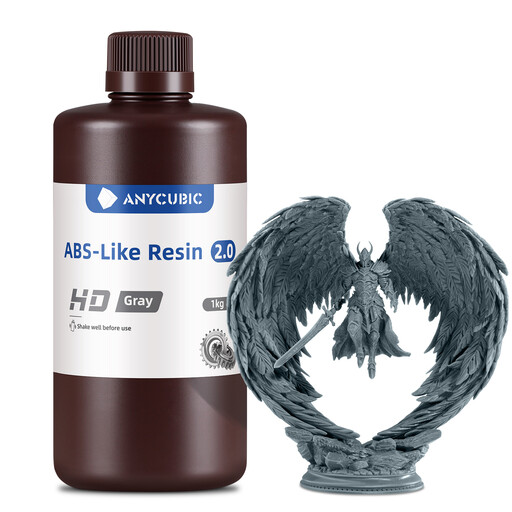
Why This Fits Their Persona: A practical option for prototypes, housings, brackets and models that need more toughness than a basic standard resin.
The formulation is positioned for strength and toughness, helping avoid using a brittle display resin for frequently handled parts.
Stated 20–25% elongation at break; 365–405nm wavelength and 3.9–4.9% volume shrinkage range.
We have compiled a complete, real-time list of products that fully satisfy these strict selection criteria and UK safety regulations.
No. Check the printer’s supported technology, UV wavelength and resin exposure profile. The products above specify 365–405nm, but the correct settings can still vary between LCD, DLP and SLA machines.
It depends on model size, infill, supports, failed prints and calibration pieces. Small figurines may use only a modest amount, while large prototypes can consume several hundred grams. Keep the bottle sealed, away from light and at a suitable room temperature between prints.
It may reduce reliance on IPA for the initial wash, but it is not automatically cheaper. You still need gloves, containers and safe wastewater handling. Compare the resin price, cleaning equipment and disposal requirements rather than judging cost from the bottle label alone.