If serving apple juice itself matters most, choose a clearly labelled 100% juice, but do not assume it is lower in sugars: the Tropicana, Copella and Asda products described here list 10–11g sugars per 100ml. For a lower-sugar apple refreshment, compare no-added-sugar juice drinks or prepared squash by their nutrition panels; squash needs measured dilution, and every option needs a storage plan that works at the stall.
Who are the options for?
Start with whether customers expect apple juice, a lower-sugar apple-flavoured drink, or a sealed portion that is straightforward to serve outdoors.
Sellers offering a lower-sugar apple refreshment
Compare sugars per 100ml rather than relying on “no added sugar” wording. The Sainsbury's and Grower's Harvest juice drinks listed here contain 2.6g and 4.6g sugars per 100ml respectively; they are drinks with sweeteners, not 100% apple juice.
Buyers who specifically want 100% apple juice
Look for a product described as apple juice and check whether it is pressed or made from concentrate. NHS guidance counts sugars naturally present in unsweetened fruit juice as free sugars, so the serving size still matters.
Sellers working without fixed catering facilities
Check storage instructions before taking drinks to an outdoor stall. Sealed portions avoid pouring; squash requires water and consistent dilution. If you plan to sell refreshments, ask the local authority whether your activity needs food-business registration.
What should you check before choosing?
Choose the type of drink first, then compare sugars at the volume you intend to serve and check what preparation and storage that format requires.
| Priority |
What to check |
Your needs |
| Actual sugars |
Read sugars per 100ml and per serving. Compare drinks at the same volume where possible; for squash, use the figure for the drink as prepared. “No added sugar” does not mean zero sugar. |
I want customers to see the sugar figure for the drink they will receive, not mistake its front-of-pack wording for a sugar-free claim. |
| Type of drink |
Check whether the label says 100% apple juice, juice drink or squash. Read the juice percentage, other fruit ingredients and any sweeteners. |
If I am offering apple juice, I want it identified as juice. If lower displayed sugars matter more, I can compare juice drinks without describing them as pure juice. |
| Preparation |
Check whether the drink is ready to serve or needs dilution. For squash, follow the stated dilution instructions and plan how to measure and supply water. |
Pouring from a ready-to-drink pack is simpler for my stall; I would choose squash only if I can prepare each serving consistently. |
| Outdoor storage |
Read the instructions for unopened and opened packs separately. Plan cooling for products that require refrigeration and keep their packaging available for ingredient checks. |
Without dependable chilling, I need a format whose unopened-pack instructions I can follow throughout the sale. |
What can go wrong at the stall?
-
Calling a no-added-sugar drink “zero sugar”
The Sainsbury's no-added-sugar apple and pear juice drink lists 2.6g sugars per 100ml. Its front-of-pack claim does not replace the sugars figure on the nutrition panel.
Use the product's drink category on any sign, and keep the pack available so customers can check its ingredients and nutrition information.
-
Assuming pure juice is the lower-sugar option
Tropicana Orchard Apple and Copella Cloudy Apple each list 10g sugars per 100ml; Asda Apple Juice lists 11g. NHS guidance counts sugars in unsweetened fruit juice as free sugars.
Offer 100% juice to customers seeking juice, but compare the nutrition panels of prepared drinks if lower displayed sugars are the priority.
-
Bringing chilled juice without a cooling plan
A product that must be refrigerated still needs appropriate storage at an outdoor sale. Opening a larger bottle also brings its after-opening instructions into play.
Read both storage statements before buying. Food Standards Scotland advises keeping products that would normally be refrigerated cool at an event, using a cool box or bag with suitable cooling media.
-
Assuming occasional sales need no checks
Food Standards Agency guidance for community and charity events says that selling or supplying food may make an activity a food business that needs local-authority registration. Whether that applies to a particular car boot stall needs checking.
Ask the local authority for the event location before trading, and keep original drink packaging available for customers who need ingredient information.
Which brands illustrate the options?
These named products show why “apple refreshment” can describe different formulations; check the current pack before buying for an event.
Tropicana
Tropicana describes Orchard Apple as 100% pressed apple juice, not from concentrate.
- The Orchard Apple listing gives 10g sugars per 100ml and 15g per 150ml.
- It is a pure-juice choice, not a zero-sugar apple drink.
Copella
Copella describes Cloudy Apple as pressed apple juice with added vitamin C.
- Its published nutrition information lists 10g sugars per 100ml and 15g per 150ml.
- Check the bottle's refrigeration instructions before choosing it for an outdoor stall.
Tesco
Tesco's Grower's Harvest listing provides a ready-to-drink no-added-sugar apple juice drink.
- The listed drink contains 50% apple juice from concentrate and 4.6g sugars per 100ml.
- It also contains water and sucralose, so it should not be described as pure juice.
Sainsbury's
The named range includes a ready-to-drink apple and pear juice drink and an apple squash that must be diluted.
- The apple and pear drink lists 2.6g sugars per 100ml; the squash listing gives 2.5g per 250ml prepared serving.
- Neither is 100% apple juice. Check the squash's dilution directions before comparing servings.
Asda
Asda's named 1L product is apple juice from concentrate.
- Its listing gives 11g sugars per 100ml and 16g per 150ml.
- Choose it for the apple-juice category, not as a lower-sugar juice drink.
M&S
M&S lists a 200ml cloudy apple juice for shoppers seeking an individual pack.
- The smaller pack avoids measuring a portion from a larger bottle at the stall.
- Its listed 10.3g sugars figure is per 100g, not per 100ml; check the pack before comparing it with drinks labelled on a volume basis.
Joybuy apple refreshment options
These options cover a sugar-free-labelled apple soft drink, a no-added-sugar mixed-fruit drink and a sparkling 100% apple juice. Check the drink category as well as the sugar wording before choosing stock for a stall.
 No image available
Tango Apple Sugar-Free, 24 × 330ml cans
An apple-flavoured option in sealed cans for serving without pouring. This is a carbonated soft drink, not apple juice; check the pack's ingredients and nutrition panel when explaining the sugar-free label. Handle the pressurised cans with care.
Joybuy
 No image available
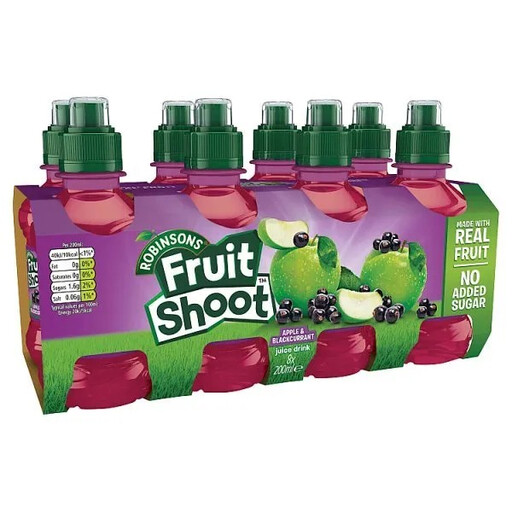
Fruit Shoot Black & Apple No Added Sugar, 8 × 200ml
The individual bottles offer an apple-and-blackcurrant drink without on-stall pouring; they are not apple-only juice. Refrigerate an opened bottle and follow its three-day use instruction. Check the unopened-pack storage directions before planning to keep the bottles without chilling.
Joybuy
 No image available
Appletiser 100% Apple Juice Lightly Sparkling, 6 × 250ml
This is the 100% apple-juice option among these sealed packs, with a lightly sparkling finish rather than a still juice. It does not meet a lower-sugar brief; check its nutrition panel and note that each 250ml can is larger than the 150ml combined daily fruit-juice and smoothie amount in NHS guidance.
Joybuy
Questions about serving apple drinks
Does “no added sugar” mean an apple drink has zero sugar?
No. The Sainsbury's no-added-sugar apple and pear juice drink lists 2.6g sugars per 100ml, while its apple squash listing gives 2.5g per 250ml prepared serving. Read the nutrition panel for the drink you plan to serve rather than treating “no added sugar” as a zero-sugar statement.
Is pure apple juice the lower-sugar choice?
Not among the named juice and juice-drink examples here: Tropicana and Copella list 10g sugars per 100ml, while the Sainsbury's apple and pear juice drink lists 2.6g per 100ml. Pure juice suits a request for apple juice itself; compare equal serving volumes if displayed sugars are the deciding factor.
Can I serve chilled juice at an outdoor car boot sale?
Yes, if you can follow that product's storage instructions throughout the event. Food Standards Scotland advises using a cool box or bag with cooling media for products normally kept in the fridge. Also check what the label requires once a bottle is opened.
Do I need to register to sell apple drinks at a car boot sale?
Check with the local authority for the event location rather than assuming an occasional stall is exempt. Food Standards Agency guidance says that selling or supplying food at community and charity events may make an activity a food business requiring registration; Food Standards Scotland says food businesses in Scotland must register with their local authority at least 28 days before opening.
Why keep the original packaging at the stall?
It lets customers check the drink's ingredients, nutrition information and storage directions for themselves. This is particularly useful when a juice drink contains other fruit or sweeteners, or when someone needs to check ingredients relevant to an allergy.


