What should you check?
Start with the intended serving and ingredient list, then compare sugars on the same volume basis and check how the drink will be stored or prepared.
| Priority | What to check | Your needs |
|---|
| Listed sugars |
Compare sugars per 100ml, then per intended serving. Check whether the product is pure juice, a diluted juice drink or a concentrate measured after dilution. |
I want to know how much sugar is in the drink I will serve, not just whether it says no added sugar. Tropicana UK lists 10g per 100ml for Orchard Apple; Tesco Groceries lists 2.6g per 100ml for its no-added-sugar apple-and-pear juice drink. These are different product types. |
| Serving size |
Check the carton or can volume and how many servings it represents. For fruit juice, the NHS advises a combined limit of 150ml a day for juices and smoothies, taken at mealtimes. |
For meeting packs, a drink allocated to each person is easier to plan than a shared bottle. If I choose fruit juice, I also need to account for the NHS advice about serving size and timing. |
| Ingredients |
Read the juice percentage and sweetener declaration. If considering high-juice concentrate, check the dilution instructions and allergen information on the current pack. |
An all-juice list matters to me if I am avoiding sweeteners; a juice drink may suit a different ingredient preference. Ocado lists sucralose and sulphites in the M&S apple-and-elderflower high juice, so I would check the pack before sharing it. |
| Office handling |
Check unopened storage, refrigeration and use periods after opening. For concentrate, check that water and clean serving equipment will be available. |
Our kitchen needs a format colleagues can serve and finish within the label’s instructions. Tesco Groceries says to refrigerate its 1L apple-and-pear juice drink after opening and use it within five days; Sainsbury’s gives four days for its listed version. |
Brand and own-label references
These examples show how ingredient lists and formats differ; a brand name alone does not establish the composition of every drink it sells.
Tropicana
Orchard Apple is a pressed, not-from-concentrate 100% apple juice listed by Tropicana UK.
- Its listed ingredients are apple juice and ascorbic acid.
- Tropicana UK lists 10g sugars per 100ml; check the current pack if specific no-added-sugar wording is required.
Copella
Cloudy Apple is a pressed apple juice offered in individual and larger bottles, according to Copella Fruit Juices.
- The 300ml bottle listed by ASDA Groceries contains two 150ml servings.
- Copella lists 10g sugars per 100ml; ASDA Groceries says to keep the 300ml bottle refrigerated.
Tesco
Tesco Groceries lists a ready-to-drink no-added-sugar apple-and-pear juice drink in a 1L carton.
- The listing gives 2.6g sugars per 100ml and says to refrigerate after opening and use within five days.
- It contains 20% apple juice, 5% pear juice and sucralose; it is not 100% juice.
Sainsbury’s
Sainsbury’s lists both a ready-to-drink apple-and-pear juice drink and an apple high-juice concentrate.
- Its listed 1L apple-and-pear drink contains 2.6g sugars per 100ml.
- That drink lists acesulfame K and sucralose; the separately listed high-juice concentrate contains sulphites and needs dilution.
Asda
ASDA Groceries lists apple-and-pear juice drink in a pack of five 150ml cartons.
- Each carton is a defined serving and lists 1.8g sugars.
- The listed drink contains 6% apple juice, 4% pear juice and sucralose, rather than 100% juice.
M&S
The M&S apple-and-elderflower high juice listed by Ocado is a concentrate for a workplace drinks station.
- Ocado’s instructions specify one part concentrate to four parts water and list 2.5g sugars per prepared 250ml serving.
- It lists sucralose and sulphites; check the current ingredients and allergen declaration.
Joybuy apple drink options
These options cover individually packed apple-and-pear fruit water and individual cans of sparkling 100% apple juice. Compare their stated pack sizes and ingredient preferences with the office’s intended serving.
 No image available
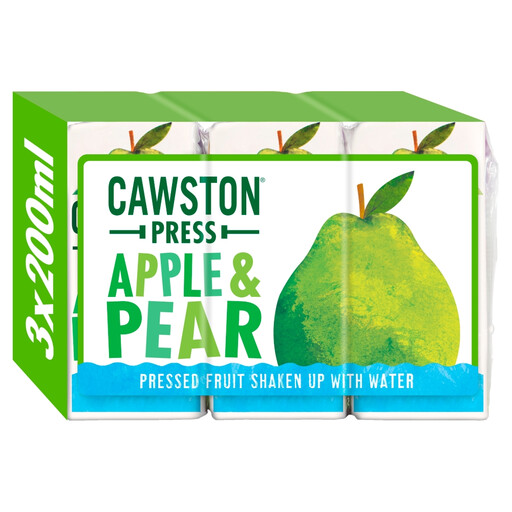
Cawston Press Apple & Pear Fruit Water, 3 × 200ml
The individual cartons suit drinks allocated to desks or meetings. This is an apple-and-pear fruit drink containing water, not 100% apple juice; check the current pack’s sugar figure alongside its no-added-sugar wording.
View on Joybuy
 No image available
Appletiser Lightly Sparkling 100% Apple Juice, 6 × 250ml
The individual cans offer an all-apple-juice option rather than a diluted juice drink. Each can is 250ml: for fruit juice, the NHS advises a combined 150ml daily limit for juice and smoothies and recommends having them at mealtimes. Check the current pack if explicit no-added-sugar wording is required.
View on Joybuy
Frequently asked questions
Does no added sugar mean an apple drink is sugar-free?
No. The drink can still contain sugars from its fruit ingredients. Tropicana UK and Copella Fruit Juices each list 10g sugars per 100ml for the 100% apple juices described here, so compare the nutrition panel rather than relying on the front-of-pack phrase.
Is 100% apple juice the lower-sugar option for an office?
Not in the examples compared here. Tropicana UK and Copella Fruit Juices list 10g sugars per 100ml for their apple juices, while Tesco Groceries and Sainsbury’s each list 2.6g per 100ml for their no-added-sugar apple-and-pear juice drinks. The latter are diluted drinks containing sweeteners, so the ingredient preference matters too.
Is fruit juice suitable for sipping between office meals?
The NHS advises having fruit juice and smoothies at mealtimes rather than between meals, and limiting them to a combined 150ml a day. Keep water available for drinking throughout the working day.
What should we do with an opened 1L juice-drink carton?
Refrigerate it and follow the period on its own label. Tesco Groceries says to use its listed apple-and-pear drink within five days of opening; Sainsbury’s specifies four days for its version. Mark the opening date so colleagues can follow the relevant instructions.
What needs checking before serving apple high-juice concentrate?
Check the dilution instructions and current allergen declaration. The M&S and Sainsbury’s high-juice examples list sulphites; the Food Standards Agency identifies sulphites as a possible risk for people sensitive to them. The M&S product listed by Ocado requires one part concentrate to four parts water.


