Workers who want 100% apple juice
If fruit juice without added sweeteners is the deciding factor, start with the ingredients list and a portion you can drink with lunch. Compare the labelled sugars per 100ml as well as the size of the container.


Choose 100% apple juice if fruit juice rather than a sweetened juice drink is your priority, but check the sugars on the label and plan a smaller portion: ‘no added sugar’ does not mean sugar-free. A no-added-sugar juice drink or dilutable squash may suit a packed lunch when its labelled sugars per serving, format or preparation method fits your needs; check its fruit percentage, sweeteners and any allergens before choosing.
If fruit juice without added sweeteners is the deciding factor, start with the ingredients list and a portion you can drink with lunch. Compare the labelled sugars per 100ml as well as the size of the container.
A sealed, single-serve juice drink can be convenient for a desk lunch. Check sugars per bottle alongside the fruit percentage: Tesco’s Fruit Splash Apple, for example, is a 250ml no-added-sugar drink containing 12% apple juice and sweeteners.
If you can mix a drink before leaving or have water at work, a dilutable apple squash is another format to consider. Follow its preparation directions and check the ingredients and allergen statement; the Sainsbury’s and M&S high-juice examples both list sulphites.
Choose it when: You want a drink made from apple juice rather than a diluted juice drink.
Bear in mind: Fruit juice still contains sugars. Tropicana UK lists 10g sugars per 100ml for Orchard Apple, despite describing them as naturally occurring.
Choose it when: A sealed bottle and its labelled sugars per bottle matter more to you than a high fruit-juice percentage.
Bear in mind: ‘No added sugar’ does not rule out sweeteners; Tesco lists acesulfame K and sucralose in Fruit Splash Apple.
Choose it when: You can prepare a drink in a reusable bottle or cup rather than carrying a ready-to-drink pack.
Bear in mind: The Sainsbury’s and M&S apple-based examples are concentrates, not 100% juice, and both list sucralose and sulphites.
| Priority | What to check | Your needs |
|---|---|---|
| Fruit content | Read the product name and ingredients. Check the fruit-juice percentage and whether the drink is juice, a juice drink or a squash. | I want to know whether I am buying apple juice or a drink that contains some apple juice. Tesco lists Fruit Splash Apple as 12% apple juice; Tropicana describes Orchard Apple as 100% pressed juice. |
| Labelled sugars | Compare sugars per 100ml on the same basis, then check the amount in the portion or whole container you expect to drink. Do not use ‘no added sugar’ as a substitute for the nutrition panel. | The amount I will actually pour or carry matters more to me than the front-of-pack wording alone. |
| Juice portion | Check the pack volume against the amount you intend to drink. The NHS advises limiting fruit juice and smoothies to a combined 150ml a day and having juice at mealtimes. | If I take 100% juice with lunch, I can pour a smaller portion rather than assume a large bottle or can is one serving. |
| Lunch format | Choose between a sealed single-serve pack and a drink you will decant or prepare. Check the selected pack’s instructions for storage after opening. | A bottle I can take straight to work is useful when I cannot prepare a drink there; a larger carton or squash suits me only if I can store or mix it as directed. |
| Other ingredients | Read the sweetener names and allergen statement on the exact product. If choosing squash, follow its dilution instructions. | I want to know what is in my drink before putting it in a reusable bottle. The Sainsbury’s and M&S high-juice examples list sulphites, while several cited juice drinks contain sweeteners. |
The phrase does not tell you how much fruit juice a drink contains. Tesco’s no-added-sugar Fruit Splash Apple lists 12% apple juice and sweeteners, whereas Tropicana describes Orchard Apple as 100% pressed juice.
Check the product name, fruit percentage, ingredients and sugars per 100ml before comparing packs.
A portable pack can hold more juice than you intend to have at lunch. The NHS advises a combined limit of 150ml a day for fruit juice and smoothies, taken at mealtimes; Tesco lists Juice Burst Apple Juice in a 500ml bottle.
If you choose fruit juice, pour the portion you plan to drink and follow the pack’s storage instructions for anything left over.
The cited Sainsbury’s and M&S apple-based high-juice squashes are concentrates. Both list sulphites, so neither should be assumed to have the same ingredients as a ready-to-drink apple juice.
Check the dilution directions and current allergen statement, and make sure you will have water and a suitable bottle or cup.
These examples illustrate different label and pack decisions; a brand name alone does not establish the ingredients of every drink it sells.
Orchard Apple is an example of the 100% juice route rather than a diluted juice drink.
Cloudy Apple is a chilled-juice option listed in several pack sizes by Sainsbury’s.
Fruit Splash Apple illustrates how a single-serve no-added-sugar juice drink differs from 100% juice.
Its cited apple-based products include a ready-to-drink juice drink and a squash that needs dilution.
Apple & Elderflower High Juice is a dilutable option rather than a ready-to-drink apple juice.
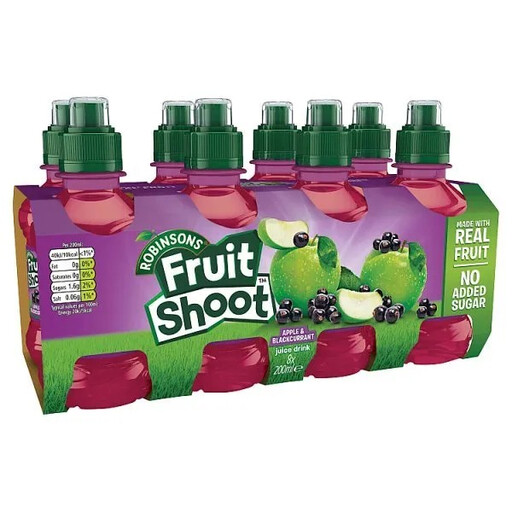
These options cover two different packed-lunch formats: a lightly sparkling 100% apple juice in cans and a no-added-sugar blackcurrant-and-apple drink in small bottles. Check the fruit content and portion you want rather than treating them as equivalent apple juices.
 No image available
The individual cans are a ready-to-carry option if you want sparkling apple juice with lunch. The listed ingredient is carbonated apple juice from concentrate (100%); the stated sugars are 10.5g per 100ml and 26g per 250ml can. Each can is larger than the NHS’s 150ml daily guide for fruit juice and smoothies, so consider how much you intend to drink. If an explicit ‘no added sugar’ claim matters to you, check the current pack wording.
 No image available
The individual bottles suit a ready-to-drink lunch format if a blackcurrant-and-apple drink meets your needs. The stated sugars are 0.7g per 100ml; the listed fruit-juice ingredients are 6% apple and 2% blackcurrant. It is not pure apple juice and contains sucralose and acesulfame K. Follow the pack’s refrigeration and use instructions after opening.
No. It does not tell you the drink’s total sugars, fruit percentage or whether it contains sweeteners. Tesco lists 3.1g sugars per 250ml bottle for Fruit Splash Apple, which contains sweeteners; Tropicana UK lists 10g sugars per 100ml for its 100% Orchard Apple juice. Check the nutrition panel on the same volume basis when comparing them.
The NHS advises limiting fruit juice and smoothies to a combined 150ml a day and having juice at mealtimes because juicing releases sugars that can damage teeth. A 500ml bottle, such as the Juice Burst pack listed by Tesco, is therefore larger than that daily juice guide; you can pour a smaller portion and store the rest as the pack directs.
Yes. Tesco lists acesulfame K and sucralose in Fruit Splash Apple, and Sainsbury’s lists both in its Apple & Pear Juice Drink. If you prefer a drink without those ingredients, read the ingredients list rather than relying on the front-of-pack claim.
No. The cited Sainsbury’s Apple High Juice and M&S Apple & Elderflower High Juice products are concentrates containing 50% fruit juice, intended for dilution rather than drinking as 100% apple juice. Both list sucralose and sulphites, so check the selected pack’s preparation directions and allergen statement.