Choose 100% apple juice when juice content matters more than reducing sugar; the apple juices listed by Sainsbury's and ASDA contain 9.2g to 11g sugars per 100ml, and Food Standards Scotland advises limiting fruit juice and smoothies to a combined 150ml a day. If less labelled sugar is the priority, compare no-added-sugar juice drinks and sugar-free apple-flavoured soft drinks, but check their fruit content, sweeteners and whether they are sparkling. For an office, also match pack size to available storage and how quickly an opened drink will be finished.
Who is each option for?
The useful distinction is whether colleagues want apple juice itself, a drink with less labelled sugar, or a pack format that works in the office.
Buyers comparing sugar labels
If reducing labelled sugar is the priority, compare sugars per 100ml rather than relying on “diet” or “no added sugar”. Check the juice percentage and sweeteners too: an apple-flavoured drink is not necessarily 100% apple juice.
Colleagues who want apple juice
Choose a product labelled as 100% juice if fruit-juice content is the deciding factor. Juice still contains naturally occurring sugars; Food Standards Scotland advises a combined limit of 150ml a day for fruit juice and smoothies.
People stocking a shared office
Consider whether individual packs can be stored unopened in a cupboard, or whether a shared bottle will need fridge space. Check its instructions for storage after opening and how soon it should be finished.
What should you check before buying?
Decide what sort of drink the office wants, then compare labels on the same per-100ml basis before choosing a pack size.
100% apple juice
Choose when: The drink needs to be apple juice rather than an apple-flavoured alternative.
Trade-off: Its naturally occurring sugars still count as free sugars, so plan the serving rather than treating juice as an unlimited desk drink.
No-added-sugar juice drink
Choose when: A lower labelled sugar figure matters more than having 100% juice.
Trade-off: “No added sugar” does not mean sugar-free; check the remaining sugars, fruit content and sweeteners.
Sugar-free apple-flavoured drink
Choose when: Apple flavour with a sugar-free label is the priority, rather than juice content.
Trade-off: Check whether it is sparkling and contains sweeteners; it may be a soft drink rather than apple juice.
| Priority | What to check | Your needs |
|---|
| Sugar and claims |
Compare sugars per 100ml. Distinguish “no added sugar” from “sugar-free”; the sugar-free claim condition set out in the nutrition-claims legislation for Great Britain is no more than 0.5g sugar per 100ml. |
I want to reduce labelled sugar, so I need the nutrition figure as well as the wording on the front of the pack. |
| Fruit content |
Read the product description and juice percentage. ASDA lists 1.2g sugars per 100ml for its Apple & Pear Juice Drink, but its ingredients include 6% apple juice, 4% pear juice and sucralose; it is not 100% juice. |
Does the office want apple juice, or would an apple-flavoured drink suit the people drinking it? |
| Serving size |
Check the sugars in the amount actually served. Food Standards Scotland advises limiting fruit juice and smoothies together to 150ml a day and having juice with a meal rather than on its own. |
I want a practical serving of juice at work, not a pack size that I mistake for the advised amount. |
| Storage and packs |
Check unopened storage, refrigeration after opening and the stated opened life. Sainsbury's says its 200ml Pure Apple Juice cartons can be stored in a cool, dry place unopened; ASDA says its Copella Cloudy Apple bottle must be refrigerated and finished within four days of opening. |
With limited fridge space, individual packs may be simpler; a shared chilled bottle makes more sense if colleagues will finish it within its stated period. |
Common buying mistakes
-
Reading “no added sugar” as “sugar-free”
ASDA's no-added-sugar Apple & Pear Juice Drink still lists 1.2g sugars per 100ml.
Compare the sugars line per 100ml with the claim on the pack. For a sugar-free claim in Great Britain, the nutrition-claims legislation sets a maximum of 0.5g sugar per 100ml.
-
Assuming 100% juice has little sugar
The 100% apple juices listed by Sainsbury's and ASDA in these examples range from 9.2g to 11g sugars per 100ml. Food Standards Scotland includes sugars naturally present in fruit juice among free sugars.
Choose 100% juice for its juice content, and consider a measured serving. If reducing labelled sugar matters more, compare juice drinks and their ingredients instead.
-
Opening a large bottle without a plan to finish it
ASDA's Copella Cloudy Apple listing says to keep the bottle refrigerated and consume it within four days of opening.
Match a shared bottle to fridge space and likely consumption; otherwise consider a smaller or individually packed format.
Juice left in an opened bottle may go unused when its stated consumption period passes.
-
Treating an apple-flavoured soft drink as pure juice
Morrisons describes Fanta Apple Zero as a sparkling apple-flavoured drink with sweeteners and 3.3% apple juice from concentrate.
Order it for the type of drink described on its label, not as a substitute for colleagues specifically requesting 100% apple juice.
Brand and retailer examples
These examples show why the individual product label matters more than a brand name when comparing juice, sugar and storage.
Tropicana
ASDA lists Tropicana Pressed Apple Fruit Juice as a 100% pressed juice option.
- The ASDA listing gives 10g sugars per 100ml and 15g per 150ml.
- Being 100% juice does not make this product sugar-free.
Copella
ASDA lists Copella Cloudy Apple as a not-from-concentrate juice in a 1.35L bottle.
- Its listed sugars figure is 10g per 100ml.
- The bottle needs refrigeration and should be consumed within four days of opening, according to ASDA's listing.
ASDA
ASDA's listed apple juice and Apple & Pear Juice Drink illustrate two different formulations.
- Its Apple Juice from Concentrate lists 11g sugars per 100ml; its Apple & Pear Juice Drink lists 1.2g per 100ml.
- The lower-sugar drink contains 10% fruit juice in total and sucralose, rather than being 100% apple juice.
Sainsbury's
Sainsbury's Pure Apple Juice comes in a pack of six 200ml cartons for individually packed drinks.
- The listing describes 100% apple juice from concentrate, with 9.2g sugars per 100ml.
- One carton contains 18.4g sugars and holds more than the 150ml daily fruit-juice amount advised by Food Standards Scotland.
M&S
M&S lists apple juices alongside other juice drinks, so check the particular product rather than assuming the range has one formulation.
- Its listed 200ml Cloudy Apple Juice gives a sugars figure of 10.3g per 100g.
- That per-100g figure should not be treated as a per-100ml figure when comparing drinks.
Joybuy drink options
These options cover sugar-free apple-flavoured cans, a no-added-sugar blackcurrant-and-apple drink, and lightly sparkling 100% apple juice. Compare their labels if the office needs a particular sugar figure or fruit-juice content.
 No image available
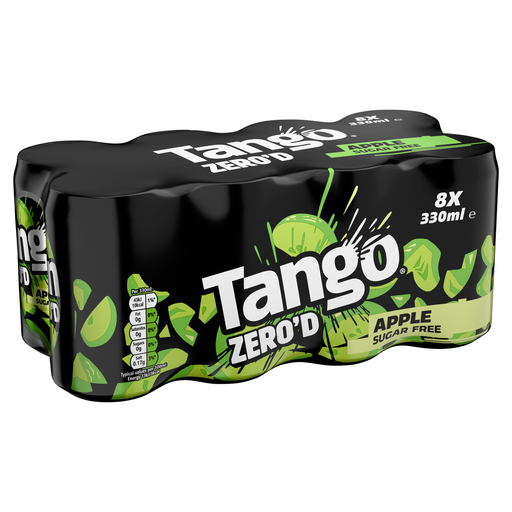
Tango Sugar Free Apple 8 × 330ml
An eight-can apple-flavoured option for colleagues seeking a sugar-free drink rather than 100% apple juice. Check the current ingredients and nutrition panel for the full formulation.
 No image available
Tango Apple Sugar-Free Can 24 × 330ml
A larger multipack of individually packed apple-flavoured drinks. The sugar-free wording does not make it 100% apple juice; check the current label for ingredients and juice content.
 No image available
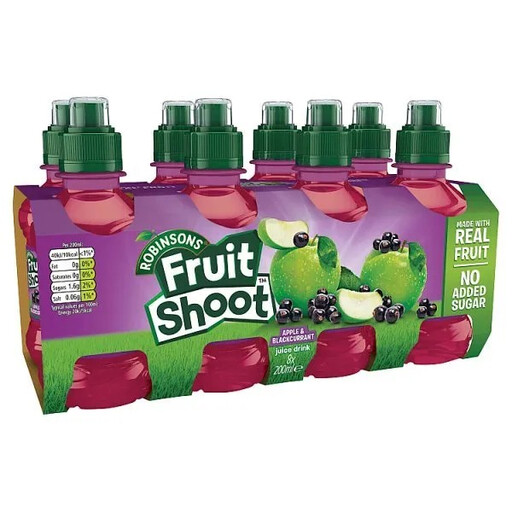
Fruit Shoot Black & Apple No Added Sugar 8 × 200ml
An individually packed blackcurrant-and-apple option, rather than pure apple juice. “No added sugar” does not mean sugar-free, so compare its sugars figure per 100ml with other drinks.
 No image available
Appletiser 100% Apple Juice Lightly Sparkling 6 × 250ml
A lightly sparkling 100% apple-juice option in individual cans, not a sugar-free alternative. Each 250ml can is larger than the 150ml daily fruit-juice amount advised by Food Standards Scotland; consider the amount served.
Questions about office apple drinks
Does “no added sugar” mean a drink is sugar-free?
No. A no-added-sugar drink can contain naturally occurring sugars: ASDA's Apple & Pear Juice Drink makes that claim and lists 1.2g sugars per 100ml. For a sugar-free claim in Great Britain, the nutrition-claims legislation sets a maximum of 0.5g sugar per 100ml. Check the sugars line as well as the front-of-pack wording.
Can 100% apple juice be an office snack drink?
Yes, if its juice content is what colleagues want and the serving is planned. Food Standards Scotland advises limiting fruit juice and smoothies together to 150ml a day and drinking juice with a meal rather than on its own.
Are individual cartons or a shared bottle more practical?
Choose by storage space and how quickly the drink will be used. Sainsbury's says its 200ml Pure Apple Juice cartons can be kept in a cool, dry place unopened, while ASDA's Copella Cloudy Apple bottle needs refrigeration and should be consumed within four days of opening. A 200ml juice carton is also larger than Food Standards Scotland's advised 150ml daily amount for fruit juice and smoothies.
Is a sugar-free apple-flavoured drink the same as apple juice?
No. Morrisons describes Fanta Apple Zero as a sparkling drink with sweeteners and 3.3% apple juice from concentrate. If colleagues specifically want 100% apple juice, check for that description on the product label rather than choosing by apple flavour alone.


