Choose a sparkling apple can when you mainly want a portable drink after an ordinary workout, not a drink that supplies both carbohydrate and protein for recovery. If you want carbohydrate from 100% apple juice, consider a measured portion alongside food containing protein and water; NHS guidance says to limit fruit juice, vegetable juice and smoothies to a combined 150ml a day and have them with meals.
Who is this choice for?
Gym-goers wanting a portable drink
An individual sparkling apple can is convenient after a routine session, but check its carbohydrate and protein rather than treating the can format as a recovery claim. Cawston Press lists less than 0.1g protein per 100ml for its Sparkling Cloudy Apple drink.
People who prefer a measured juice portion
A bottle or carton lets you pour a smaller serving of 100% apple juice. NHS guidance recommends no more than 150ml of fruit juice, vegetable juice and smoothies combined per day, consumed with a meal.
People training again soon
When refuelling is the reason for choosing a drink, look at carbohydrate per serving and plan protein-containing food and water separately. AXA Health’s post-exercise guidance discusses carbohydrate, protein and hydration together; the apple drinks described here supply little protein.
What should you check?
Start with the purpose of the drink, then compare the labelled serving with the amount you intend to have. A can, a sparkling juice drink and a portion of 100% juice are not interchangeable descriptions.
| Priority |
What to check |
Your needs |
| Recovery nutrition |
Read carbohydrate and protein per serving. Plan a separate drink of water and, when relevant, food containing protein; AXA Health discusses all three in its post-exercise guidance. |
If I am choosing something after a demanding session, I want to know what the drink contributes rather than assuming an apple can replaces food. |
| Carbohydrate and sugars |
Compare like-sized portions and check the type of drink. Cawston Press lists 4.5g carbohydrate per 100ml for Sparkling Cloudy Apple; Tropicana lists 17g per 150ml for Orchard Apple juice. |
Sometimes I want a sparkling drink; at other times I specifically want a portion of 100% juice. The fruit content and serving size matter to that choice. |
| Juice portion |
Check whether you can measure the amount you plan to drink. NHS guidance limits fruit juice, vegetable juice and smoothies to 150ml combined per day and recommends having them with meals. |
I would rather pour a measured serving than assume that finishing a larger can counts as the same portion. |
| Pack format |
Confirm the number of units, their size and whether they are cans, cartons or bottles. Read the product name and ingredients to distinguish 100% juice from a sparkling apple drink or apple-flavoured water. |
For a drink to carry after exercise, individual containers matter; for home use, I can pour from a larger pack. |
Common buying mistakes
-
Treating an apple can as a complete recovery drink
Cawston Press lists less than 0.1g protein per 100ml of Sparkling Cloudy Apple. AXA Health’s post-exercise guidance discusses protein alongside carbohydrate and hydration.
If recovery nutrition is your reason for buying, plan food containing protein and water as well as checking the drink’s carbohydrate per serving.
-
Assuming no added sugar removes the need to measure juice
The NHS advises a combined daily limit of 150ml for fruit juice, vegetable juice and smoothies, with these drinks consumed at mealtimes.
If choosing 100% juice, measure the serving rather than using a full can or several pours as your portion guide.
-
Confusing sparkling apple drinks with 100% juice
Cawston Press describes its sparkling drink as containing 49% pressed apple juice. Marks & Spencer lists 16% apple juice from concentrate and added sugar in its Sparkling British Apple Spring Water.
Check the product name, ingredient list, juice percentage and nutrition per serving before comparing drinks.
-
Checking the pack count but not the container
A multipack does not necessarily contain individual cans: ASDA’s apple juice multipack, for example, contains four 1L cartons.
Confirm both the container type and unit size if portability is the reason for buying a multipack.
Apple drink brands and ranges
These examples show why the drink type and container matter more than a brand name alone.
Cawston Press
Sparkling Cloudy Apple is listed by Cawston Press as a four-pack of 250ml cans.
- Its ingredients list includes 49% pressed apple juice and sparkling water.
- It is a sparkling juice drink, not 100% apple juice; Cawston Press lists less than 0.1g protein per 100ml.
Tropicana
Orchard Apple is labelled by Tropicana as 100% pressed apple juice, not from concentrate.
- Its label lists 17g carbohydrate per 150ml serving.
- The same serving lists 0.3g protein; a bottle is not an individual can.
Copella
Copella Cloudy Apple appears in supermarket apple-juice listings in bottle formats.
- Tesco lists a 300ml apple-juice product, while Sainsbury’s lists a 1.35L Cloudy Apple product.
- Check the container and serving information if individual cans are essential.
Tesco
Tesco’s own-label apple-juice listings include larger formats for pouring at home.
- Tesco lists 100% Pressed Apple Juice in a 1L format.
- Its listed 1L and 1.75L formats do not serve the same portability need as individual cans.
Sainsbury’s
Sainsbury’s lists own-label apple juice in 1L formats.
- Its listings include Pure Apple Juice and 100% Pressed Apple Juice, Not From Concentrate.
- A larger container requires pouring if you want a measured serving after exercise.
Asda
ASDA Groceries lists Apple Juice from Concentrate as a multipack of four 1L cartons.
- Its label lists 15g carbohydrate per 150ml, making the serving information straightforward to compare with another measured juice portion.
- The cartons are not individual cans; the label lists less than 0.5g protein per 150ml.
M&S
Marks & Spencer lists Sparkling British Apple Spring Water as a 330ml canned drink.
- The individual can format may suit someone seeking a portable sparkling apple-flavoured drink.
- Its ingredients list gives 16% apple juice from concentrate and added sugar; it is not 100% apple juice.
Joybuy product options
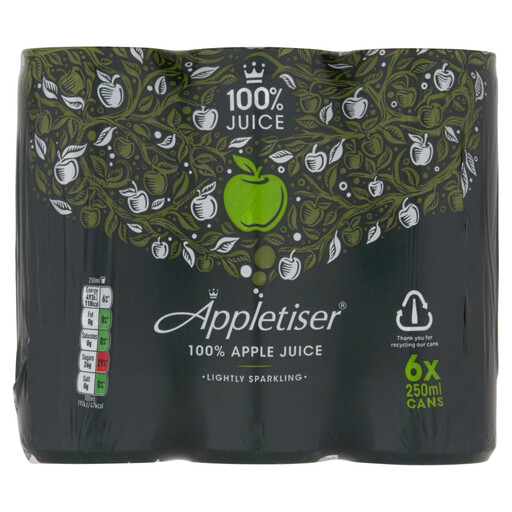
This 6 x 250ml Appletiser multipack is an option to consider if you want lightly sparkling 100% apple juice after exercise. Check the container format if cans are essential, and consider how the 250ml unit fits the NHS’s 150ml daily guidance for fruit juice, vegetable juice and smoothies.
 No image available
Appletiser Lightly Sparkling 100% Apple Juice, 6 x 250ml
The individual 250ml units offer a portable juice option after exercise. If you want a measured juice serving, check how you will pour it; NHS guidance limits fruit juice, vegetable juice and smoothies to 150ml combined per day and recommends having them with meals. Check the product listing for the container format if you specifically need cans.
View on Joybuy
Questions about apple juice after exercise
Can an apple drink replace food containing protein after exercise?
Do not rely on the apple drinks described here to provide protein. Cawston Press lists less than 0.1g protein per 100ml for Sparkling Cloudy Apple, and Tropicana lists 0.3g per 150ml for Orchard Apple; AXA Health’s post-exercise guidance discusses carbohydrate, protein and hydration together.
How much 100% apple juice fits NHS guidance?
The NHS advises limiting fruit juice, vegetable juice and smoothies to a combined 150ml a day and having them with meals, rather than between meals. That guidance still matters when the juice has no added sugar.
Is a sparkling apple can the same as 100% apple juice?
Not necessarily: Cawston Press lists 49% pressed apple juice in its Sparkling Cloudy Apple drink, while Marks & Spencer lists 16% apple juice from concentrate in Sparkling British Apple Spring Water. Read the product name, ingredients and juice percentage if you specifically want 100% juice.


