Hosts serving a small table
A 750ml sparkling glass bottle gives guests an alcohol-free drink to share and lets you pour the amount wanted. Asda Groceries lists Appletiser in this format, while Ocado lists a Daylesford Organic alternative.


For a brunch where guests can help themselves, individual still-juice bottles avoid pouring; for a drink to share at the table, choose a sparkling glass bottle if your guests want fizz. Check the packaging of the exact product rather than relying on the brand, and plan the pour size: the NHS advises limiting fruit juice and smoothies to a combined 150ml a day.
A 750ml sparkling glass bottle gives guests an alcohol-free drink to share and lets you pour the amount wanted. Asda Groceries lists Appletiser in this format, while Ocado lists a Daylesford Organic alternative.
Separate bottles make self-service straightforward when guests arrive at different times. Folkington's sells its cloudy apple juice as 12 × 250ml glass bottles; each bottle holds more than the NHS-advised daily 150ml limit for juice and smoothies.
Check the exact product before ordering. Sainsbury's lists Copella Cloudy Apple Fruit Juice 1.35L in plastic, and Tesco lists Tropicana Orchard Apple 1.8L in a carton, despite both being apple-juice options.
Decide how guests will serve themselves, then compare the exact bottle's packaging, label and storage instructions.
Choose when: Guests will help themselves at different times and you would rather not pour from a shared bottle.
Bear in mind: Folkington's 250ml glass bottles come in a case of 12, and one full bottle exceeds the NHS's 150ml daily juice-and-smoothie guidance.
Choose when: You want an alcohol-free drink with fizz to pour at the brunch table.
Bear in mind: An opened bottle needs to be stored and used according to its own label, which matters if the group will not finish it.
| Priority | What to check | When it matters to me |
|---|---|---|
| Serving format | Check the volume of each bottle and whether it is sold singly or by the case. A 250ml bottle is an individual format; a 750ml bottle can be poured into glasses. | If people will come and go, separate bottles simplify self-service. For everyone seated together, I would rather pour from one shared bottle. |
| Still or sparkling | Check whether the label describes still cloudy juice or carbonated apple juice, and read the ingredients if that distinction matters to you. | I'd choose still juice for a conventional juice serve, or sparkling juice when the table wants fizz. |
| Packaging | Confirm “glass bottle” for the exact size and variant. Sainsbury's lists the checked Copella 1.35L product in plastic; Tesco lists the checked Tropicana 1.8L product in a carton. | Glass is part of my plan for the table, so a familiar apple-juice brand alone is not enough to settle the choice. |
| Pour size and sugars | Compare sugars per 100ml on the product labels. The NHS advises a combined maximum of 150ml of fruit juice and smoothies a day, taken with a meal. | I want to offer juice alongside water and choose the glass size before guests start pouring. |
| After opening | Read the bottle's refrigeration and use-within instructions. Asda Groceries says to refrigerate Appletiser after opening and consume it within four days. | If the brunch is small, I want to know how to store any juice left in a shared bottle. |
The checked Copella Cloudy Apple Fruit Juice 1.35L is listed by Sainsbury's in plastic, while Tesco lists Tropicana Orchard Apple 1.8L in a carton.
Look for the packaging description of the exact size and variant before ordering glass bottles.
A full 250ml bottle exceeds the NHS's advised combined daily limit of 150ml for fruit juice and smoothies.
Put out smaller glasses and water so guests can choose how much juice to pour.
The absence of added sugar does not tell you the amount of naturally occurring sugars in a juice.
Read the nutrition panel per 100ml and consider the amount you intend to serve.
Asda Groceries instructs buyers to refrigerate Appletiser after opening and consume it within four days. Ocado's online Daylesford listing gives conflicting use-within periods.
Keep the physical label and follow its instructions for refrigeration and use after opening.
A shared bottle may leave more juice to store than a small group will drink at brunch.
These are examples of specific product formats, not a guarantee that every juice from each brand comes in glass.
Its cloudy apple juice offers a still option for individual serving.
A sparkling apple-juice option for pouring from a shared bottle.
Another shared sparkling format when an organic-labelled juice is the preference.
A still-juice route for hosts considering a case rather than a single shared bottle.
Its checked large cloudy apple juice is a still alternative when glass packaging is not essential.
This sparkling apple option is a 750ml format for pouring at a brunch table; check the exact bottle and label when deciding whether it meets your glass-packaging preference.
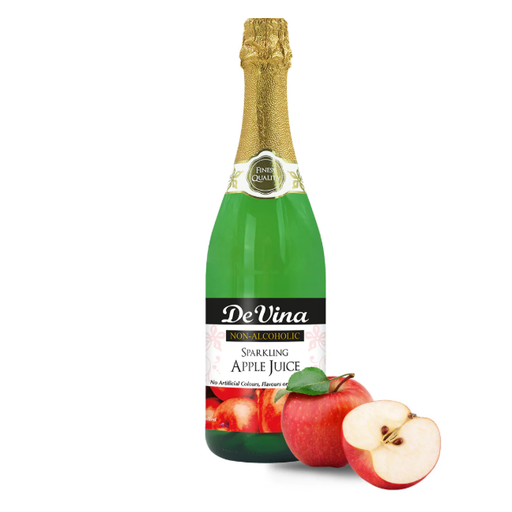 No image available
A 750ml sparkling apple drink for pouring at the table. Confirm the glass-bottle description and nutrition panel on the product label. The product description says to refrigerate after opening and consume within three days; it also says the drink is not suitable for children under four.
An individual bottle makes self-service easy, but 250ml exceeds the NHS's advised combined daily limit of 150ml for fruit juice and smoothies. Smaller glasses let guests pour less, and you can offer water alongside the juice.
Both have 750ml glass-bottle options: Asda Groceries lists Appletiser as carbonated apple juice from concentrate, while Ocado lists Daylesford Organic Sparkling Apple Juice as an organic option. Check the current bottle label for ingredients and storage instructions before choosing.
Not the versions checked here. Sainsbury's lists Copella Cloudy Apple Fruit Juice 1.35L in plastic, and Tesco lists Tropicana Orchard Apple 1.8L in a carton. Check the packaging of the exact product you intend to order.
Follow the opened bottle's storage and use-within instructions. Asda Groceries says to refrigerate Appletiser after opening and consume it within four days; because Ocado's Daylesford listing gives conflicting periods, use the instructions on the physical Daylesford bottle.
No. Read the product's sugars figure per 100ml and decide how much to pour. The NHS advises limiting fruit juice and smoothies to a combined 150ml a day and having them with a meal.