People who want individual cans
A multipack can be convenient for taking one drink after the gym. Check the juice percentage and ingredients, as a sparkling apple drink is not necessarily 100% juice.


Choose multipack cans if individual portions are useful, but check whether the drink is 100% apple juice or a mixture of juice and sparkling water: Cawston Press’s four-pack contains 49% pressed apple juice. After a hard or long session, have a protein-containing food as well if you need a recovery snack rather than relying on a can alone. For 100% juice, bear in mind the NHS guidance to limit fruit juice and smoothies to a combined 150ml a day when choosing a can size.
A multipack can be convenient for taking one drink after the gym. Check the juice percentage and ingredients, as a sparkling apple drink is not necessarily 100% juice.
If a hard or long session calls for a recovery snack, consider food containing protein alongside the drink. University College London Hospitals NHS Foundation Trust discusses carbohydrate-and-protein snacks around exercise.
The NHS advises limiting fruit juice and smoothies to a combined 150ml a day. Check the volume of a 100% juice can before treating it as one portion.
Start with what is in the can, then consider the portion and whether you need food alongside your drink.
| Priority | What to check | Your needs |
|---|---|---|
| Juice content | Read the ingredients and stated juice percentage. Cawston Press lists 49% pressed apple juice and sparkling water in its canned drink; Tropicana describes Orchard Apple as 100% pressed juice. | I want to know whether I am buying pure apple juice or a sparkling drink made with juice and water. |
| Post-exercise snack | Consider the length and intensity of the session and whether food is due soon. If you need a recovery snack, include a protein-containing food rather than relying on juice alone; University College London Hospitals NHS Foundation Trust discusses carbohydrate-and-protein snacks around exercise. | After a harder or longer session, I want a snack that includes food as well as a drink. After a short session, I may simply be ready for my next meal. |
| Portion size | Compare the can volume with how much you intend to drink. The NHS advises no more than 150ml of fruit juice and smoothies combined per day; Cawston Press lists 250ml cans in its four-pack and 330ml cans in its larger cases, although its drink is not pure juice. | A single can is convenient, but I do not want its size to decide my juice portion for me. |
| Sugars | Compare nutrition panels using the same per-100ml or per-serving measure, and check the ingredients. The NHS classifies sugars in unsweetened fruit juice as free sugars. | I want to understand the sugars in the drink rather than relying on fruit imagery or a front-of-pack phrase. |
| Pack format | Check the number of containers, the volume in each and whether they are cans or bottles. Costco UK lists Juice Tree apple juice from concentrate as 12 × 330ml bottles, not cans. | Individual containers would suit my routine, but I need to decide whether cans matter more than the type of juice inside. |
Cawston Press states that its Sparkling Cloudy Apple cans contain 49% pressed apple juice and sparkling water. The label describes a different drink from Tropicana’s 100% pressed Orchard Apple juice.
Read the ingredients and juice percentage if pure juice is important to you.
A drink alone does not cover every part of a post-exercise snack. University College London Hospitals NHS Foundation Trust discusses carbohydrate-and-protein snacks around exercise, while the UK Sports Institute identifies fuel and hydration as recovery considerations.
After demanding activity, consider whether you need food containing protein alongside your drink, and account for fluids separately.
The NHS advises limiting fruit juice and smoothies to a combined 150ml daily. That matters when choosing a 250ml can labelled 100% juice; a sparkling drink containing juice and water has a different composition.
Check both the volume and juice percentage before deciding how much to drink.
Four 250ml cans and a case of 330ml cans differ in both total volume and the size of each drink. Can count does not show whether the portions fit your routine.
Compare the volume per can and the total volume you are likely to use.
Sparkling Cloudy Apple comes in a four-pack of 250ml cans and larger cases of 330ml cans, according to Cawston Press.
Tropicana describes Orchard Apple as 100% pressed apple juice made without concentrate.
Tesco Groceries lists a 1.35L Copella apple juice bottle.
Costco UK lists Juice Tree apple juice from concentrate in a pack of 12 × 330ml bottles.
Marks & Spencer has an apple juice range and describes multipacks for drinks on the go.
This selection is a six-can pack of lightly sparkling apple juice for people considering an individual drink after the gym. Food may still be needed alongside it if you want a recovery snack after demanding exercise.
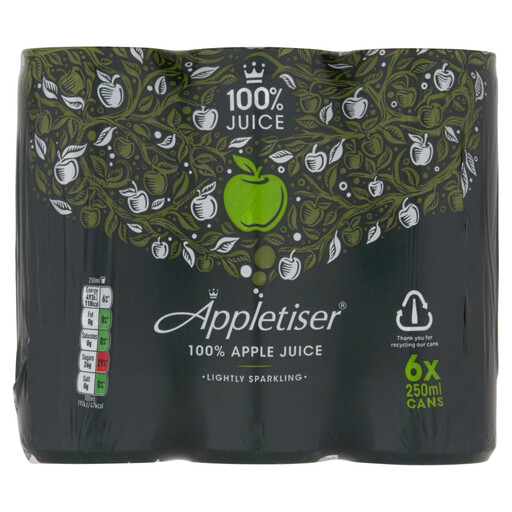 Image unavailable
The six-pack provides individual 250ml cans for taking a drink after exercise. The product name specifies 100% apple juice and a lightly sparkling format. A full can is larger than the NHS’s recommended 150ml daily combined limit for fruit juice and smoothies; if you need a recovery snack, consider food containing protein alongside the drink.
After a hard or long session, do not rely on juice alone if you need a recovery snack. University College London Hospitals NHS Foundation Trust discusses snacks containing both carbohydrate and protein around exercise; consider protein-containing food alongside your drink.
The NHS advises limiting fruit juice and smoothies to a combined 150ml a day, so finishing a 250ml can of 100% apple juice exceeds that volume. Check the ingredients as well as the can size: Cawston Press’s sparkling apple drink contains 49% pressed apple juice rather than being pure juice.
No. The NHS says sugars in unsweetened fruit juice count as free sugars. Read the nutrition panel for total sugars on a consistent per-100ml or per-serving basis, and check the ingredients to see what kind of apple drink you are buying.
Not necessarily. Consider whether you are hungry and when your next meal is due rather than buying juice automatically after every session. If you manage a condition such as diabetes, follow your individual care advice instead of a general snack rule.