What should you check before buying?
Start with carbohydrate per serving, then check whether the juice content and pack format fit how you plan to use the drink.
| Priority |
What to check |
Your needs |
| Carbohydrate per serving |
Compare the stated serving size and carbohydrate: ASDA lists 28g per 250ml Appletiser can, while Sainsbury's lists 4.5g per 100ml for Cawston Press, or about 11.25g per 250ml can. A 2015 review in Nederlands Tijdschrift voor Geneeskunde advises 30–60g per hour for intense exercise lasting 1–2.5 hours; neither can alone reaches the lower figure. |
I want to know what one can contributes alongside any other food or drink in my plan, rather than treating it as a complete hour's fuel. |
| Juice content |
Read the ingredients and product description. ASDA lists Appletiser as 100% carbonated apple juice from concentrate; Sainsbury's lists Cawston Press Sparkling Cloudy Apple as containing 49% pressed apple juice with sparkling water. |
If I specifically want 100% juice, an apple-flavoured or lower-juice sparkling drink does not meet that preference. |
| Portion and pack |
Check both the number of servings and the volume of each: Appletiser is 6 × 250ml cans, Cawston Press is 4 × 250ml cans, and Sainsbury's Pure Apple Juice is 3 × 200ml cartons. Sainsbury's lists 21g of carbohydrate per carton. |
A carton works for me if I need a countable serving but not a can. If I plan to drink during a run, I also need to try the format and timing in training. |
| Everyday intake |
Consider routine juice consumption separately from an event-specific plan. The NHS Eatwell Guide recommends limiting fruit juice and smoothies to a combined 150ml a day as general dietary guidance; a 250ml can exceeds that amount. |
I want to distinguish what I choose for a training session from how much juice I usually drink. The NHS figure is not a product-specific marathon fuelling rule. |
Relevant brand and retailer options
These references distinguish the documented can and carton formats; they do not indicate which products are currently available at a particular shop.
Appletiser
A six-pack of 250ml sparkling cans listed by ASDA as 100% carbonated apple juice from concentrate.
- ASDA lists 28g of carbohydrate per can.
- It is sparkling; try the serving size and timing in training before relying on it during an event.
Cawston Press
Sparkling Cloudy Apple comes in four 250ml cans and is listed by Sainsbury's as containing 49% pressed apple juice.
- Its listed 4.5g of carbohydrate per 100ml allows a per-can calculation of about 11.25g.
- It does not provide the same carbohydrate amount per can as the listed Appletiser product.
Sainsbury's
Pure Apple Juice is listed in a three-pack of 200ml cartons containing 100% apple juice from concentrate.
- The product listing states 21g of carbohydrate per carton.
- Cartons offer a different format from the requested cans.
Tesco, Copella and Tropicana
Tesco Groceries lists apple-juice options from these names in bottle and individual-serving formats.
- The listed options include a 300ml Copella serving and larger Copella, Tropicana and Tesco bottles.
- Check the pack format and nutrition information for the specific product rather than assuming it matches a 250ml can.
Joybuy canned apple-juice option
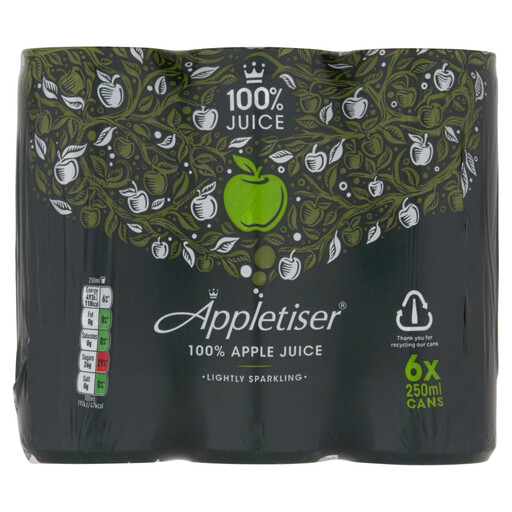
This six-can Appletiser multipack is an option for counting a 250ml apple-juice serving within a marathon-training fuelling plan.
 No image available
Appletiser 100% Apple Juice Lightly Sparkling 6 × 250ml
For a portioned drink in a training plan, each 250ml can provides 28g of carbohydrate. The six-pack contains 100% carbonated apple juice from concentrate. One can is below the 30g-per-hour lower figure cited in a 2015 Nederlands Tijdschrift voor Geneeskunde review for intense exercise lasting 1–2.5 hours; count other planned fuel and try the sparkling drink during training.
Joybuy
Frequently asked questions
Does one 250ml Appletiser can cover an hour of marathon fuelling?
Not on its own against the 30g-per-hour lower figure advised for intense exercise lasting 1–2.5 hours in a 2015 Nederlands Tijdschrift voor Geneeskunde review. ASDA lists 28g of carbohydrate per can. What else belongs in a plan depends on the session, other food and drink, and what you have tried in training.
Is Cawston Press Sparkling Cloudy Apple equivalent to 100% apple juice?
No. Sainsbury's lists it as containing 49% pressed apple juice and 4.5g of carbohydrate per 100ml, or about 11.25g per 250ml can. ASDA lists the compared Appletiser can as 100% carbonated apple juice from concentrate with 28g of carbohydrate per 250ml.
Should I first try a sparkling apple drink during an event?
Try the drink, portion size and timing during training before making it part of an event plan. The listed Appletiser and Cawston Press cans are sparkling, but their product information cannot tell you how you will tolerate them while running.
Does the NHS 150ml guidance prohibit a 250ml can for marathon training?
No. The NHS Eatwell Guide recommends limiting fruit juice and smoothies to a combined 150ml a day as general dietary guidance because they contain free sugars; it does not set a product-specific marathon fuelling rule. A 250ml can exceeds that general daily amount, so keep routine consumption and an event-specific plan distinct.
What should I check on an apple-juice multipack?
Check the serving volume, carbohydrate per serving, ingredients, juice content, pack quantity and date marking on the actual pack. UK government food-labelling guidance identifies the food name, quantity, ingredients where required and date marking among the information to provide on pre-packed food.


