What should you check before buying?
Start with the individual serving, then check the drink itself and whether its packaging suits the school’s packed-lunch rules.
| Priority |
What to check |
Your needs |
| Serving size |
Read the volume per can, carton or bottle, not just the pack total. The NHS advises a maximum of 150ml of fruit juice and smoothies per day, with a meal; a 200ml unit exceeds that amount by 50ml and a 250ml unit by 100ml. |
For a regular lunch, I want to know how much juice is in the individual drink and account for any other juice or smoothie that day. |
| Drink type |
Read the product description, ingredients and declared juice content. Distinguish apple juice, including juice from concentrate, from apple-flavoured drinks; check whether the drink is sparkling. |
If I am looking for apple juice rather than an apple-flavoured drink, the word “apple” on its own is not enough to make the choice. |
| Pack format |
Compare the number of individual drinks and their volumes. Tesco Groceries lists Growers Harvest apple juice from concentrate in 6 x 200ml cartons; Amazon.co.uk lists Tropicana apple juice in 12 x 250ml bottles. Neither listing describes a can. |
I need a drink that is practical to pack, but I do not want to mistake a carton or bottle multipack for the cans I set out to buy. |
| School rules |
Check the individual school’s current packed-lunch policy, particularly for cans and sparkling drinks. The Department for Education’s school-food guidance concerns food and drink provided in state-funded schools in England; it does not establish what a particular school permits in lunches brought from home. |
Before buying several cans, I want to know whether my child can take them to school. |
Brand and retailer references
These references describe specific products and listings, not a ranking of brands or a statement about what is stocked on Joybuy.
Tropicana
Tropicana describes Orchard Apple as 100% pressed apple juice, not from concentrate.
- Amazon.co.uk lists a Tropicana apple-juice multipack of 12 x 250ml bottles.
- That listed format is bottles rather than cans, and each 250ml bottle exceeds the NHS’s 150ml daily fruit-juice guidance.
Copella
Copella describes its apple-juice range as fresh pressed.
- Tesco Groceries lists Copella apple juice in 300ml, 900ml and 1.35L sizes.
- The listed 300ml individual drink exceeds the NHS’s 150ml daily fruit-juice guidance; those listed sizes do not establish a canned multipack.
Tesco
Tesco Groceries provides a lunchbox-format carton listing to compare with cans and bottles.
- Its listings include Growers Harvest Apple Juice From Concentrate in a 6 x 200ml carton multipack.
- Those individual cartons are not cans, and each 200ml serving exceeds the NHS’s 150ml daily fruit-juice guidance.
Joybuy apple-juice option
This option is a lightly sparkling 6 x 250ml apple-juice multipack for shoppers considering cans for a packed lunch; check the serving size and the school’s rules before choosing it.
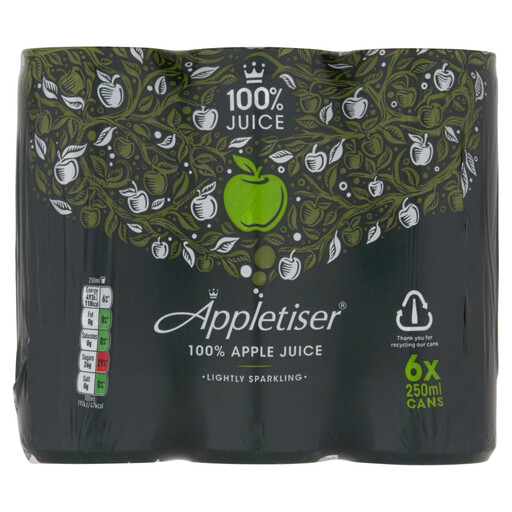 Image unavailable
Appletiser 100% Apple Juice Lightly Sparkling 6 x 250ml
For a school packed lunch, check whether cans and sparkling drinks are allowed before choosing this option.
The listed multipack contains six 250ml servings of lightly sparkling apple juice. Each serving is 100ml above the NHS’s guidance of no more than 150ml of fruit juice and smoothies a day, taken with a meal.
View on Joybuy
Questions about packed-lunch apple juice
Is a 200ml apple-juice carton a suitable regular lunch drink?
A 200ml carton is portable, but it contains 50ml more than the NHS’s advised daily maximum of 150ml of fruit juice and smoothies, taken with a meal. Check the individual serving rather than assuming that a lunchbox-sized carton fits that guidance.
Are 250ml bottles preferable to apple-juice cans?
The packaging alone does not settle the choice. Check the drink type, individual volume and school rules: the Tropicana multipack listed by Amazon.co.uk contains 250ml bottles, each 100ml above the NHS’s 150ml daily fruit-juice guidance.
Do England’s School Food Standards decide what goes in a packed lunch from home?
The Department for Education’s guidance describes requirements for food and drink provided in state-funded schools in England, not a universal list of drinks permitted in home-packed lunches. Check the individual school’s policy if you want to send cans or sparkling juice.
How can I tell whether an apple drink is 100% juice?
Check its full product description, ingredients and stated juice content rather than relying on “apple” in the name. Tropicana describes its Orchard Apple product as 100% pressed juice, not from concentrate; that description applies to the named product, not every apple drink.
Should apple juice be the everyday packed-lunch drink?
For a regular lunch, water avoids making a juice serving the daily default. If you pack fruit juice, the NHS advises limiting fruit juice and smoothies to a maximum of 150ml a day and having it with a meal.


