Families packing juice regularly
A 150ml individual carton gives you a defined serving. The NHS advises limiting fruit juice, vegetable juice and smoothies to a combined 150ml a day and having them at mealtimes.


For a regular school packed lunch containing apple juice, a 150ml carton makes it easier to follow NHS guidance to limit fruit juice, vegetable juice and smoothies to a combined 150ml a day and have them at mealtimes. If you prefer multipack cans, check the juice percentage, sugars per whole can and whether the school accepts cans and fizzy drinks: a 250ml can of 100% apple juice exceeds that daily amount on its own.
A 150ml individual carton gives you a defined serving. The NHS advises limiting fruit juice, vegetable juice and smoothies to a combined 150ml a day and having them at mealtimes.
Check whether a can contains 100% apple juice or a sparkling drink made partly with apple juice and water. Compare sugars per whole can as well as pack size.
Ask the individual school whether it accepts cans and fizzy drinks in home-packed lunches. Department for Education guidance on school food in England concerns food and drink provided in state-funded schools; it does not establish one packed-lunch container rule for every school.
Start with the serving you intend to pack, then compare the drink inside each container and check the school’s policy.
| Priority | What to check | Your needs |
|---|---|---|
| Serving size | Check millilitres per container and any other juice or smoothies planned that day. The NHS advises a combined daily limit of 150ml for fruit juice, vegetable juice and smoothies, consumed at mealtimes. | I want one lunchbox serving that is straightforward to account for. A 150ml carton matches that NHS amount; a 250ml can of 100% juice exceeds it. |
| Juice content | Read the ingredients and apple-juice percentage. ASDA’s 150ml cartons contain apple juice from concentrate; Appletiser’s 250ml cans list 100% carbonated apple juice from concentrate, while Cawston Press Cloudy Apple cans list 49% pressed apple juice. | If I choose a can, I want to know whether it is apple juice or a sparkling drink made partly with apple juice and water. |
| Sugars per container | Compare the sugars figure for the whole carton or can, not just per 100ml. ASDA Groceries lists 17g per 150ml carton; its Appletiser listing gives 26g per 250ml can. | When packs have different serving sizes, I need figures that describe what will actually go into the lunchbox. |
| School acceptance | Check the school’s current packed-lunch policy for cans and fizzy drinks. Department for Education guidance for food provided in state-funded schools in England does not settle what an individual school accepts from home. | I would check the school’s rules before buying a multipack of sparkling cans. |
A sparkling apple drink can contain both juice and water. Cawston Press Cloudy Apple lists 49% pressed apple juice, whereas Appletiser lists 100% carbonated apple juice from concentrate.
Read the juice percentage and ingredients, then compare sugars per whole can. “No added sugar” does not mean a drink contains no sugars.
One 250ml can of 100% apple juice is larger than the NHS’s advised combined daily 150ml amount for fruit juice, vegetable juice and smoothies.
For a regular packed-lunch juice, consider an individual 150ml carton and account for other juice or smoothies consumed that day.
Department for Education guidance covers food and drink provided in state-funded schools in England. It does not establish a universal rule for home-packed cans.
Check the individual school’s packed-lunch policy for containers and fizzy drinks before choosing a canned multipack.
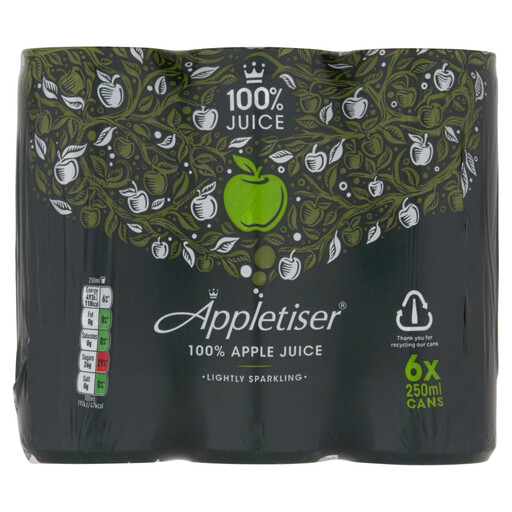
Its sparkling apple juice is listed by ASDA Groceries as a 6 × 250ml can multipack made from 100% carbonated apple juice from concentrate.
Sainsbury’s lists Cloudy Apple as a 4 × 250ml sparkling can multipack containing 49% pressed apple juice and sparkling water.
ASDA Groceries lists an own-label 3 × 150ml apple juice from concentrate multipack.
Sainsbury’s lists a 1.8L Orchard Apple Juice pack containing twelve 150ml servings.
This canned option is relevant if you want a multipack of 100% sparkling apple juice. For a school packed lunch, consider its 250ml serving alongside NHS juice guidance and the school’s rules on cans and fizzy drinks.
 No image available
This multipack suits a preference for sparkling apple juice in cans, provided the school accepts the format.
The drink is listed as 100% carbonated apple juice from concentrate, with 26g sugars per 250ml can.
One can exceeds the NHS’s advised combined daily 150ml amount for fruit juice, vegetable juice and smoothies.
A 250ml can exceeds the NHS’s advised combined daily 150ml amount for fruit juice, vegetable juice and smoothies. If you are packing juice regularly, a 150ml carton makes that amount easier to follow; the NHS also advises having juice at mealtimes.
No. Sainsbury’s lists Cawston Press Cloudy Apple as a sparkling drink with 49% pressed apple juice and water, while ASDA Groceries lists Appletiser as 100% carbonated apple juice from concentrate. Check the ingredients and sugars per container; “no added sugar” does not mean sugar-free.
No universal home-packed-lunch can rule follows from the cited Department for Education guidance. It concerns food and drink provided in state-funded schools in England, so check the individual school’s policy on cans and fizzy drinks brought from home.
A sealed 150ml carton provides a defined individual serving. ASDA Groceries lists its apple juice as 3 × 150ml cartons, while Sainsbury’s lists twelve 150ml servings in Tropicana’s 1.8L bottle; serving from the bottle requires measuring and a separate suitable lunchbox container.