Parents hosting primary-school-age children
If you are planning juice alongside party food, use the NHS 150ml daily maximum for fruit juice and smoothies when deciding how much to pour. A larger can need not become one child’s serving.


For a children’s party, decide how much juice to serve before choosing a multipack: NHS guidance limits fruit juice and smoothies to 150ml in total per day, while the can examples discussed here hold 250ml or 330ml each. If you want to hand out drinks without pouring, look for a pack that fits your serving plan; with larger cans, arrange cups and measured portions, and check whether you are buying 100% juice or a sparkling juice drink.
The right format depends on whether children will take a whole pack or an adult will pour drinks into cups.
If you are planning juice alongside party food, use the NHS 150ml daily maximum for fruit juice and smoothies when deciding how much to pour. A larger can need not become one child’s serving.
Individual packs are straightforward to hand out, but check their volume. The British Nutrition Foundation describes 150–200ml as a smaller glass for younger children; its glass-size range does not change the NHS 150ml daily juice guidance.
Check both the can size and the drink description. The M&S apple-and-elderflower example listed by Ocado contains 59% apple juice from concentrate in a carbonated 330ml drink, rather than being plain 100% apple juice.
Work out the portion and how it will be served, then compare the drink type and the handling instructions on the exact pack.
| Priority | What to check | Your needs |
|---|---|---|
| Juice portion | Check the volume per can or pack, not just the multipack total. NHS guidance limits fruit juice and smoothies to 150ml in total per day; a 250ml juice can is larger than that amount. | I want each child’s juice portion to be clear, rather than assuming one can equals one serving. |
| Serving method | Decide whether drinks will be handed out unopened or poured into cups. For larger units, have cups and someone available to pour the intended portions. | Handouts would make serving quicker, but I can use cups if the available packs are larger than the juice portion I plan to offer. |
| Drink type | Read the product description and ingredients to distinguish 100% apple juice from an apple-based juice drink. Check whether it is still or carbonated, and compare sugars for the amount you intend to serve. | I want to know what is in the drink, rather than treating “no added sugar” as meaning sugar-free or assuming every apple drink is 100% juice. |
| Other drinks | Plan what children can drink throughout the party as well as at the food table. The British Nutrition Foundation says most drinks for children aged 5–11 should be water or milk. | Water needs to be easy to reach even if I also offer apple juice with food. |
| Pack handling | Confirm the container format, storage directions and instructions for opened drinks on the exact product label. Consider how much fridge space and how many cups you will need. | I need a pack I can store and serve as planned, without buying cans when I expected cartons—or the other way round. |
A retailer listing for Tropicana shows 250ml apple-juice cans. Drinking a whole 250ml can would exceed the NHS 150ml daily maximum for fruit juice and smoothies.
Count the juice portions you intend to offer, then decide whether to buy smaller packs or pour from larger ones.
The M&S multipack listed by Ocado is a carbonated drink containing 59% apple juice from concentrate. Its 330ml can is different in both volume and composition from a serving of 100% still apple juice.
Check the ingredients, drink description and sugars for the portion you will serve, rather than relying on the front-of-pack name.
Children may want a drink throughout the party, not only when food is served. The British Nutrition Foundation advises that most drinks for children aged 5–11 should be water or milk.
Keep water readily available and decide separately whether to offer a measured apple drink with food.
Apple drinks come in different container types and unit sizes. A multipack description alone may not tell you how the drinks will need to be stored or served.
Before ordering, check the container format, volume per unit, ingredients and storage instructions on the exact product listing and label.
These examples show different ways to serve an apple drink; a brand name alone does not establish the size or type of every product in its range.
An Ocado listing describes Tropicana Pressed Apple Fruit Juice as 100% pressed and not from concentrate, with 150ml servings. An Amazon UK search listing also identifies a Tropicana Apple Juice 12 × 250ml multipack.
Ocado describes Copella Cloudy Apple Fruit Juice as not from concentrate and lists nine 150ml servings. Its separate 300ml Apple Juice bottle is listed as two servings.
Tesco Groceries search results include a 200ml apple juice from concentrate and a Growers Harvest 6 × 200ml pack.
Ocado lists M&S Juicy Apple & Elderflower with Sparkling Spring Water as four 330ml cans. Its ingredient description identifies a carbonated drink containing 59% apple juice from concentrate.
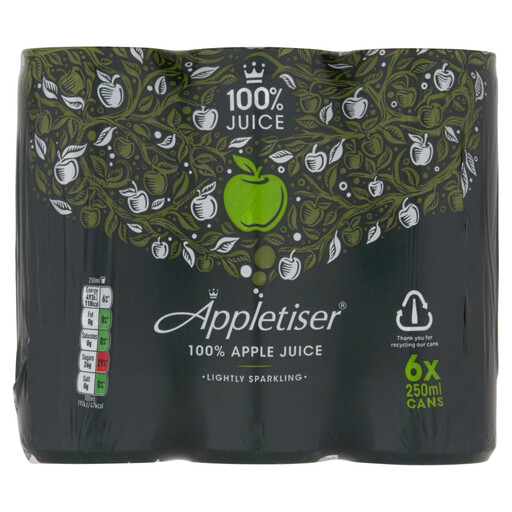
This sparkling apple-juice multipack is relevant if you plan to pour portions at the party rather than treat each 250ml unit as one child’s juice serving.
 No image available
For a children’s party, plan to pour or share the 250ml units: a whole unit exceeds the NHS 150ml daily maximum for fruit juice and smoothies. The product name identifies a six-pack of lightly sparkling 100% apple juice. Confirm the container format and storage instructions on the product listing before ordering.
Not if you are following the NHS guidance of no more than 150ml of fruit juice and smoothies in total per day. A 250ml can contains 100ml more than that amount, so plan to pour or share it rather than automatically handing out one full can per child.
No. “No added sugar” does not mean a drink contains no sugars. Read the nutrition panel for the amount in the portion you will offer, and check the ingredients to see whether the product is 100% juice or a juice drink.
Keep water available throughout. The British Nutrition Foundation says most drinks for children aged 5–11 should be water or milk; if you also offer juice, the NHS advises a maximum of 150ml of fruit juice and smoothies in total per day.
Follow the storage and use-after-opening instructions on that exact pack. If you plan to pour from a larger bottle or carton, check those instructions before buying so the remaining drink fits your plans after the party.