Parents packing school-day drinks
If no added sugar matters for a lunchbox, check what the claim says alongside the portion size. The NHS counts sugars in unsweetened fruit juice as free sugars and advises having juice with a meal.


For a school-day drink, choose 100% apple juice if you want full fruit juice, or check the juice content if you prefer a no-added-sugar juice drink. In either case, read the ingredients and sugars per serving: no added sugar does not mean sugar-free. The NHS advises limiting fruit juice and smoothies to a combined 150ml a day and having juice with a meal.
If no added sugar matters for a lunchbox, check what the claim says alongside the portion size. The NHS counts sugars in unsweetened fruit juice as free sugars and advises having juice with a meal.
If you prefer 100% apple juice, measure the serving rather than judging it by the carton size. The NHS advises a combined limit of 150ml a day for fruit juice and smoothies.
Check whether each pack is apple juice or a juice drink, then compare its ingredients, sugars per 100ml, serving size and instructions for storage after opening. A pressed or cloudy description does not replace those checks.
Start with the type of drink, then check the sugar information and whether the pack suits the school-day serving you have in mind.
| Priority | What to check | Your needs |
|---|---|---|
| No-added-sugar claim | Read the exact claim and ingredient list. Compare “of which sugars” per 100ml and for the amount you plan to serve; the claim does not mean sugar-free. | I want to avoid added sweetening ingredients without overlooking the sugars already present in juice. The NHS counts sugars in unsweetened fruit juice as free sugars. |
| Daily portion | Check the carton volume against a measured serving. The NHS advises a combined maximum of 150ml a day for fruit juice and smoothies and recommends having juice at mealtimes. | A school drink needs to fit alongside anything served at breakfast or later that day, rather than becoming an additional full carton of juice. |
| Juice or juice drink | Read the product designation, juice content and ingredients. A no-added-sugar apple juice drink is not automatically 100% apple juice. | If I am looking for full fruit juice, I need to distinguish it from a juice drink before comparing the packs. |
| Pack and storage | Match the pack volume to planned servings and follow its instructions after opening. For example, Marks & Spencer says its Cloudy Apple Juice must be refrigerated after opening and drunk within 24 hours. | A smaller pack may suit occasional use better if a large carton would remain open longer than its label allows. |
The claim concerns added sweetening ingredients, not the total sugars in the drink. The NHS counts sugars in unsweetened fruit juice as free sugars.
Read both the ingredients and “of which sugars” on the nutrition panel, using your planned serving size for the comparison.
Apple juice and apple juice drinks have different product designations. A no-added-sugar claim alone does not tell you how much fruit juice a drink contains.
Check the designation and juice content on the pack, followed by the ingredients and nutrition panel.
The NHS advises limiting fruit juice and smoothies to a combined 150ml a day. A multi-serve carton also has its own storage instructions once opened.
Measure the amount you intend to serve and choose a pack the household can use within its stated opened-storage period.
A carton that cannot be finished within that period may leave juice unused.
A range listing may not give the claim, ingredients or storage instructions for the exact carton you receive.
Before using a product for a no-added-sugar school drink, read the current pack’s wording, nutrition panel and storage instructions.
These examples show why the exact product label matters more than a brand or retailer name when choosing a no-added-sugar drink.
Tropicana describes its Orchard Apple product as pressed apple juice, not from concentrate.
Tesco lists Copella Apple Juice, including a 1.35L carton.
Tesco’s listings include pressed apple juice and, separately, a Growers Harvest No Added Sugar Apple Juice Drink.
Marks & Spencer lists apple-juice options, including Cloudy Apple Juice.
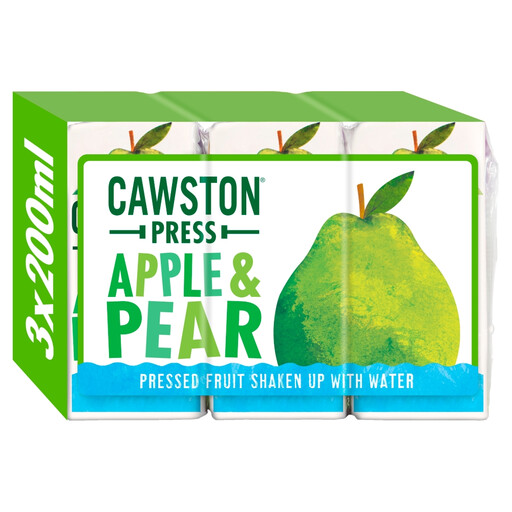
These options are a mixed apple-and-pear fruit water and a lightly sparkling 100% apple juice. Check the exact pack if no-added-sugar wording is essential to your choice.
 No image available
Three individual 200ml cartons offer a packable mixed-fruit drink, rather than 100% apple juice. For a no-added-sugar school drink, check the carton’s claim, ingredients and sugars per serving; the NHS’s 150ml daily guidance specifically concerns juice and smoothies.
 No image available
This lightly sparkling 100% apple juice comes in six 250ml cans. A full can exceeds the NHS’s combined 150ml daily guidance for juice and smoothies, so plan the amount served rather than treating the can as one recommended portion. Check the current pack if you require an explicit no-added-sugar claim.
No. No added sugar concerns added sweetening ingredients, while apple juice contains naturally occurring sugars. The NHS counts sugars in unsweetened fruit juice as free sugars, so check “of which sugars” for the amount you plan to serve.
The NHS advises limiting fruit juice and smoothies to a combined 150ml a day; that amount counts as one 5 A Day portion. If you serve juice, account for any other juice or smoothie that day and offer it with a meal.
If you pack juice, plan it as the day’s measured juice serving with lunch rather than an all-day drink. The NHS advises a combined 150ml daily limit for juice and smoothies; also check your school’s packed-lunch policy.
Follow the instructions on the exact carton. Marks & Spencer, for example, says its Cloudy Apple Juice should be refrigerated after opening and drunk within 24 hours; do not assume another product has the same opened-storage period.