Hosts serving guests who want pure apple juice
Look for a 100% apple juice description, then choose a pack you can store and serve in planned portions. No added sugar does not remove the sugars naturally present in juice.


Choose 100% apple juice if guests specifically want juice, and plan measured servings rather than treating a large bottle as an all-evening drink. A no-added-sugar squash or ready-to-drink alternative may be more convenient for repeated drinks, but it is not necessarily pure juice: compare the ingredients and sugars in a prepared serving. The NHS advises limiting fruit juice, vegetable juice and smoothies to a combined 150ml a day.
Start with whether the group wants apple juice itself or an apple-flavoured alternative; the pack size matters only after that choice.
Look for a 100% apple juice description, then choose a pack you can store and serve in planned portions. No added sugar does not remove the sugars naturally present in juice.
A squash or ready-to-drink fruit drink may suit a longer session if guests do not require pure juice. Compare sugars for the drink as served, and read the ingredients for sweeteners and declared allergens.
Do not plan multiple glasses of pure juice per person on the strength of a large pack. The NHS advises a combined daily limit of 150ml for fruit juice, vegetable juice and smoothies; check the exact drink and pack for any age-related instructions.
Decide on pure juice or a prepared alternative first. Then compare the serving information, ingredients and storage instructions for the exact pack.
| Priority | What to check | Your needs |
|---|---|---|
| Drink type | Check whether the label says 100% apple juice or describes a squash or fruit drink. For a squash, read the fruit-juice percentage and preparation directions. | Do I want to serve apple juice itself, or would a diluted or ready-to-drink alternative work for the group? |
| Sugars and servings | Read sugars per stated serving, using the prepared serving for squash. No added sugar does not mean sugar-free: UK oral-health guidance counts sugars naturally present in fruit juice as free sugars. The NHS advises a combined 150ml daily limit for fruit juice, vegetable juice and smoothies. | I want to plan drinks for the evening without assuming that a no-added-sugar claim makes repeated glasses of juice equivalent to water. |
| Ingredients | Read the complete ingredient and allergen declarations on the exact pack. In particular, check a squash or fruit drink for sweeteners rather than assuming it has the same ingredients as pure juice. | Will anyone drinking it need to avoid a declared ingredient, or prefer a drink without sweeteners? |
| Pack and storage | Compare the pack volume with the servings you plan to pour. Check storage before opening, refrigeration after opening and the stated period for using leftovers. | A pack should cover the gathering, but I also need somewhere to keep it and a plan for anything left over. |
Pure apple juice still contains naturally occurring sugars. UK oral-health guidance classifies the sugars naturally present in fruit juice as free sugars.
Compare sugars for the stated serving and decide separately whether guests want pure juice or another kind of drink.
Sainsbury's describes its No Added Sugar Apple High Juice Squash as a concentrated drink containing 50% fruit juice and sweetener. Its prepared glass is not the same product type as a glass of 100% apple juice.
Choose the drink type first. If comparing nutrition, use the label's prepared-serving information and keep the serving sizes in view.
A no-added-sugar description does not tell you which sweeteners or other ingredients a particular drink contains.
Check the current pack's full ingredients and allergen declaration before serving it to a mixed group.
Storage instructions can differ between drinks. The innocent Pure Apple Juice 900ml listing, for example, specifies refrigeration at 0–8°C and use within four days of opening.
Check the instructions on the bottle you buy, along with available fridge space and when the remaining drink would be used.
An opened bottle that cannot be stored or used as directed may have to be discarded.
These examples illustrate drink types and pack choices; the description of one product should not be assumed to apply across a brand's range.
Tropicana describes its Long Life Orchard Apple product as 100% pressed, not-from-concentrate apple juice.
Tesco's apple-juice listing includes Copella products in 300ml and 1.35L formats.
Tesco's apple-juice category lists an own-label Apple Juice 1.75 Litre alongside branded products.
Sainsbury's describes its No Added Sugar Apple High Juice Squash as a concentrated drink containing 50% fruit juice and sweetener, rather than 100% apple juice.
M&S lists cloudy and single-variety options within its apple-juice range.
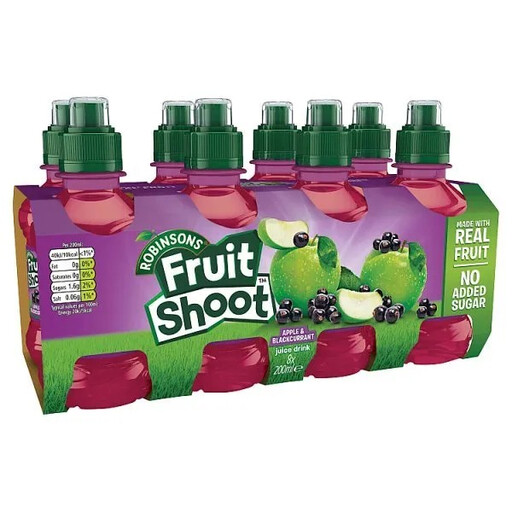
This ready-to-drink, no-added-sugar apple-and-blackcurrant option is for a host considering an alternative to pure apple juice.
 No image available
The eight 200ml bottles offer individual drinks for a group, but this apple-and-blackcurrant drink is not 100% apple juice.
Check the current pack's ingredients and age-related instructions before serving.
No. Pure apple juice can contain sugars naturally present in the fruit even when none is added. UK oral-health guidance counts sugars naturally present in fruit juice as free sugars, so read the sugars figure for the serving you intend to pour.
Use the NHS advice of a combined 150ml daily limit for fruit juice, vegetable juice and smoothies when planning juice portions, rather than treating a large bottle as a cue for repeated glasses. Other drinks can cover the rest of a long session.
No. Sainsbury's No Added Sugar Apple High Juice Squash, for example, is described as a concentrate containing 50% fruit juice and sweetener. Follow its preparation directions and compare the prepared drink's nutrition and ingredients with those of any pure juice you are considering.
Follow that bottle's refrigeration and use-after-opening instructions. For example, the innocent Pure Apple Juice 900ml listing specifies storage at 0–8°C and use within four days after opening; do not assume another juice has the same instructions.