Choose 100% apple juice if you want juice made entirely from fruit; choose a no-added-sugar juice drink if its lower listed sugar content matters more than 100% juice composition. For example, Tesco lists 3.1g sugars per 150ml for its drink, which contains 20% apple juice and sucralose, so “no added sugar” does not mean zero sugar. For a UK breakfast, the NHS advises limiting fruit juice, vegetable juice and smoothies to 150ml combined per day.
Who is this choice for?
Breakfast drinkers choosing between juice and a juice drink
A 100% apple juice suits a preference for juice made entirely from fruit. A no-added-sugar juice drink is a different option when the sugars listed on the label are the deciding factor; check its juice percentage and ingredients too.
Households comparing sugar labels
Compare sugars for the same serving size rather than assuming “100% juice” or “no added sugar” tells you how much sugar is in the glass.
Shoppers who prefer pressed or cloudy juice
Pressed, cloudy and not-from-concentrate describe the style of juice. Check the nutrition panel separately: Copella lists 15g sugars per 150ml for its Cloudy Apple juice.
What should you check?
Start with the ingredient list and sugars for a comparable serving, then consider the portion and juice style you want at breakfast.
| Priority | What to check | Your needs |
|---|
| Sugars and ingredients |
Compare sugars per 150ml and read the juice percentage and sweetener ingredients. Tesco lists 3.1g sugars per 150ml for its no-added-sugar drink, made with 20% apple juice and sucralose; Sainsbury's lists 13.0g per 150ml for its 100% pressed juice. |
I want to know whether I am choosing 100% juice or a juice drink with a different ingredient mix, not just whether the front label says “no added sugar”. |
| Portion size |
Check the amount you plan to pour and count other juices or smoothies that day. The NHS advises a combined daily limit of 150ml for fruit juice, vegetable juice and smoothies; 150ml counts once towards 5 A Day. |
A small glass with breakfast suits me better than pouring without checking the serving size. |
| Juice style |
Look for “100%”, “from concentrate”, “not from concentrate” or “cloudy” according to the style you want. Compare sugars on the same measurement basis rather than treating a processing term as a sugar claim. |
If I prefer pressed or cloudy apple juice, I still want to check its sugar label and storage instructions before choosing a carton. |
Common label mix-ups
-
Assuming 100% juice has no sugar
The 100% apple juices listed by Tropicana, Copella and Sainsbury's contain 13.0g to 15g sugars per 150ml. “100%” describes the juice composition, not a zero-sugar drink.
Choose 100% juice for that composition, then check the sugars for your serving. The NHS advises no more than 150ml of juices and smoothies combined per day.
-
Reading “no added sugar” as “100% juice”
Tesco's No Added Sugar Apple Juice Drink lists 3.1g sugars per 150ml, but its ingredients include water, 20% apple juice from concentrate and sucralose.
Check both the nutrition panel and juice percentage to decide which distinction matters for your breakfast.
-
Using “pressed” or “cloudy” as a sugar shortcut
Processing and appearance do not establish the sugar content of a particular juice. Sainsbury's lists 13.0g sugars per 150ml for its 100% pressed juice, while Copella lists 15g per 150ml for Cloudy Apple.
Choose the style you prefer, but compare sugars using the same serving size.
Brand and retailer examples
These named products illustrate different juice labels; their details do not apply to every drink sold by the brand or retailer.
Tropicana
Orchard Apple is a 100% pressed, not-from-concentrate apple juice.
- Tropicana describes Orchard Apple as 100% pressed apple juice.
- Its product information lists 15g sugars per 150ml; it is not a zero-sugar choice.
Copella
Cloudy Apple is a pressed apple juice for shoppers who prefer a cloudy style.
- Copella lists pressed apple juice in the ingredients.
- Its nutrition information lists 15g sugars per 150ml.
Tesco
Its No Added Sugar Apple Juice Drink illustrates the difference between a lower-sugar juice drink and 100% juice.
- The listed drink contains 3.1g sugars per 150ml.
- It contains 20% apple juice from concentrate and sucralose, rather than being 100% juice.
Sainsbury's
Its Pure Apple Juice and 100% Pressed Apple Juice illustrate from-concentrate and not-from-concentrate options.
- Both listed products are 100% apple juice; the pressed product is labelled not from concentrate.
- Sainsbury's lists 13.8g sugars per 150ml for Pure Apple Juice and 13.0g for its 100% Pressed Apple Juice.
M&S
Its cloudy apple juice listings provide examples for shoppers comparing this juice style.
- Marks & Spencer lists pressed and cloudy apple juice products.
- The two product listings give sugars as 10.6g and 10.2g per 100g respectively; check the exact pack rather than treating “cloudy” as a sugar claim.
Apple juice on Joybuy
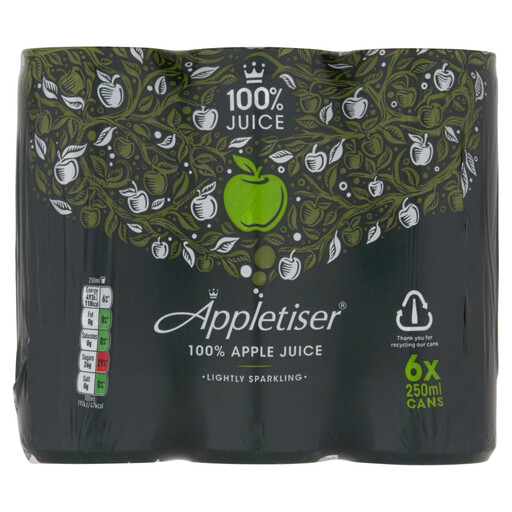
The option here is a lightly sparkling 100% apple juice for a breakfast where that style appeals. Its 250ml pack size is worth considering alongside the NHS advice to limit juices and smoothies to 150ml combined per day.
 No image available
Appletiser 100% Apple Juice Lightly Sparkling, 6 × 250ml
A lightly sparkling option if you want 100% apple juice with breakfast. The pack contains six 250ml portions; check the nutrition panel for sugars and decide how much to serve.
View on Joybuy
Questions about apple juice
How much apple juice should I serve at breakfast?
The NHS advises limiting fruit juice, vegetable juice and smoothies to 150ml combined per day. A 150ml serving counts once towards 5 A Day; drinking more juice that day does not add another portion.
Does “no added sugar” mean zero sugar?
No. Tesco's No Added Sugar Apple Juice Drink lists 3.1g sugars per 150ml. It contains 20% apple juice from concentrate and sucralose, so check both the sugar figure and ingredients.
Does “not from concentrate” mean lower sugar?
Not necessarily. Sainsbury's lists 13.0g sugars per 150ml for its 100% pressed, not-from-concentrate juice and 13.8g for its 100% juice from concentrate; Tropicana and Copella each list 15g for their named products. Compare the exact products on the same serving basis.
How should I store apple juice after opening?
Follow the storage and use instructions on the individual pack. A carton suitable for cupboard storage before opening may need refrigeration afterwards, so check this when buying ahead for breakfast.


