Households comparing sugars per glass
A no-added-sugar apple juice drink may suit a family willing to choose a drink with less than 100% juice and an added sweetener. Check the sugars figure rather than assuming “no added sugar” means sugar-free.


Choose 100% apple juice if the household wants a drink made entirely from juice and can manage portions. If sugars per glass matter more, compare the nutrition and ingredients of no-added-sugar juice drinks: Tesco lists one with 4.6g sugars per 100ml, 50% apple juice and sucralose. For fruit juice, the NHS advises a maximum of 150ml a day, with a meal.
A no-added-sugar apple juice drink may suit a family willing to choose a drink with less than 100% juice and an added sweetener. Check the sugars figure rather than assuming “no added sugar” means sugar-free.
If a drink made entirely from juice is the priority, compare 100% products while planning serving sizes. The NHS advises limiting fruit juice and smoothies to 150ml a day and having them with a meal.
Bottles, individual cartons and multipacks serve different household routines. Check where the product must be kept, how soon to use it after opening and the volume in each individual pack.
Start with the choice between 100% juice and a juice drink, then compare serving sizes and storage instructions for the packs your household would use.
| Priority | What to check | Your needs |
|---|---|---|
| Sugars and ingredients | Compare sugars per 100ml at the same volume. Check the juice percentage and ingredient list for water, flavourings or sweeteners. Tesco lists 4.6g sugars per 100ml for its 50% apple-juice drink with sucralose; Tropicana lists 10g per 100ml for Orchard Apple 100% juice. | I want to know what changes when I choose a no-added-sugar drink instead of 100% juice. A lower sugars figure does not make the drink sugar-free. |
| Serving size | Compare the volume you would pour or drink with the pack’s per-serving figures. The NHS advises no more than 150ml of fruit juice and smoothies combined a day, with a meal; a 200ml juice carton is larger than that amount. | If family members take individual juice cartons, I need to check the carton volume rather than treating every carton as a 150ml serving. |
| Packs and storage | Check pack volume, storage before opening and the stated period for use after opening. Sainsbury’s lists a Copella 900ml chilled juice that should be used within four days of opening; Tesco says to refrigerate its 1L Grower’s Harvest drink after opening and use it within five days. | For a large shop, I need packs that fit the available storage space and that we can finish within their opened-life instructions. |
Tesco lists 4.6g sugars per 100ml in its Grower’s Harvest No Added Sugar Apple Juice Drink. It contains 50% apple juice from concentrate and sucralose.
Read the sugars line alongside the juice percentage and ingredients, especially if 100% juice or avoiding sweeteners matters to your household.
Being made entirely from juice does not remove its sugars. The NHS advises limiting fruit juice and smoothies to a maximum of 150ml a day and having them with a meal.
Plan juice as a measured serving rather than assuming that a large glass or a full carton matches that guidance.
A household may not finish a bottle within its stated period after opening. Sainsbury’s says its Copella 900ml chilled juice should be used within four days; Tesco specifies five days, refrigerated, for its 1L Grower’s Harvest drink.
Check the instructions on the exact pack and choose a size the household can use within them.
Tropicana Orchard Apple is a 100% pressed, not-from-concentrate juice option.
Copella Cloudy Apple is a pressed apple juice for households considering a shared chilled bottle.
Tesco lists apple juice alongside a Grower’s Harvest no-added-sugar apple juice drink.
Sainsbury’s Pure Apple Juice is listed in a six-pack of 200ml cartons made with 100% juice from concentrate.
M&S lists apple juice in formats including 200ml packs and a 1.75L pressed cloudy juice.
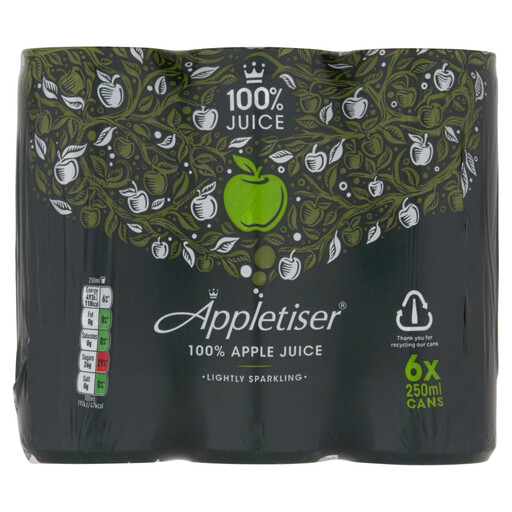
This option is a six-pack of lightly sparkling 100% apple juice for households considering individual packs, rather than a no-added-sugar juice drink.
 No image available
The six individual 250ml packs offer a way to stock up on lightly sparkling 100% apple juice. If drinking a pack as fruit juice, note that 250ml exceeds the NHS’s advised daily maximum of 150ml for fruit juice and smoothies.
No. Tesco lists 4.6g sugars per 100ml in its Grower’s Harvest No Added Sugar Apple Juice Drink. Its ingredients include 50% apple juice from concentrate and the sweetener sucralose, so check both the nutrition panel and ingredient list.
The NHS advises limiting fruit juice and smoothies combined to a maximum of one small glass, 150ml, a day and having it with a meal. That guidance also applies when the product is 100% apple juice.
No. A 200ml carton is 50ml larger than the NHS’s advised daily maximum for fruit juice and smoothies. Sainsbury’s lists 18.4g sugars in each 200ml carton of its Pure Apple Juice, so check figures per carton as well as per 100ml.
Check the product name, juice percentage, ingredients, sugars per 100ml, serving volume and storage instructions. An ingredient list also lets you check for sweeteners when comparing a no-added-sugar juice drink with 100% juice.
Choose a volume the household can use within the exact product’s storage instructions. Sainsbury’s says its Copella 900ml chilled juice should be used within four days of opening, while Tesco says to refrigerate its 1L Grower’s Harvest drink after opening and use it within five days.