Families packing a daily school lunch
If the drink goes in the lunchbox every day, decide whether juice is needed at all. The NHS counts sugars in unsweetened fruit juice as free sugars; water avoids those juice sugars.


Choose 100% apple juice when pure juice matters and you can pack a small serving to drink with lunch; its naturally occurring sugars still count as free sugars, according to the NHS. A no-added-sugar juice drink can have less sugar on its label, but check its fruit content and sweeteners. Water is the straightforward choice when the packed-lunch drink does not need to be juice.
If the drink goes in the lunchbox every day, decide whether juice is needed at all. The NHS counts sugars in unsweetened fruit juice as free sugars; water avoids those juice sugars.
If “diet”, “zero” or “no added sugar” catches your eye, check the sugars figure and ingredients. A juice drink with sweeteners is a different choice from 100% apple juice, even when both have no added sugar.
A measured serving makes more sense than treating a large carton as one lunch drink. NHS advice for young children uses about 150ml of fruit juice or smoothie a day, served with meals; that is a practical small-serving reference for planning a school lunch, not a rule specific to teenagers.
Start with the type of drink, then compare the sugars in the amount you plan to pack. Serving size and ingredients can change the decision even when two front labels sound similar.
| Priority | What to check | Your needs |
|---|---|---|
| Drink type and sugars | Read both the product description and sugars per 150ml. Sainsbury's lists 13.0g sugars per 150ml for its 100% Pressed Apple Juice and 3.9g for its No Added Sugar Apple & Pear Juice Drink. The NHS counts sugars in unsweetened juice as free sugars. | I want to know whether I am packing pure apple juice or a juice drink with a lower labelled sugar figure. “No added sugar” alone does not answer that. |
| Serving and timing | Measure the amount going into the lunchbox rather than using the carton size as a portion. NHS advice for young children uses about 150ml of juice or smoothie a day with meals; check other juice or smoothies the pupil has that day. | My child wants juice with lunch, but I do not want a large container to become a drink sipped throughout the school day. |
| Fruit and sweeteners | Check the fruit percentage, fruit blend and sweetener names. Tesco lists 20% apple juice and sucralose in its No Added Sugar Apple Juice Drink; Sainsbury's lists acesulfame K and sucralose in its No Added Sugar Apple & Pear Juice Drink. | Lower labelled sugar matters to me, but I also want to decide whether a mixed-fruit drink and its sweeteners suit our preferences. |
| Lunchbox fit | Check the individual container size, any storage instructions and the school's packed-lunch policy, particularly before choosing a fizzy drink. | I need a drink that can be packed in a suitable amount and meets the school's rules. |
Unsweetened apple juice still contains sugars that the NHS counts as free sugars. A no-added-sugar juice drink can also contain fruit sugars.
Compare the sugars figure for the same serving amount, then read the ingredients for fruit content and sweeteners.
A 1L or 1.5L carton is not a single packed-lunch serving. The amount poured and when it is drunk matter more than the carton's size.
Measure a small portion into a suitable bottle if choosing juice. NHS advice for young children uses about 150ml with meals as its daily juice-and-smoothie reference.
A lower sugars figure may come with water, less fruit juice and sweeteners. Tesco's No Added Sugar Apple Juice Drink, for example, lists 20% apple juice and sucralose.
If apple-only juice matters, check for an ingredients list that supports it. If the sugars figure matters more, check the exact fruit blend and sweeteners before choosing.
The pack is the place to check the drink you are about to use, including its serving information and storage directions.
Read its nutrition panel, ingredients, allergen information and storage instructions when preparing the lunch.
These named products illustrate the difference between pure juice and juice drinks; a brand name alone does not tell you the sugars in a particular pack.
Tesco describes Tropicana Pressed Apple Fruit Juice as 100% pressed juice, not from concentrate.
Tesco lists Copella Cloudy Apple Juice as not from concentrate.
Tesco No Added Sugar Apple Juice Drink illustrates the sweetened juice-drink route, not the 100% juice route.
Two Sainsbury's products show why the exact product matters: 100% Pressed Apple Juice and No Added Sugar Apple & Pear Juice Drink.
M&S lists both Apple Juice and Cloudy Apple Juice for shoppers comparing juice labels.
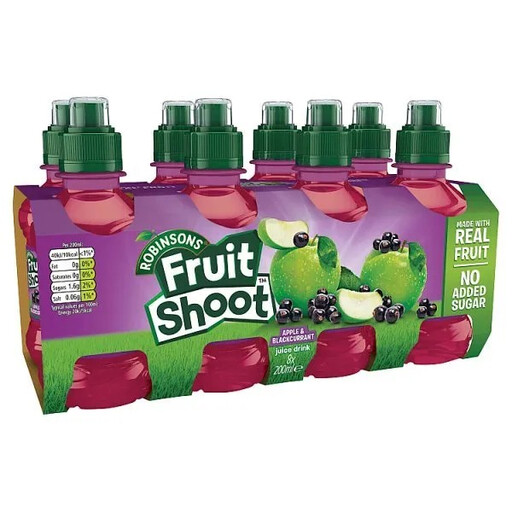
These options cover a no-added-sugar apple-and-blackcurrant drink and a sugar-free apple-flavoured fizzy drink. Neither should be treated as a 100% apple-juice option; check its label and container size against the lunch you plan to pack.
 No image available
The eight individual 200ml bottles offer a ready-to-pack apple-and-blackcurrant drink. “No added sugar” does not mean sugar-free: check the pack's sugars figure and sweeteners, and decide whether a 200ml bottle is the portion you want for lunch.
No image available
This is an apple-flavoured fizzy drink in eight 330ml cans, rather than a serving of pure apple juice. Check the ingredients, whether that can size suits the planned lunch and whether the school permits fizzy drinks in packed lunches.
No. The NHS counts naturally occurring sugars in unsweetened fruit juice as free sugars. A no-added-sugar juice drink can also contain some fruit sugars and may contain sweeteners, so read both the sugars figure and ingredients list.
A measured serving of about 150ml with lunch is a practical way to avoid sending a large carton or bottle. NHS guidance for young children uses about 150ml of fruit juice or smoothie a day, served with meals; it is not a secondary-school-specific rule. Take account of any juice or smoothies the pupil has at other meals.
Choose 100% apple juice if pure juice is the priority and you can measure a small lunch serving. If the labelled sugars figure matters more, compare juice drinks while checking their fruit content and sweeteners. For example, Sainsbury's lists 13.0g sugars per 150ml for its 100% Pressed Apple Juice and 3.9g per 150ml for its No Added Sugar Apple & Pear Juice Drink; they are different types of drink.
The Department for Education describes its school food requirements as applying to food and drink provided in state-funded schools in England, not as a single rule for every packed lunch brought from home. Check the individual school's packed-lunch policy, especially before packing a fizzy drink; arrangements elsewhere in the UK may differ.