What should you check before buying?
Start with carbohydrate per serving, then check what is in the drink and whether its nutrition figures describe juice, concentrate or a diluted serving.
| Priority |
What to check |
Your needs |
| Carbohydrate contribution |
Compare grams of carbohydrate per 100ml and per portion. Tropicana and Copella list 17g and 16g respectively per 150ml; Sainsbury's lists 14.1g per 150ml for its 1.75L juice. |
I want to know what a serving contributes alongside any other food or fuel, rather than treating every apple drink as interchangeable. |
| Juice and sweeteners |
Read the juice percentage and ingredient list. Tesco lists 50% apple juice and sucralose in its Grower's Harvest drink; the M&S Apple & Elderflower High Juice also contains 50% fruit juice and sucralose. |
If I am choosing a no-added-sugar drink, I still want to know whether I am buying 100% juice, a juice drink or a squash. |
| Serving and dilution |
Check the stated portion and the basis of the nutrition table. Sainsbury's lists 21g carbohydrate per 200ml carton; M&S lists 1.0g per 100ml after dilution at one part squash to four parts water. |
A fixed portion helps me count what I drink. With squash, I need to compare the prepared drink, not the undiluted concentrate. |
| Hydration and routine use |
Keep hydration separate from carbohydrate planning. The NHS identifies water as the best way to replace fluid lost through sweating and, for general dietary use, advises limiting fruit juice and smoothies to 150ml a day with a meal because they are high in sugar. |
After a sweaty run, I want a drink for fluid replacement; I would choose juice separately if I also want its carbohydrate contribution. General juice guidance is not an individual race-fuelling prescription. |
| Ingredients around a run |
Check sweeteners, allergens and whether a drink is still or sparkling. Ocado's M&S ingredient listing includes sulphites in its Apple & Elderflower High Juice. |
I want to avoid ingredients that are unsuitable for me and find out in training whether the drink itself suits me around exercise. |
Which brand products illustrate the differences?
These product examples show why the ingredient list and serving figures matter more to this decision than the brand name alone.
Tropicana
Tropicana Orchard Apple is a 100% pressed, not-from-concentrate juice with nutrition stated per 100ml and 150ml serving.
- Tropicana lists 11g carbohydrate per 100ml and 17g per 150ml.
- It also lists 10g sugars per 100ml; “100% juice” does not mean sugar-free or sufficient fuel for a whole run.
Copella
Copella Cloudy Apple is pressed apple juice with ascorbic acid listed as an antioxidant.
- Copella lists 11g carbohydrate per 100ml and 16g per 150ml.
- Its juice composition and nutrition do not make it a complete endurance-fuelling plan.
Sainsbury's
Two Sainsbury's 100% apple juices illustrate how bottle and carton portions change the amount you count.
- The not-from-concentrate 1.75L juice lists 9.4g carbohydrate per 100ml; a separate 200ml carton of juice from concentrate lists 21g per carton.
- These are different products and serving sizes. Check the nutrition of the one you actually choose.
Tesco / Grower's Harvest
Grower's Harvest No Added Sugar Apple Juice Drink is a juice drink, not 100% apple juice.
- Tesco lists 50% apple juice, water and sucralose, with 5.6g carbohydrate per 100ml.
- Its 8.4g carbohydrate per 150ml is less than the amounts listed for the 150ml portions of Tropicana and Copella above.
M&S
M&S No Added Sugar Apple & Elderflower High Juice is a squash intended for dilution, rather than a ready-to-drink 100% apple juice.
- Its listing specifies one part squash to four parts water and 1.0g carbohydrate per 100ml diluted.
- The listed ingredients include sucralose and sulphites; check suitability as well as the prepared-drink nutrition.
Joybuy apple juice option
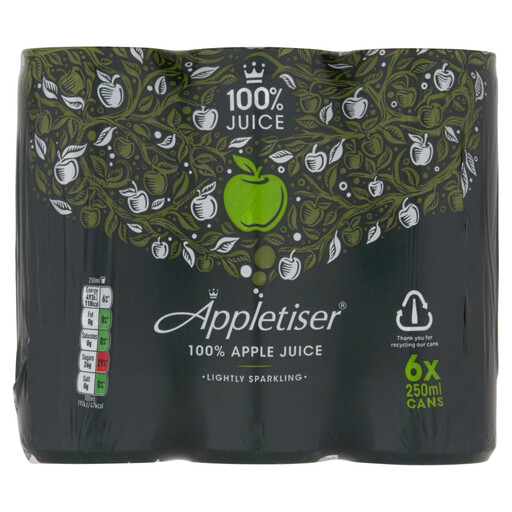
This 100% apple-juice option is relevant if you want to count an apple drink towards carbohydrate intake. It is lightly sparkling, so consider whether that format suits the occasion.
 No image available
Appletiser 100% Apple Juice Lightly Sparkling, 6 x 250ml
The six 250ml portions give you a defined serving size if you want to count apple juice alongside other fuel. Check the pack's carbohydrate figure per portion and any no-added-sugar wording if that wording matters to your choice; do not assume a sparkling drink will suit you around a run without trying it in training.
View on Joybuy
Common questions
Does “no added sugar” mean an apple drink will fuel a long run?
No. The wording does not tell you its carbohydrate content. Tesco lists 8.4g carbohydrate per 150ml for Grower's Harvest No Added Sugar Apple Juice Drink; the Tropicana, Copella and Sainsbury's 100% juices discussed here list 14.1–17g per 150ml. Compare both the ingredients and the serving figure.
Can apple juice provide all my carbohydrate during a marathon?
Do not assume that it can. A 2015 review published in Nederlands Tijdschrift voor Geneeskunde discusses 30–60g carbohydrate per hour for exercise lasting 1–2.5 hours, with a higher figure applying only under further duration, intensity and carbohydrate-mixture conditions. The 150ml portions of the 100% juices discussed here supply 14.1–17g, so count any juice within your wider, training-tested plan.
Should I choose water or apple juice after sweating?
Use water as the starting point for fluid replacement: the NHS identifies it as the best way to replace fluid lost through sweating. Choose a measured apple-juice serving separately if you also want to account for its carbohydrate.
Does general UK advice on fruit juice apply if it has no added sugar?
Yes. For general dietary use, the NHS advises limiting fruit juice and smoothies to one small glass of 150ml a day and having them with a meal because they are high in sugar. That public-health advice is not an individual marathon-race fuelling prescription.
What matters on an apple high-juice squash label?
Check the dilution direction, whether nutrition is stated for the prepared drink, and the ingredient list. M&S Apple & Elderflower High Juice directs one part squash to four parts water and lists 1.0g carbohydrate per 100ml diluted; its ingredients include sucralose and sulphites.


