First-home grocery shoppers
If this is your first shop for a new household, think about how quickly you will use an opened carton before choosing a large pack. Check its refrigeration and use-by-after-opening instructions.


For a first household shop, check the ingredients and sugars panel before choosing a pack you can use within its storage instructions: no added sugar does not mean sugar-free. Individual cartons may be easier to portion, while pressed, not-from-concentrate juice is a choice of production style, not a reason to assume it contains less sugar. The NHS advises limiting fruit juice, vegetable juice and smoothies to a combined 150ml a day.
If this is your first shop for a new household, think about how quickly you will use an opened carton before choosing a large pack. Check its refrigeration and use-by-after-opening instructions.
Read the ingredient list to distinguish apple juice from an apple-flavoured drink, and check the sugars line too. Juice can contain naturally occurring sugars even when no sugar is added.
A small carton can be convenient, but its contents may still exceed a daily serving. The NHS advises limiting fruit juice, vegetable juice and smoothies to a combined 150ml a day.
Start with what is in the juice, then consider serving size and whether the pack fits your household’s routine.
| Priority | What to check | Your needs |
|---|---|---|
| Ingredients and sugars | Check whether the ingredient list identifies apple juice or apple juice from concentrate. Read the sugars value per 100ml and the serving size; no added sugar does not mean sugar-free. | I want to know what is in the drink, rather than relying on a front-of-pack phrase. |
| Serving size | Compare the carton or can size with the NHS advice to limit fruit juice, vegetable juice and smoothies to a combined 150ml a day. A 200ml or 250ml container is larger than that amount. | Individual packs would be useful, but I do not want to mistake the whole container for the advised daily amount. |
| Pack and storage | Check the number and size of containers, whether the unopened product needs chilling, and its instructions after opening. The checked ASDA 4 × 1L juice says to refrigerate an opened carton and use it within five days. | For a small household, I would rather choose a pack I can finish than open more juice than we will use. |
| Production style | Look for “from concentrate” or “not from concentrate” on the exact product. Tesco describes its checked Tropicana 900ml juice as pressed and not from concentrate; the checked ASDA and Sainsbury’s products are from concentrate. | If production style matters to me, I can choose it deliberately without assuming it tells me the juice’s sugar content. |
Tesco lists 10g of sugars per 100ml for its checked Tropicana no-added-sugar juice. The NHS advises limiting fruit juice, vegetable juice and smoothies to a combined 150ml a day because juicing releases sugars that can damage teeth.
Read both the ingredients and the sugars value, and measure a serving rather than treating the label as permission to drink any amount.
The checked ASDA 4 × 1L juice must be refrigerated after opening and used within five days. A large pack is less practical if an opened carton will sit unused.
Check the exact pack’s instructions and consider smaller containers if your household uses juice slowly.
These examples show different pack formats and product descriptions; check the label of the exact juice you choose.
Tesco describes the checked Tropicana Pressed Apple Juice 900ml as 100% pressed and not from concentrate.
Tesco lists Copella apple juice in 900ml and 1.35L formats.
Tesco lists a 1.75L apple juice and a 1L 100% pressed apple juice in its own-brand range.
Sainsbury’s lists a six-pack of 200ml cartons made with 100% apple juice from concentrate.
ASDA lists a four-pack of 1L apple juice from concentrate.
M&S lists apple, cloudy apple and pressed apple juices, and its apple-juice category has a no-added-sugar filter.
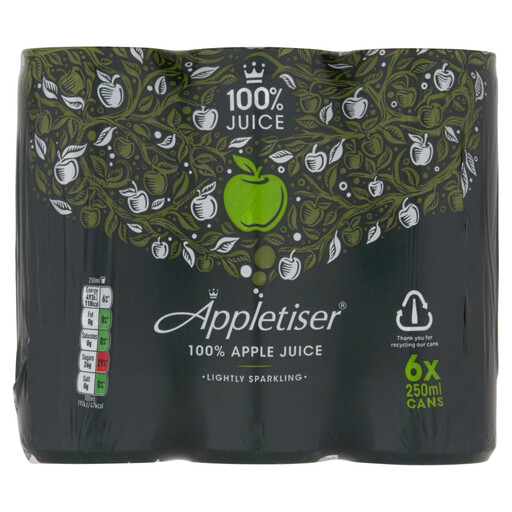
This lightly sparkling apple juice comes in a 6 × 250ml pack. It is an option to consider if separate containers suit your first household shop.
 No image available
The 6 × 250ml format offers separate containers for a household shop. Each 250ml container exceeds the NHS advised daily maximum of 150ml for fruit juice, vegetable juice and smoothies combined, so measure out a smaller serving. Check the pack’s ingredient list and wording if a specific no-added-sugar claim matters to you.
No. Apple juice can contain naturally occurring sugars without added sugar: Tesco lists 10g sugars per 100ml for its checked Tropicana juice, which it describes as having no sugar added. Read the ingredients and the “of which sugars” value on the exact product.
The NHS advises limiting fruit juice, vegetable juice and smoothies to a combined 150ml a day. That amount counts as one portion of 5 A Day; a larger pack size does not change the guidance.
No. A 200ml carton is larger than the NHS advised daily maximum of 150ml for fruit juice, vegetable juice and smoothies combined. Choose cartons for their format if it suits you, but measure the amount served.
NHS guidance says babies under 12 months do not need fruit juice or smoothies. If you choose to give juice to a baby, the NHS says to dilute one part juice with 10 parts water and limit it to mealtimes.