What should you check?
Start with the kind of drink you want, then compare sugar figures on the same per-100ml basis and plan how you will serve and store it.
| Priority |
What to check |
Your needs |
| Drink type and sugars |
Read the product description, ingredients and ‘of which sugars’ figure per 100ml. Sainsbury’s lists 8.7g per 100ml for its 100% pressed apple juice and 2.6g for its no-added-sugar apple-and-pear juice drink; these are different types of drink. |
I would accept a juice drink rather than pure apple juice if its lower labelled sugar figure is the deciding factor. If I want 100% apple juice, I need to account for the sugars in juice. |
| Serving size |
Compare the intended serving with the pack size. The NHS advises a maximum of one small glass of fruit juice or smoothie, 150ml a day, with a meal. |
A large bottle or a 250ml can is not automatically one juice portion for me; I want to know how much I plan to pour or drink. |
| Ingredients and preparation |
Check fruit percentage, declared sweeteners and whether the drink is ready to drink or concentrated. Sainsbury’s describes its no-added-sugar apple-and-pear product as a juice drink with sweeteners; Marks & Spencer Food describes its Apple and Elderflower High Juice as a concentrate made with 50% fruit juice. |
I may prefer the ingredients of pure juice, or I may be happy with a juice drink or squash. If choosing squash, I need to follow its dilution directions rather than compare the concentrate directly with ready-to-drink juice. |
| Journey storage |
Read the unopened and after-opening instructions for the exact product. Tesco Groceries says to refrigerate its 100% Pressed Apple Juice and consume it within five days of opening; its Copella Apple Juice listing says four days after opening and requires refrigeration. |
For a long car journey, I need a way to keep a chilled drink refrigerated and to store any unfinished drink as its label directs. |
Brand and product-line references
These examples show how the labels of particular apple drinks differ; a brand name alone does not tell you whether a drink is pure juice, a juice drink or squash.
Tropicana
Tropicana describes Orchard Apple as 100% pressed apple juice, not from concentrate.
- Relevant when the requirement is pure apple juice rather than a diluted juice drink.
- It is not a zero-sugar route: the NHS counts sugars in unsweetened fruit juice as free sugars.
Copella
Copella Apple Juice is a cloudy, not-from-concentrate apple-juice option.
- Tesco Groceries lists 10g sugars per 100ml for its 900ml Copella Apple Juice, giving a per-100ml figure to compare with other juices.
- The Tesco listing says to keep it refrigerated and consume it within four days of opening.
Tesco
Tesco 100% Pressed Apple Juice is a 1-litre, not-from-concentrate pure-juice option.
- Tesco Groceries lists 11.2g sugars per 100ml for this specific juice.
- Its product instructions require refrigeration and use within five days after opening.
Sainsbury’s
The specific Sainsbury’s products considered here offer a choice between 100% pressed apple juice and a no-added-sugar apple-and-pear juice drink.
- Sainsbury’s lists 8.7g sugars per 100ml for its 100% Pressed Apple Juice and 2.6g per 100ml for its Apple & Pear Juice Drink, No Added Sugar.
- The lower-sugar figure belongs to a juice drink with sweeteners, not to 100% apple juice.
M&S
Marks & Spencer Food describes Apple and Elderflower High Juice as a concentrated, no-added-sugar drink made with 50% fruit juice.
- A concentrate is an option for someone who wants to prepare an apple-flavoured drink rather than pack ready-to-drink juice.
- Follow its dilution and allergen information; the concentrate is not directly interchangeable with 100% ready-to-drink apple juice.
Joybuy apple drink options
These options cover two different choices for the journey: an apple-and-blackcurrant no-added-sugar drink in small bottles, and lightly sparkling 100% apple juice in cans. Compare their drink types and portions rather than treating them as substitutes on sugar content alone.
 No image available
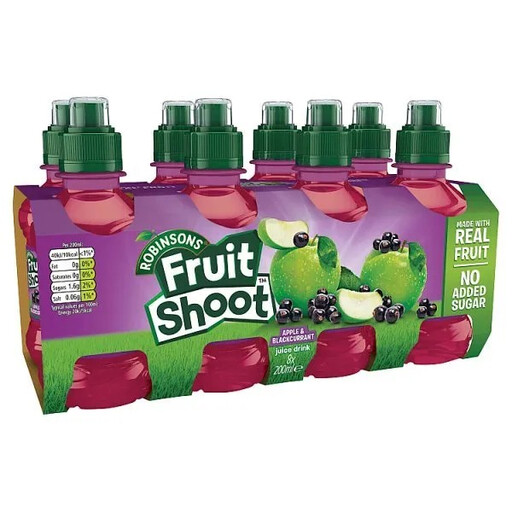
Fruit Shoot Black & Apple No Added Sugar, 8 × 200ml
The separate 200ml bottles offer an apple-containing drink to pack individually. This is a mixed apple-and-blackcurrant drink, not 100% apple juice or a sugar-free drink; check its per-100ml sugar figure and sweeteners on the pack. Follow the refrigeration instructions for any opened bottle.
View on Joybuy
 No image available
Appletiser 100% Apple Juice Lightly Sparkling, 6 × 250ml
This is a canned pure-juice choice rather than a lower-sugar juice drink. Each can contains 250ml, so a whole can exceeds the NHS-advised maximum daily 150ml serving of fruit juice or smoothie; plan a smaller serving with a meal if following that guidance.
View on Joybuy
Questions about apple drinks on the road
Does ‘no added sugar’ mean an apple drink is sugar-free?
No. Sainsbury’s lists 2.6g sugars per 100ml for its Apple & Pear Juice Drink, No Added Sugar. Check the nutrition panel for sugars and the ingredients for fruit content and sweeteners; the front-of-pack wording does not establish that the drink contains zero sugar.
Is 100% apple juice a zero-sugar choice?
No. Sainsbury’s lists 8.7g sugars per 100ml for its 100% Pressed Apple Juice, while Tesco Groceries lists 11.2g per 100ml for its 100% Pressed Apple Juice. The NHS counts sugars naturally present in unsweetened fruit juice as free sugars.
How much apple juice should I plan for one person?
The NHS advises limiting fruit juice and smoothies to a maximum of 150ml a day, with a meal. If you take a larger bottle or can, plan the serving rather than assuming the whole container is one portion; pack water separately for the journey.
Will an apple drink need a cool bag in the car?
Check the instructions for the exact drink. Tesco Groceries says its 100% Pressed Apple Juice must be refrigerated and consumed within five days of opening; its Copella Apple Juice listing also requires refrigeration and says to consume it within four days of opening. If the product requires chilled storage, plan how to maintain it during the journey.
Is a no-added-sugar apple drink automatically suitable for children?
No: ‘no added sugar’ does not settle the question of ingredients, preparation or age guidance. The NHS identifies water and milk as children’s everyday drinks. For a particular juice drink or squash, read the pack’s age, dilution, sweetener and allergen information before serving it.


