What should you check before buying?
Start with the amount you intend to drink, then decide whether carbonation and the stated juice ingredients match what you want.
| Priority |
What to check |
Your needs |
| Portion size |
Read the bottle volume and plan the amount you will pour. The NHS advises limiting fruit juice and smoothies to a combined 150ml a day; a 250ml, 270ml or 275ml bottle exceeds that amount if drunk in full. |
I want juice with a snack without assuming the whole bottle is one daily portion. |
| Still or sparkling |
Check whether the label describes still juice or a carbonated drink. Biddenden Vineyards and Appletiser describe sparkling products; Folkington's and Luscombe describe still apple juices. |
Before activity, I would rather choose the format I know I want than buy a fizzy drink by mistake. |
| Ingredients |
Read the ingredient and processing statements separately. Folkington's is described by Nisbets as not from concentrate; Bestway Wholesale lists Appletiser as carbonated apple juice from concentrate. |
If pressed or not-from-concentrate juice matters to me, I want to check that wording on the particular product. |
| Carbohydrate and sugars |
Compare nutrition values using the amount you expect to drink, noting whether figures are per 100ml or per bottle. Bestway Wholesale lists 30.3g carbohydrate and 28.9g sugars per 275ml Appletiser bottle. |
I want to know what is in my intended serving rather than relying on phrases such as ‘100% juice’ or ‘no added sugar’. |
| Packaging and pack size |
Confirm glass packaging for the exact variant and check whether the listing is for one bottle or a multipack. A larger multi-serve bottle also needs measuring if you want a smaller serving. |
Glass is part of my buying decision, so a similarly named carton or a different bottle size would not be an automatic substitute. |
Which brands offer useful comparisons?
These brand examples illustrate differences in format and labelling; they are not a list of products available on Joybuy.
Luscombe
Luscombe describes its English Apple Juice as 100% organic, simply pressed juice with no added sugar, sold in 12 × 270ml glass bottles.
- A documented still, glass-bottle option.
- One 270ml bottle exceeds the NHS 150ml daily guidance for combined juice and smoothies.
Folkington's
Nisbets lists Folkington's cloudy apple juice, made with Russet and Jonagold apples, in a pack of twelve 250ml glass bottles.
- The listing describes the juice as not from concentrate.
- Check whether a 12-pack and 250ml bottles suit the amount you intend to use.
Biddenden Vineyards
Biddenden Vineyards describes a sparkling apple juice available in 250ml and 1L glass bottles, made without added water or concentrate.
- A documented sparkling format with two bottle sizes.
- It is not a still-juice alternative if carbonation is unwanted.
Appletiser
Bestway Wholesale lists Appletiser as carbonated apple juice from concentrate in 275ml glass bottles.
- The listing gives nutrition values for the full 275ml bottle.
- It lists 28.9g sugars per bottle, and the full bottle exceeds the NHS 150ml daily juice guidance.
Hullabaloos
Hullabaloos describes an apple juice sold as twelve 250ml glass bottles, with apple juice and vitamin C in its ingredient listing.
- The producer gives nutrition information per 100ml.
- Check the current listing before relying on availability.
Copella
Tesco lists a 900ml Copella cloudy apple juice described as not from concentrate, with nutrition information per 150ml.
- A supermarket reference for comparing stated serving values.
- Do not assume this listing establishes glass packaging.
Tropicana
Tesco lists a 900ml Tropicana pressed apple juice described as not from concentrate, with nutrition information per 150ml.
- A multi-serve reference if you prefer to measure your own serving.
- The listed product is a carton, not a glass-bottle choice.
A Joybuy product option
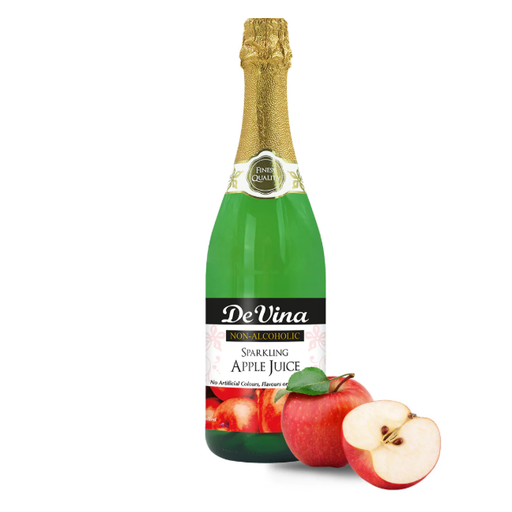
This sparkling apple drink is an option for shoppers who want fizz before activity. Check the exact listing's packaging if a glass bottle is essential.
 No image available
De Vina Sparkling Apple 750ml
For a snack occasion where you specifically want a sparkling apple drink, this 750ml option calls for a decision about how much to pour. The NHS advises limiting combined juice and smoothie intake to 150ml a day; do not treat the whole bottle as that daily amount. Check the product label for its nutrition values and packaging before relying on either for your choice.
View on Joybuy
Common questions
How much apple juice counts towards the daily juice limit?
The NHS advises limiting fruit juice and smoothies to a combined 150ml a day. A 250ml, 270ml or 275ml glass bottle contains more than that amount, so check the volume you actually pour rather than treating a whole bottle as one advised portion.
Is apple juice a complete pre-workout snack?
No single drink is a complete answer for every training session. Apple juice can contribute carbohydrate, but the UK Sports Institute recommends a food-first approach to sports nutrition; consider the rest of your snack and the timing and demands of your activity rather than relying on juice alone.
Should I choose still or sparkling apple juice before exercise?
Choose still juice if you do not want carbonation; choose sparkling juice if you specifically want a fizzy drink and know that format suits you. Biddenden Vineyards and Appletiser describe sparkling products, while the Folkington's and Luscombe examples are still-juice options. Sparkling juice has no established advantage here over still juice.
Does ‘no added sugar’ mean apple juice contains little sugar?
No. It says that sugar has not been added, not how much sugar the finished drink contains. Diabetes UK explains that sugars in fruit juice count as free sugars; compare the nutrition label using your intended serving size.
What if I count carbohydrates?
Check the carbohydrate value on the product label against the amount you intend to drink, paying attention to whether the figure is per 100ml, per serving or per bottle. If you follow an individual carbohydrate-counting plan, use that plan rather than assuming one apple-juice bottle represents a standard serving.


