People taking a drink to training
Individual cans can be easier to pack than a bottle. Compare the number of cans, volume per can and whether you want still juice or a sparkling drink.


Start with the drink itself: a canned multipack labelled 100% apple juice is different from the sparkling apple drinks listed with 49% or 16% apple juice. Then compare can size and carbohydrate per serving with what else you plan to eat; University College London Hospitals NHS Foundation Trust advises that a snack eaten 60–90 minutes before exercise should include carbohydrate and protein.
Individual cans can be easier to pack than a bottle. Compare the number of cans, volume per can and whether you want still juice or a sparkling drink.
If you plan to eat 60–90 minutes before exercise, consider the drink alongside your food. University College London Hospitals NHS Foundation Trust describes carbohydrate and protein as components of a snack at that time.
A 100% apple juice claim, a juice percentage and a no-added-sugar claim answer different questions. Check each on the particular product rather than relying on the word “apple”.
Choose the format you will use, then read the ingredients and nutrition information for one can rather than comparing pack names alone.
| Priority | What to check | Your needs |
|---|---|---|
| Can format | Check the number of cans, volume per can and whether the drink is still or sparkling. Ocado lists Cawston Press in 4 × 250ml cans and two M&S options in 4 × 330ml cans. | I want individual cans to take with me, but a larger can is not automatically the portion I want to drink. |
| Juice and ingredients | Read the declared juice percentage and ingredient list. Ocado lists 49% pressed apple juice for Cawston Press, over 60% juice for M&S Juicy Apple & Elderflower, and 16% apple juice from concentrate plus sugar for M&S Sparkling Apple. | If I want 100% apple juice or want to avoid added sugar, the product name alone will not settle either question. |
| Snack composition | Compare carbohydrate for a whole can where stated, then consider the food eaten with it. Ocado lists 21.8g carbohydrate per 330ml can of M&S Juicy Apple & Elderflower. University College London Hospitals NHS Foundation Trust includes carbohydrate and protein in its guidance for snacks 60–90 minutes before exercise. | I need to decide whether the drink is one part of my snack, taking account of when and what I have already eaten. |
| Portion size | Check the can volume against how much you intend to pour or drink. NHS guidance limits unsweetened fruit or vegetable juices and smoothies to a combined 150ml a day; a 250ml or 330ml can is larger than that volume. | I would rather decide on a portion than assume that one can is one recommended serving of juice. |
Ocado’s listings distinguish Cawston Press at 49% pressed apple juice, M&S Juicy Apple & Elderflower at over 60% juice, and M&S Sparkling Apple at 16% apple juice from concentrate with sugar in the ingredients.
Read the juice percentage, ingredients and added-sugar wording for the exact drink you intend to buy.
A can tells you about the drink, not whether the whole snack fits your plans. University College London Hospitals NHS Foundation Trust advises carbohydrate and protein for snacks eaten 60–90 minutes before exercise.
Consider what you have already eaten and whether you want food containing protein alongside the drink.
The listed canned options contain 250ml or 330ml per can. NHS guidance limits unsweetened fruit or vegetable juices and smoothies to a combined 150ml a day.
Check the drink’s ingredients and decide how much to have, taking any other juice or smoothies that day into account.
These examples help distinguish canned sparkling drinks from bottled apple juice; a brand name alone does not establish the format or ingredients of every product it sells.
Cawston Press describes Sparkling Cloudy Apple as a 4 × 250ml canned multipack.
Ocado lists two distinct 4 × 330ml sparkling apple-based multipacks.
Tropicana describes Orchard Apple as 100% pressed, not-from-concentrate fruit juice.
Tesco Groceries lists Copella Apple Juice in a refrigerated 1.35L bottle.
Tesco Groceries lists bottled own-label apple juice among its apple-juice products.
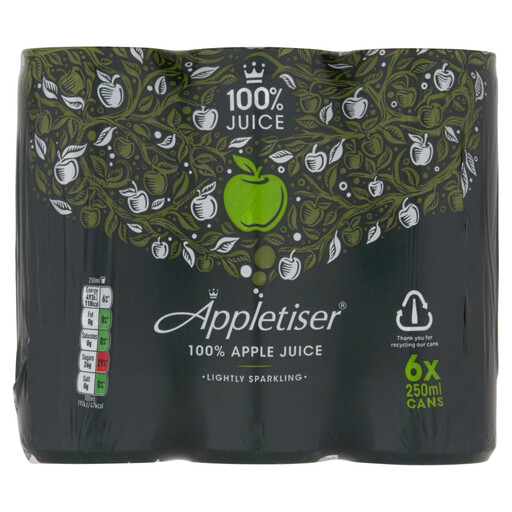
This canned apple juice multipack offers individual servings for taking with a snack. Check its portion size and what you plan to eat alongside it.
 No image available
The six individual cans suit a drink taken alongside a pre-workout snack. Each can is 250ml; if you are counting it as unsweetened fruit juice, compare your portion with the NHS limit of 150ml a day for unsweetened juices and smoothies combined. For a snack 60–90 minutes before exercise, consider food containing protein alongside the drink, as advised by University College London Hospitals NHS Foundation Trust.
No. Check the exact label and ingredients: Ocado lists Cawston Press Sparkling Cloudy Apple with 49% pressed apple juice, M&S Juicy Apple & Elderflower with over 60% juice, and M&S Sparkling Apple with 16% apple juice from concentrate and sugar. A separate product labelled 100% apple juice should not be assumed to have the same composition as those drinks.
Do not assume the drink alone makes up the snack. University College London Hospitals NHS Foundation Trust advises carbohydrate and protein in a snack eaten 60–90 minutes before exercise. Consider the timing, what you have already eaten and whether to add food containing protein.
NHS guidance limits unsweetened fruit or vegetable juices and smoothies to a combined 150ml a day. A 250ml or 330ml can is larger than 150ml; check what the drink contains and decide on a portion rather than treating the whole can as the guided amount.