Quick breakfast juicers
If you want apple juice before work or school, a centrifugal machine offers a quick route, though the juice can be frothier. Check the feed chute and preparation instructions if cutting apples would slow down your routine.


Choose a centrifugal juicer if making apple juice quickly matters most and you can accept some froth; Good Housekeeping UK notes that centrifugal speed can produce a frothier juice. Consider a slow juicer if you prefer that processing method or want a model with a feed system that reduces cutting, but check the exact machine’s apple-preparation instructions, size and permitted running time before buying.
If you want apple juice before work or school, a centrifugal machine offers a quick route, though the juice can be frothier. Check the feed chute and preparation instructions if cutting apples would slow down your routine.
For occasional batches, measure the space where the juicer will sit or be stored. Philips describes its HR1832/01 centrifugal model as compact and states that it can make up to 1.5L in one go.
If you make larger batches regularly, compare loading and running instructions as well as storage space. For scale, Kuvings lists its REVO830S slow juicer as 480mm high and 7.5kg, with a maximum use time of less than 30 minutes.
Decide how much preparation and cleaning you are willing to do, then check whether the exact juicer fits your usual batch and kitchen space.
| Concern | What to check | Who this matters to |
|---|---|---|
| Speed and preparation | Compare juicer type, feed opening and the manual’s apple-cutting instructions. | If I make juice before leaving home, I want the routine to be quick without extensive cutting. Around 36% of consumers put speed and preparation first. |
| Kitchen space | Check dimensions and storage clearance, then compare stated container capacity with your usual batch. | A small worktop means I need a machine I can leave out or put away easily; around 29% of consumers make space their primary concern. |
| Frequent or larger batches | Check permitted apple size, container capacity and maximum running time for the exact model. | When I juice apples regularly, repeated preparation and interruptions matter more to me. Around 21% of consumers prioritise frequent or larger batches. |
| Cleaning | Check which removable parts can go in a dishwasher and which require hand cleaning. | I want the juicer to be manageable to clean after each batch, not just convenient to use. Cleaning comes first for around 14% of consumers. |
A citrus press is made for citrus fruit, not for extracting juice from apples and separating the pulp.
Choose a centrifugal or slow juicer and confirm that the manufacturer permits apples or hard fruit.
Large machines can be awkward to leave assembled or lift into storage. Kuvings specifies a height of 480mm and a weight of 7.5kg for the REVO830S.
Measure the usable height and storage space against the exact model’s dimensions.
A wide opening does not establish that every apple size is permitted or that no preparation is needed.
Follow the exact model’s instructions on produce size, cutting and any parts that must be removed.
The amount a juicer can produce is not dietary serving guidance. The NHS advises limiting fruit juice and smoothies to one small glass of 150ml a day, taken with a meal.
Plan your batch around the servings you intend to use rather than treating the container capacity as a daily serving size.
Philips describes its Viva Collection HR1832/01 as a compact centrifugal juicer for batches of up to 1.5L in one go.
The Kuvings REVO830S is a larger slow juicer to assess if you expect to juice apples frequently.
The Sage Nutri Juicer Cold BJE430SIL offers another centrifugal model to consider when planning apple-juice batches.
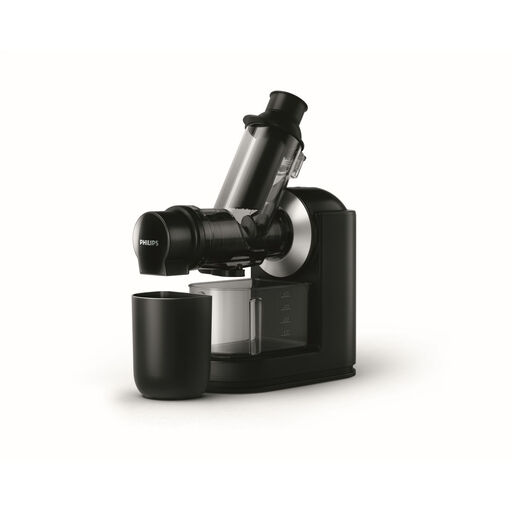
This slow-juicer option is worth considering if you prefer a masticating machine for home juicing. Check its manual for apple preparation and permitted running time before deciding whether it fits your routine.
 No image available
A slow-juicing option for a home routine if the model’s instructions permit the apples you plan to use. Check the required cutting steps and maximum running time if you intend to make repeated batches.
Choose a centrifugal juicer if speed is your priority and some froth is acceptable; Good Housekeeping UK notes that centrifugal speed can make juice frothier. A slow juicer is an alternative if you prefer slower processing, but check its feed instructions, size and cleaning steps rather than relying on the juicer type alone.
No: a citrus juicer is intended for citrus fruit. Choose a centrifugal or slow juicer whose manufacturer’s instructions permit apples.
Check the exact model’s instructions for disassembly and for which individual parts are dishwasher-safe. A claim about removable parts does not mean every component can go in the dishwasher.
The NHS advises limiting fruit juice and smoothies to one small glass of 150ml a day and having it with a meal. That advice concerns consumption, not how much juice a machine can make.
You may need to register as a food business: GOV.UK says selling, preparing or handling food can bring a business within registration requirements. Check with the local authority for the place and type of trading you plan before you start selling.