Short-session juicers with little space
If the machine needs to stay on a small worktop or fit into a cupboard between uses, compare its assembled dimensions with the space available rather than relying on a “compact” description.


For short apple-juicing sessions in a small kitchen, start with a centrifugal juicer that fits your worktop and storage space. Compare assembled dimensions, feed-chute width, container capacity and cleaning instructions before choosing; a multifunction machine makes more sense if you will use its other drink-making attachments too.
If the machine needs to stay on a small worktop or fit into a cupboard between uses, compare its assembled dimensions with the space available rather than relying on a “compact” description.
For quick apple-juice sessions, chute width, the parts that can go in a dishwasher and the space needed for the pulp container may matter as much as the juicer’s footprint.
If apple juice is only one planned use, check which attachments are included for citrus juice, smoothies or plant-based milks. Those extra functions matter only if you expect to use them.
Measure the space first, then decide how much apple preparation, cleaning and batch capacity your routine allows.
| Concern | What to check | Who this matters to |
|---|---|---|
| Worktop and storage fit | Compare assembled width, depth and height with your available space, including clearance for the containers. | If my juicer cannot fit where I can use or store it, its other features matter less. Around 33% of consumers put space fit first. |
| Preparation and cleaning | Check chute width, the manual’s apple-preparation instructions and which removable parts are dishwasher-safe. | For a short weekday session, I want to avoid extensive chopping and washing-up. Around 27% of consumers primarily care about preparation and cleaning effort. |
| Apples and batch size | Confirm that the model is intended for firm fruit, then match juice and pulp-container capacities to a typical session. | If I make several servings at once, I need containers that suit the amount I prepare. Batch size and suitability for apples come first for around 27% of consumers. |
| Other drink-making functions | Compare the included attachments with the drinks you intend to make and check the applicable guarantee terms. | When I also want citrus juice or smoothies, I would use more than an apple-juicing attachment. Around 13% of consumers prioritise that versatility and longer-term use. |
A compact description alone will not tell you whether a juicer fits beneath a cupboard or where you plan to store it. nutribullet UK lists the magic bullet Juicer at 27 × 20 × 31 cm, while Philips UK describes its Viva Collection HR1836/01 in relative size terms.
Measure your operating and storage spaces, then compare them with the assembled dimensions of the exact model.
A wider opening can reduce cutting, but it does not establish that every whole apple can be fed into the machine. Dishwasher guidance can also differ between components.
Check the model manual for apple preparation and identify which parts can be washed in a dishwasher.
A larger pitcher may be convenient when preparing juice for several people, but it is not guidance on how much to drink. The NHS advises limiting unsweetened fruit juice, vegetable juice and smoothies to a combined 150 ml per day.
Choose container capacity for the amount you need to prepare, while keeping serving guidance separate from appliance specifications.
The magic bullet Juicer appears with different wattage information in the nutribullet UK and Joybuy UK listings, so the name alone cannot establish that the selected variants match.
Compare the current model and selected variant, including its wattage, dimensions, included parts and mains-plug information, before ordering.
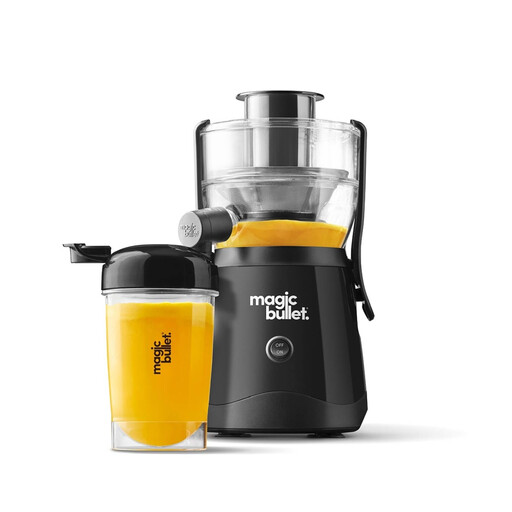
The magic bullet Juicer is a compact centrifugal option for shorter sessions. nutribullet UK lists its dimensions as 27 × 20 × 31 cm and its maximum juice capacity as 470 ml.
The nutribullet Juicer 800W is a centrifugal option for shoppers who place more emphasis on reducing apple preparation.
Philips positions the Viva Collection HR1836/01 around compact design and quick routine cleaning.
The Juice Expert 3 is a multifunction option for households that plan to make drinks beyond apple juice.
These centrifugal juicers offer two ways to approach short apple-juicing sessions: a smaller-capacity magic bullet set and a nutribullet model with a wider stated chute and larger containers. Check the selected variant and your available space before choosing.
 No image available
Consider this centrifugal juicer for modest apple-juice sessions when a 470 ml container suits your routine.
The product name describes dishwasher-safe components. Check the selected variant’s wattage and assembled dimensions, as well as its plug and voltage information, before buying.
 No image available
Consider this model if reducing apple cutting and accommodating larger sessions matter more than choosing the smallest appliance.
nutribullet UK lists two speeds and an 800 ml pitcher for its Juicer 800W. Check the assembled height against your cupboard clearance and confirm the selected unit’s plug and voltage information.
Choose a juicer for separated apple juice, or a blender if you want the drink to retain the blended pulp and fibre. nutribullet UK explains that its centrifugal juicer separates pulp, skins and fibre from the liquid.
Follow the preparation instructions for your exact model rather than assuming peeling is always necessary. nutribullet’s general guidance says peeling is usually needed for tough skins or skins not normally eaten, but model-specific instructions still govern how to prepare the fruit.
No. Pitcher capacity describes how much you can prepare at once; it is not a serving recommendation. The NHS advises limiting unsweetened fruit juice, vegetable juice and smoothies to a combined 150 ml per day.
Check the selected unit’s plug, voltage information and instructions before ordering. GOV.UK guidance says electrical equipment must meet applicable safety requirements before it is placed on the Great Britain market; product-marking arrangements for Northern Ireland differ.