Players practising directional combos
You rehearse motion-heavy or charge inputs and are willing to learn directional buttons rather than rely on a joystick.


Choose a compact leverless controller if you want button-based directional practice and easier storage; keep a traditional lever if its feel is central to how you already execute combos. Neither layout guarantees quiet practice in a shared bedroom, so check the fitted buttons, your console compatibility and your specific tournament’s rules before committing.
You rehearse motion-heavy or charge inputs and are willing to learn directional buttons rather than rely on a joystick.
You need to put the controller away after practice and want to limit disturbance to someone else in the room. Storage and fitted-button noise both matter.
You need a controller that works with the event’s console and a configuration that meets its rules, not just one that works at home.
For combo practice in a shared bedroom, consider the input layout and room fit together. Then check the exact console and event requirements before deciding how much lap comfort or modification access you need.
| Concern | What to check | Who this matters to |
|---|---|---|
| Directional inputs | Choose between four movement buttons and a physical lever; allow time to adapt if changing layouts. | If I rehearse difficult motions repeatedly, I want a layout I can use consistently without discarding technique that already works. Roughly 29% of consumers put directional execution first. |
| Noise and storage | Check stored dimensions and the fitted buttons; confirm part compatibility before planning a quieter-button modification. | When someone else sleeps or works in my room, I need to pack my setup away and avoid assuming that a slim controller is also quiet. Around 29% of consumers make room fit and disturbance their primary concern. |
| Console and event rules | Match the exact model and any adapter to the console, then check the event’s rules for SOCD settings and assisted functions. | If I practise on one system and compete on another, I need my intended configuration to work and be permitted at the event. For about 24% of consumers, that readiness comes first. |
| Comfort and modification | For lap play, consider the stated weight and padding; for modifications, confirm component fit and access. | During longer sessions, I may value a steady lap setup or access to the controls more than a small enclosure. Roughly 18% of consumers prioritise comfort or customisation. |
A leverless layout still has buttons to press. Qanba describes noise-reduction components in its Gravity KS replacement buttons, but that does not establish how quiet an assembled controller will be.
Check the fitted buttons and return terms. If you plan to change the buttons, confirm their size and mounting compatibility first.
Console support can depend on the precise controller and connection setup, so a broad compatibility description is not enough for tournament planning.
Match the model to both your home and event consoles, including any required authentication controller or converter.
Mayflash specifies a separately purchased converter for F500 FLAT use on PS5; its listed PS4 and Xbox setups require a wired controller in the USB slot.
A lock can prevent accidental system-button presses, but it does not settle an event’s rules on assisted inputs, adapters or controller settings. Evo’s published rules prohibit hardware rapid-fire, macros and other hardware-assisted mechanisms.
Read the current rules for your event and game, then test the configuration you intend to bring.
Mayflash specifies its F500 V2 at 3 kg and 36.2 × 23.3 × 11.5 cm. Its size matters if the controller must be put away after every session.
Measure where you will play and store it before choosing a full-size enclosure over a slim design.
The Kitsune is a compact leverless option for players considering button-based directions on PS5 or PC.
The Pro FS-12 is a full-size leverless option for players who value lap support and access to internal parts over a slim enclosure.
Its F500 V2 traditional stick and F500 FLAT leverless model offer distinct layouts for players considering a substantial, modifiable controller.
Gravity KS is a replacement-button line to consider when planning a compatible controller modification, not a ready-made quiet controller.
This option is for players considering a physical lever for combo practice rather than changing to directional buttons. Check how its PS5-labelled variant fits your setup, available space and event rules.
 No image available
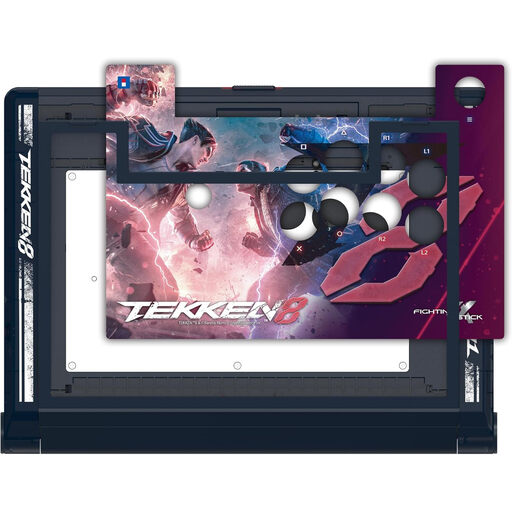
A traditional-stick choice if you prefer practising fighting-game motions with a physical lever rather than directional buttons.
Check its dimensions and fitted-button noise for your shared room, and confirm your intended configuration against the rules of your event.
No. Separate directional buttons may suit the motions you want to rehearse, but changing from a joystick takes adaptation and does not guarantee better execution. Choose the layout around your practice needs and established technique.
Do not assume the intended configuration is permitted. Evo’s published rules prohibit hardware programmable inputs, rapid-fire, macros and other hardware-assisted mechanisms; check the current rules for your particular event, game and adapter setup.
Contact the retailer promptly about your statutory remedies rather than relying only on a manufacturer warranty. Legislation.gov.uk’s explanatory notes to the Consumer Rights Act 2015 describe a minimum 30-day short-term right to reject goods that do not meet statutory standards; its starting point depends on the relevant ownership, delivery and any required installation conditions.