Traditional-motion learners
If you want your hand to follow the conventional down, down-forward, forward path, a lever gives you a physical movement to practise. Allow room for a full-size stick on the desk as well as the equipment you use for work.


Choose a traditional arcade stick if you want to learn quarter-circle inputs by moving a lever through down, down-forward and forward. Choose a leverless controller if you would rather practise those directions as separate button presses. Either way, check the exact model’s platform support and whether its layout, footprint and cable arrangement suit your home-office desk.
If you want your hand to follow the conventional down, down-forward, forward path, a lever gives you a physical movement to practise. Allow room for a full-size stick on the desk as well as the equipment you use for work.
If deliberate directional presses appeal more than a lever sweep, an all-button controller offers a joystick-free way to practise. You will be learning a different hand movement from the one used on a traditional arcade stick.
If the controller must work with a particular console and a computer, check compatibility for the exact version before settling on a layout. Some console setups also require another wired controller.
Decide which hand movement you want to practise, then check the exact controller against your platform and available desk space.
| Concern | What to check | Who this matters to |
|---|---|---|
| Learning the lever motion | Decide whether you want to move a lever through down, down-forward and forward, rather than press those directions separately. | If I want to learn the familiar arcade-stick gesture, the physical path matters more to me than a button-only layout; around 33% of consumers put that movement first. |
| Directional presses at a desk | Check the exact all-button layout and dimensions, and consider whether the button positions suit your hands. | For desk practice, I may prefer to make each direction an intentional press, even though that will not teach me a lever sweep; roughly 42% of consumers prioritise this way of learning. |
| Platform compatibility | Match the precise model to your console or computer, including any stated wired-controller requirement. | If I will switch between a console and a PC, I need the controller to work with both before its layout matters; about 25% of consumers make confirmed platform support their primary concern. |
A leverless controller replaces the joystick movement with separate directional presses. It can be a deliberate choice for quarter-circle practice, but it teaches a different movement pattern.
Choose the movement you want to learn before choosing the controller layout. If you can try both layouts, use that opportunity to assess hand position.
Mayflash says the F500 FLAT Elite needs a wired PS4 or Xbox controller connected to its USB slot for PS4 and its listed Xbox systems.
Check the instructions for your target console and confirm that you have a suitable wired controller for the stated setup.
That setup may also require a compatible cable if you do not already have one.
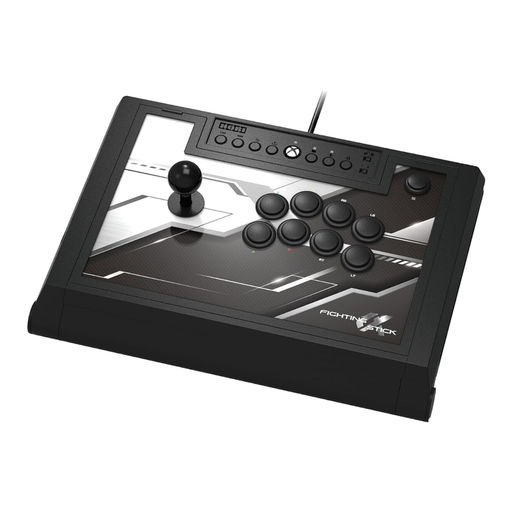
HORI lists its Xbox Fighting Stick α at approximately 410 × 300 × 120 mm, with a mass of approximately 2.7 kg and a 3.0 m cable. The controller needs space alongside the equipment you keep on your desk.
Measure the usable area, including where your hands will rest, and plan the cable route before choosing a full-size model.
HORI specifies Xbox Series X|S, Xbox One and Windows support for its Xbox Fighting Stick α. Razer identifies PS5 and PC support for the Kitsune. A product-family name alone does not establish support for another system.
Match the exact version’s stated compatibility to the system on which you intend to practise.
A reference point for a traditional lever controller, with platform-specific Fighting Stick α versions.
The Kitsune illustrates an all-button route for people practising on PS5 or PC.
The F500 FLAT Elite illustrates an all-button controller with several stated computer and console modes.
These two HORI Fighting Stick Alpha variants are options for learning the physical lever movement. Choose between them by checking the platform you need; the leverless route discussed above involves a different directional layout.
 No image available
Consider this version if you want to practise the quarter-circle movement with a lever and use an Xbox Series X/S. HORI specifies a HAYABUSA lever for its Xbox Fighting Stick α and lists approximate dimensions of 410 × 300 × 120 mm, so measure your desk before choosing it.
Check the exact version’s compatibility if you also need another platform.
 No image available
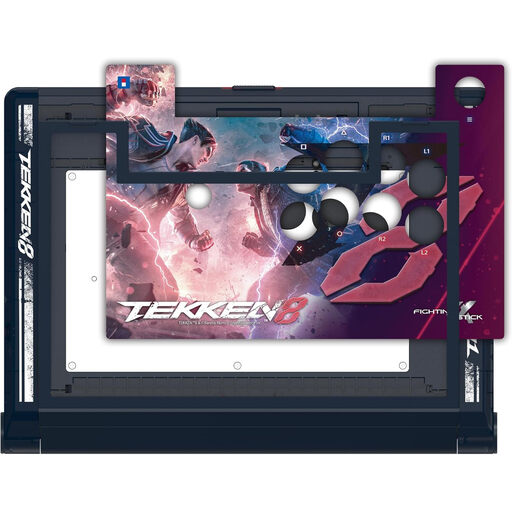
Consider this PS5-labelled Fighting Stick version if you want to practise the quarter-circle movement on a traditional stick rather than an all-button layout.
Check the exact version’s compatibility before choosing it for another system, and make room for the controller on your desk.
A quarter-circle forward follows down, down-forward and forward; you do not need a lever to enter those directions. As SuperCombo Wiki explains the motion, a lever lets you trace that path physically, while an all-button controller makes you practise it through separate directional presses. Choose according to the movement you want to learn.
For PS4, Xbox Series S|X, Xbox One and Xbox 360, Mayflash says a wired PS4 or Xbox controller must be connected to the F500 FLAT Elite’s USB slot. Check that you have a suitable controller for your intended system before ordering.
Do not assume the Xbox version will work on PlayStation. HORI specifies Xbox Series X|S, Xbox One and Windows support for that version; if PlayStation is essential, check the compatibility of the exact PlayStation-labelled model instead.
Check your council’s arrangements for electrical and electronic equipment rather than putting the controller in an ordinary household bin. Coventry City Council, for example, directs residents to its household recycling and reuse centre for electrical appliances; collection arrangements depend on your local council.