If wall sockets are scarce, start with a wired USB arcade stick or all-button controller that connects to your console or PC; you still need a compatible spare USB port. Choose a lever if you want traditional stick inputs, or directional buttons if you want to learn a different layout. Wireless play can remove the controller cable, but it still involves charging and model-specific compatibility checks.
Who these controllers suit
USB-powered combo practisers
If avoiding another wall socket matters more than removing the cable, look for a wired controller that connects to an available console or PC USB port. Nacon lists a USB cable for its Daija stick, while Razer describes a detachable USB-C cable for its Kitsune all-button controller.
Players learning directional buttons
An all-button controller suits players who deliberately want to practise movement with buttons instead of a joystick. Razer describes the Kitsune as replacing the lever with four movement buttons; that layout change does not establish that every player will execute combos more reliably.
Multi-platform or cable-free players
If you change devices or playing positions, check both the exact model's platform support and its available connection modes. MAYFLASH lists wired USB, Bluetooth and 2.4 GHz modes for the F700, but says the similarly named F700X does not work with PS5.
What to check before buying
For combo practice with limited plug sockets, decide whether the constraint is mains power, a free USB port or a cable across the playing area. Then match the controller to the intended console and game before choosing between lever and button-based movement.
| Concern |
What to check |
Who this matters to |
| Power and USB connection |
Check the connection type, available host USB port and whether the required cable is supplied. |
I want to practise without occupying another wall socket, and I can leave a cable connected if the USB setup works. Around 31% of consumers put a workable, mains-free connection first. |
| Console and game support |
Check the exact model against your console, intended fighting game and connection mode; PlayStation advises checking PS5 peripherals with their manufacturers. |
A controller is useful to me only if it works with the particular game and system I use. Roughly 31% of consumers make confirmed compatibility their primary concern. |
| Directional input layout |
Decide between a traditional lever and directional buttons; check any input-mode requirements that matter for your game or event. |
I would rather rehearse the movements I intend to keep using than change layouts just because one is marketed for competition. Around 25% of consumers place their preferred input layout first. |
| Positioning and cables |
Check whether wireless mode works on your platform, and how the controller charges or its cable detaches. |
I move my playing position often, so keeping a cable out of the way matters more to me than avoiding battery charging. About 13% of consumers prioritise portability or cable-free play. |
Mistakes to avoid
-
Assuming limited plug sockets mean you need wireless
Wireless removes the controller-to-console cable in supported modes, not the need to manage power. MAYFLASH lists a rechargeable battery for the F700, whereas a wired stick can connect through an available USB port during play.
Identify what is scarce before choosing: a wall socket, a console USB port or clear space around your playing position.
-
Assuming similarly named models support the same console
MAYFLASH lists PS5 support for the F700 but explicitly says the F700X does not work with PS5. A family name alone cannot settle compatibility.
Check the full model name and the manufacturer's stated console and connection-mode support before ordering.
-
Relying on a PS4-era stick without checking the PS5 game
PlayStation cautions that not every licensed or third-party peripheral works with PS5. Brook describes its Wingman FGC converter as intended specifically for PS5 fighting games, not as a universal way to use any stick with any title.
Confirm the exact controller and game with the manufacturer. If considering a converter for a stick you already own, check its current supported-controller and game information too.
-
Choosing leverless without wanting to change movement habits
An all-button layout replaces joystick movement with directional buttons. That difference matters during repeated combo practice if you already rely on lever motions.
Decide whether you want to preserve those motions or learn button-based movement; try the layout before committing if you have the opportunity.
Relevant brands to consider
These brands offer different controller layouts and platform variants. Check the exact product rather than treating a brand's wider range as one compatible model.
HORI
Traditional fight sticks for different console and PC setups, including a PlayStation Fighting Stick α variant.
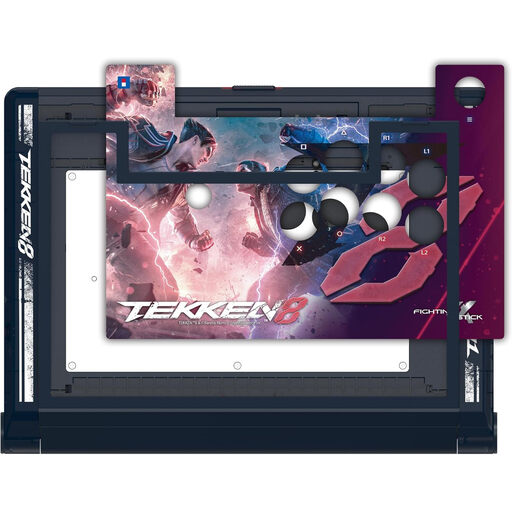
- HORI describes the PlayStation Fighting Stick α with Hayabusa controls, replaceable artwork and an opening chassis for customisation.
- Check the platform edition: features or compatibility stated for a PlayStation variant should not be assumed for an Xbox variant.
Nacon
A wired traditional-stick option for players seeking stated PS5, PS4 and PC support.
- Nacon lists configurable buttons, interchangeable stick heads and a detachable 3 m USB-A-to-USB-C cable for the Daija.
- Wired play leaves a cable in place and requires a suitable USB connection.
Razer
An all-button option for PS5 and PC players who want directional buttons rather than a lever.
- Razer describes the Kitsune with four movement buttons, optical switches and a detachable USB-C cable.
- Moving from a lever to directional buttons changes the inputs you practise; the listed features do not establish a performance advantage for every player.
MAYFLASH
Arcade sticks with a choice of connection modes on particular models.
- MAYFLASH lists Bluetooth, 2.4 GHz and wired USB modes, alongside PS5 support, for the F700.
- The F700X has different compatibility: MAYFLASH says it does not work with PS5. Wireless models also need charging.
Victrix
Turtle Beach's fight-stick range includes leverless designs for players choosing that layout deliberately.
- Turtle Beach describes the Pro FS-12 with an aluminium shell, a 6.28° wrist slope and a quick-access back panel.
- Those construction features do not by themselves establish that the Pro FS-12 suits someone whose main requirement is simply USB-connected combo practice.
Wired arcade sticks on Joybuy
These two HORI lever sticks suit players considering a wired controller for combo practice rather than choosing wireless solely to save a wall socket. They are different console editions, so match the exact stick to your intended system and game.
 No image available
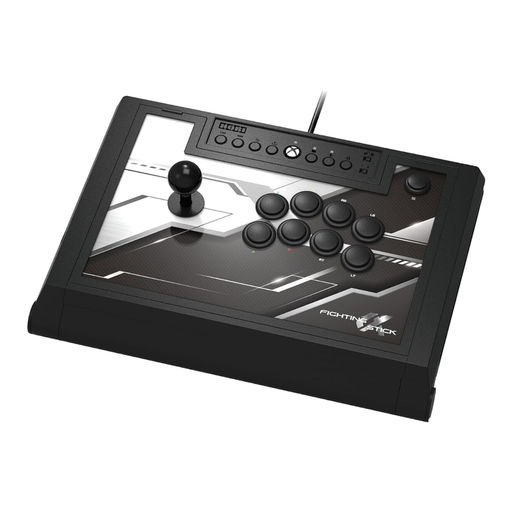
HORI SERIES X Fighting Stick Alpha (Xbox Series X/S)
Consider this wired lever stick if you practise on an Xbox Series X/S and have a compatible USB port available. Check support for your intended game and, if you plan to use a PC, confirm the Windows version you need before buying.
View on Joybuy
 No image available
HORI PS5 Fighting Stick Alpha Tekken 8 Edition
Consider this wired lever stick if you want the PS5-labelled edition for combo practice and can spare a suitable USB port. Confirm support for your intended game; for PC use, also check whether your software requires a particular input mode.
View on Joybuy
Common questions
Will a wired arcade stick take up a wall socket?
A wired USB arcade stick can connect to a console or PC without a separate wall socket for the controller during play. Nacon, for example, lists a USB cable for its wired Daija; you still need a compatible spare port on the host device.
Will an older PS4 arcade stick work with my PS5 fighting game?
Do not assume it will. PlayStation says some officially licensed arcade sticks can work with PS5 games and supported PS4 games, but cautions that not every licensed or third-party peripheral is compatible. Check the exact stick and title with the manufacturer.
Does wireless play remove power and connection constraints?
No: a wireless mode can remove the cable during play, but the controller still needs charging and must support your device. MAYFLASH lists a rechargeable battery and Bluetooth, 2.4 GHz and wired USB modes for the F700; it separately says the F700X does not work with PS5.
How should I dispose of an arcade controller in the UK?
Use an appropriate electrical-recycling collection route or a retailer take-back service where available, rather than putting the controller in general waste. GOV.UK's guidance on waste electrical and electronic equipment describes a framework intended to encourage recovery, reuse and recycling; check which collection options are available locally.


