Desk-bound PC shoot-em-up players
You play mainly at a Windows home-office desk and need to account for your games’ input support, the controller’s connection and the space it will occupy beside work equipment.


Choose the directional layout you want only after checking your exact platform and shoot-em-up titles: a controller that connects to a PC may still need game-specific support or configuration. A lever-and-button stick suits players seeking traditional arcade controls, while an all-button controller suits those who prefer directional buttons. For a shared work-and-play desk, weigh the controller’s footprint and connection requirements against the convenience of putting it away.
You play mainly at a Windows home-office desk and need to account for your games’ input support, the controller’s connection and the space it will occupy beside work equipment.
You want a physical lever and arcade buttons rather than button-only directions. Access to replaceable controls may also matter if you plan to modify the stick later.
You use more than one of PC, Switch, Xbox or PlayStation and need to check support for each exact controller version, including any required input mode or additional hardware.
Settle the lever-versus-buttons choice, then check the exact games and devices you intend to use before deciding how the controller will fit into your desk setup.
Choose it when: You want to move with a physical arcade lever, or plan to explore models with accessible, replaceable controls.
Bear in mind: A full-size enclosure needs room on the desk and somewhere to go when work resumes.
Choose it when: You already prefer pressing buttons for directional movement rather than using a lever.
Bear in mind: Console support can have model-specific conditions. Mayflash states that its F500 FLAT Elite needs a wired controller for specified PS4 and Xbox use; its stated PS5 route needs separately purchased hardware and is limited to fighting games.
| Concern | What to check | Who this matters to |
|---|---|---|
| Platform and game compatibility | Check the exact model, operating system, game support and required input mode. For Steam games, Valve notes that gamepad-specific input styles work only in games that support gamepads. | If my main shoot-em-ups do not recognise the controller’s input, its other features will not solve the problem; around 38% of consumers put confirmed platform and game compatibility first. |
| Desk space and storage | Measure the usable play area and storage spot against the stated dimensions and weight. Plan where a cable or wireless receiver would sit. | When my work desk has to be cleared after play, I need a controller I can position and put away comfortably; roughly 31% of consumers make workspace practicality their primary concern. |
| Lever feel and modification | Choose between lever and button-only directions, then check whether the maker specifies access to the controls and support for any replacement parts you want. | I want the movement of a physical arcade lever and may change the controls later; around 23% of consumers prioritise that layout or modification path. |
| Wireless convenience | Check which connection modes the exact version supports on your platform, and whether its receiver and charging arrangement suit the desk. | A cable across my work area is what I most want to avoid, provided the connection works with my setup; about 8% of consumers put wireless convenience first. |
Mayflash specifies additional hardware for certain F500-series console setups. For the F500 FLAT Elite, its stated PS5 route is limited to fighting games, which does not establish support for your shoot-em-ups.
Check the exact model, console and game together, including any required wired controller or converter, before choosing it for more than one platform.
Valve’s Steam guidance says gamepad-specific input styles work only with games that support gamepads. Connecting a controller to Windows does not settle how an individual game will handle it.
Check support for your main titles and their controller-configuration options, then try a representative game promptly after purchase.
Full-size sticks can take up substantial space. Mayflash lists the F500 Elite at 360 × 231.3 × 118.3 mm and 3 kg; 8BitDo lists its Switch/Windows Arcade Stick at 303 × 203 × 111.5 mm and 2.1 kg.
Measure the space beside your keyboard and the place where you would store the controller. Allow room to operate its lever and route its cable, where applicable.
These manufacturers offer relevant controller layouts, but compatibility and connection options differ between their models and versions.
Consider its lever sticks if a Windows-and-Switch or Windows-and-Xbox setup matches the particular version you are assessing.
Relevant when comparing a conventional F500 Elite lever stick with the F500 FLAT Elite’s button-only directions.
Its PlayStation-version Fighting Stick α is relevant to players seeking a lever stick with an enclosure that opens for maintenance or customisation.
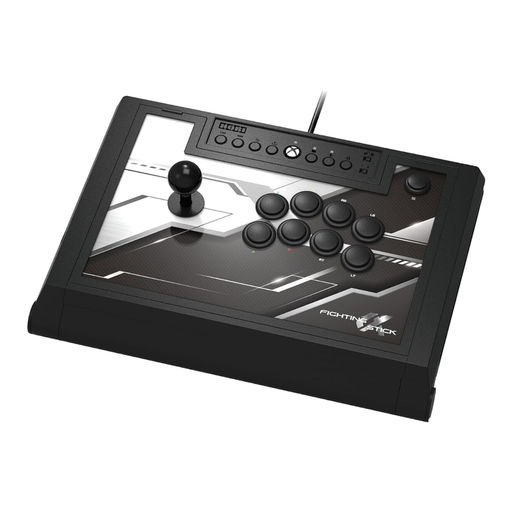
A lever-and-button option to consider if you want traditional arcade controls. Check the exact games and platform you plan to use before deciding whether this variant suits your desk setup.
 No image available
A lever-and-button choice for players considering the Xbox Series X/S variant. Confirm support for your shoot-em-ups and check Windows compatibility separately if you also intend to play on a PC.
No: the game must accept the input style you intend to use. Valve’s Steam guidance says gamepad-specific input styles work only in games with gamepad support, so check your main titles and try the relevant controller configuration promptly after purchase.
Choose a lever stick if you want physical arcade-style directional movement; choose an all-button controller if you prefer directions on buttons. Neither layout removes the need to check support for your platform and games.
Do not assume native support. Mayflash’s instructions for the F500 V2 and F500 Elite describe additional hardware for specified PS5 setups and a plugged-in Xbox Series controller for Xbox Series use; check the exact model, accessories and game before purchase.
Check an electrical recycling or take-back route rather than putting it in ordinary household waste. GOV.UK identifies the Waste Electrical and Electronic Equipment Regulations 2013, as amended, as the UK framework encouraging recovery, reuse and recycling; your local authority or retailer can tell you which collection options are available.