Console combo practisers
If you practise on a console connected to a large display, match the controller’s exact platform mode and connection requirements to your console and fighting game before choosing a layout.


Choose a traditional lever stick if you want joystick movement for practising combos; choose a leverless controller if you want to learn directional inputs on buttons instead. Neither layout removes the need to check your exact console and game compatibility. For play on a large screen, also check cable reach or the stated wireless connection, and whether the controller will sit securely on your desk or lap.
If you practise on a console connected to a large display, match the controller’s exact platform mode and connection requirements to your console and fighting game before choosing a layout.
If you want to practise motion inputs using directional buttons instead of a joystick, allow for a change in hand position and technique rather than assuming the new layout will feel familiar immediately.
If you drill combos at a desk or on your lap, consider where the controller will rest, how the cable reaches your playing position and whether its shape supports the way you sit.
Start with the layout you want to practise on and the exact game and platform it must work with. Then assess the space between your seat and the large screen.
| Concern | What to check | Who this matters to |
|---|---|---|
| Game and platform compatibility | Check the exact model against your console or PC and fighting game. For PS5, check whether additional hardware or setup is required. | If my controller cannot run the game on my console, its layout is beside the point. Around 36% of consumers put game and platform compatibility first. |
| Directional-input layout | Choose between joystick movement and directional buttons; try the unfamiliar layout if you can. | When I repeat motion inputs, I want a layout whose hand movements I am prepared to learn. For around 29% of consumers, input layout is the primary concern. |
| Reach and stability | Measure the safely routed connection from your seat and check the base for desk or lap use. | I practise away from the console and need the controller to stay in a usable position through a session. Reach and stability come first for around 21% of consumers. |
| Customisation and storage | Check access to components and compatibility with intended replacement parts; consider where the controller will be stored. | I expect to change parts or put the controller away after play, so those practical details shape my choice. Around 14% of consumers make them their first concern. |
Mayflash distinguishes between platform support and use that needs separate conversion hardware. Nacon also notes that Daija lacks analogue controls required by some games.
Check the exact controller’s current compatibility instructions against the game you intend to play, including any required adapter or connected controller.
A required adapter, authentication controller or firmware step also adds to the setup.
Directional buttons change how you perform movements; a manufacturer’s response claims do not establish that you will find combos easier to learn.
Choose the layout you are willing to practise on. If possible, try an all-button controller before moving away from a familiar lever.
Large-screen practice may place you farther from the console or PC. Nacon specifies a 3 m detachable cable for Daija, but the usable distance depends on how you route it.
Measure a safe cable path around furniture and decide whether the controller will rest on a desk or your lap.
Your seating arrangement may call for a different cable-routing solution.
Accessible internals and supplied customisation tools do not establish compatibility with every third-party button, lever or artwork option.
Consult the instructions for the exact model and intended part before planning a modification.
The Kitsune represents a slim, leverless route specified by Razer for PS5 and PC.
Daija is a traditional lever stick specified for PS5, PS4 and PC.
The Pro FS-12 is a substantial leverless option for PS5, PS4 and PC desk or lap setups.
The F500 range includes traditional-lever and all-button models with differing platform requirements.
FlexStrike offers a PS5-focused lever-stick route with wireless and wired connection options.
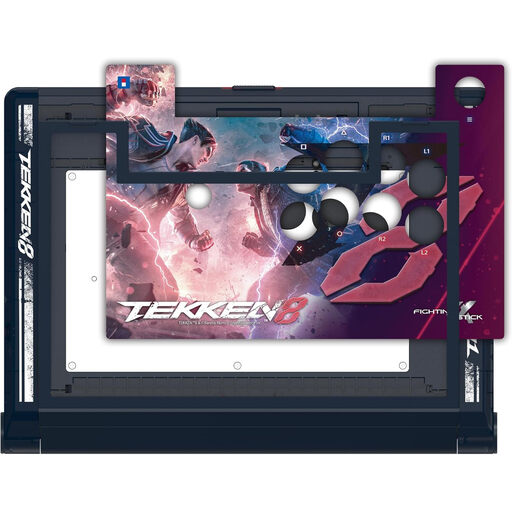
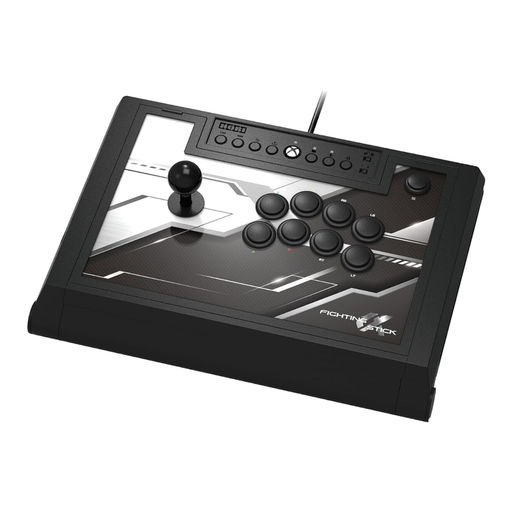
These two HORI models are traditional lever sticks for practising joystick-based inputs. Their platform variants differ, so choose for your own console and game rather than treating them as interchangeable.
 No image available
Consider this traditional stick if you want to practise joystick movements on a PS5 setup. Confirm compatibility with your exact game and check cable reach from your playing position.
 No image available
Consider this traditional stick for joystick-based practice on an Xbox Series X/S setup. Check your fighting game’s controller support and where you can position the stick relative to the screen.
No. Screen size alone does not require one. Choose an arcade controller for the input layout you want to practise, then check compatibility and whether its connection and base work from your seat.
Choose a lever for physical joystick movement or leverless for directional buttons; neither layout is automatically easier to learn on. The useful choice is the one whose hand movements you are prepared to practise consistently.
Not automatically. Check the exact model and game: Nacon specifies Daija for PS5, PS4 and PC, while Mayflash states that F500 FLAT Elite needs separate conversion hardware for its stated PS5 fighting-game use.
Check the model’s instructions for how to open it and which parts fit. Nacon documents customisation accessories for Daija and Turtle Beach documents a quick-access panel for Victrix Pro FS-12, but those features do not establish universal third-party part compatibility.