
24/7 Customer Support

Free returns

Same-day & Next-day Delivery

Quality Guaranteed

Unlock Your Welcome Offers: FREE Delivery | Up to 80% OFF | Free 30-day JoyPlus trial
Download the APP
Choosing art marker pens can seem straightforward until you compare tip sizes, ink types, colour counts and surface claims. A large pack is not automatically suitable for detailed illustration, while a marker labelled “permanent” may be unsuitable for a child’s school project or an indoor craft table.
This guide from the Joybuy Product Recommendation Officer focuses on the practical details that help UK shoppers avoid wasted money and select pens for drawing, colouring, lettering, Manga illustration, personalisation and mixed-media work.
An assorted colour marker set may contain dozens of shades, but a large collection is not always the most economical choice. If you mainly sketch in black and add occasional highlights, a multi-nib black or white set may be more useful than a broad colour assortment. For school projects or family craft sessions, however, a wider palette can offer better variety.
Check whether the set includes genuinely different colours or several near-identical shades. Also consider storage: a cardboard wallet, pouch, suitcase or carrying case can make a difference when pens are used between home, school and art classes.
A fine tip is useful for outlines, small lettering and Manga drawing pens, but it will be slow for filling large areas. Medium tip paint markers are more practical for bold lettering, colouring and decorative work. Brush pens offer variable line width, although they require more control than a conventional bullet tip.
Some listings use “fine” broadly, so look for a stated measurement. For example, a 0.4 mm line width is designed for precise lines, whereas a medium paint marker may cover approximately 2.0–4.0 mm depending on the model.
Water-based felt-tip pens are generally associated with paper, card and washable creative activities. Paint markers may also be suitable for fabric, wood, glass, plastic and metal, but the finish, durability and wash resistance can vary by surface.
Always test on a spare area first. A water-based marker may be easier to clean, while permanent paint markers can require ventilation and careful handling. “Washable” should also be understood accurately: it may refer to removal from skin or most fabrics, not guaranteed removal from every material.
For paper-based illustration, look for water-based ink, particularly if the project involves children, classrooms or easy clean-up. Food-dye-based ink and washable formulations can be practical for everyday drawing, but users should still follow the product’s age guidance and keep caps securely replaced.
For artwork intended to last, pigmented and waterproof ink may be more suitable. The Faber-Castell PITT Artist range, for example, is described as using pigmented, waterproof and fade-resistant ink. These are product features rather than a guarantee that every finished artwork will remain unchanged in all storage conditions.
Paint markers use opaque liquid paint rather than conventional felt-tip ink. They can create visible coverage on darker or non-porous surfaces, but usually need shaking, tip activation and testing before use.
A metal-framed tip can be helpful when working with rulers and templates. A triangular or textured grip may also improve control during longer writing or drawing sessions, particularly for students.
For paint markers, confirm the listed surface range rather than relying on a product photo. The POSCA options supplied here are described for paper, card, fabric, metal, plastic, glass and wood. The surface should still be clean and dry, and the marker should be tested before committing to a finished item.
To reduce drying and inconsistent flow:
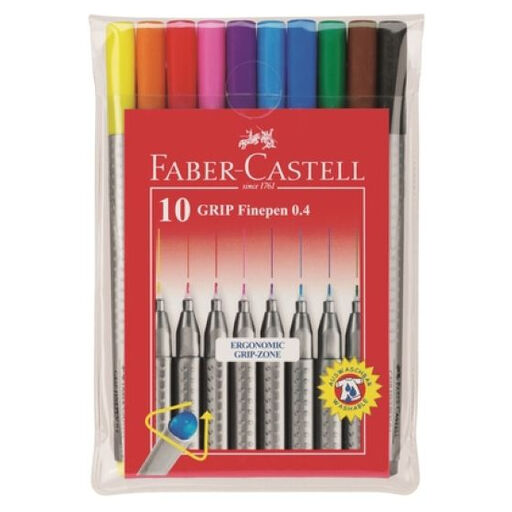
Why This Fits Their Persona: A compact ten-colour wallet suits students, journal users and first-time illustrators who want precision without buying a large craft marker set.
The stated 0.4 mm line width makes the intended use clearer than a vague “fine” label, while the wallet avoids an oversized unused colour selection.
Metal-framed tip for rulers and templates; triangular barrel with a grip zone; ink is described as washing out of most fabrics.
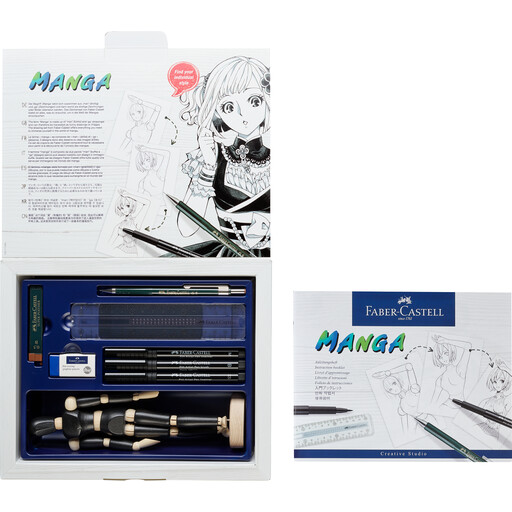
Why This Fits Their Persona: Manga enthusiasts and illustrators can explore varied line work in one purpose-built starter set rather than assembling individual nibs.
The set specifies six nib varieties and identifies the ink as pigmented and waterproof, making its illustration purpose easier to assess.
Six nib styles; acid-free and pH-neutral ink; described as fade-resistant and waterproof.
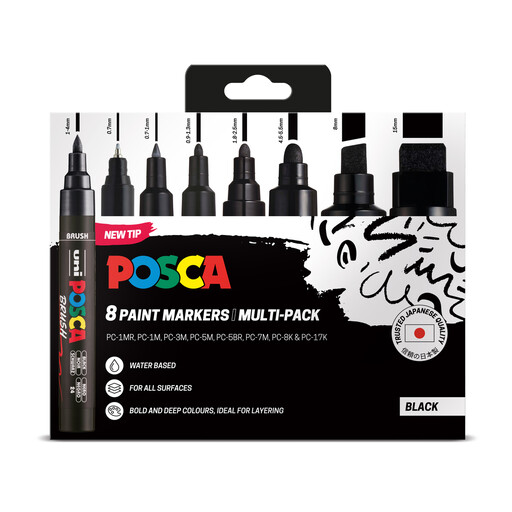
Why This Fits Their Persona: Crafters and frequent makers working across signs, models, glass, wood or mixed-media surfaces can change stroke width without changing systems.
Instead of buying separate fine, medium and broad markers, this pack lists eight tip sizes from ultra fine to XXL.
Water-based opaque paint; listed for paper, card, fabric, metal, plastic, glass and wood; supports layering and blending.
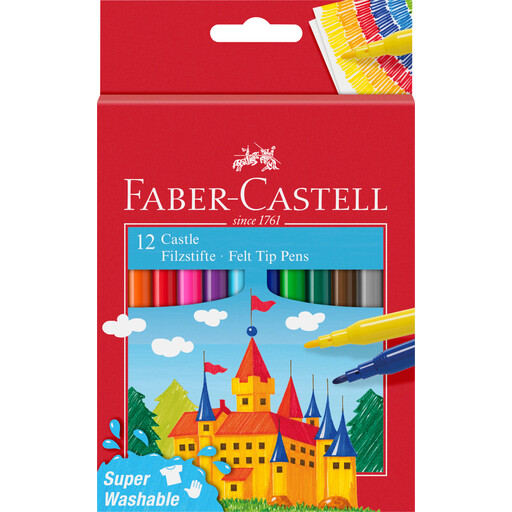
Why This Fits Their Persona: Parents, teachers and children need accessible drawing and colouring pens with straightforward storage and easier clean-up for everyday use.
The product description clearly identifies water-based washable ink rather than implying that all marker ink is easy to remove.
Wide and fine tip functions; ink is described as washing from skin and most fabrics at 30°C; supplied in a cardboard box.
We have compiled a complete, real-time list of products that fully satisfy these strict selection criteria and UK safety regulations.
Water-based, washable felt-tip pens are often more practical for children and classroom activities, but always check the age guidance, warnings and supervision instructions. Paint markers and permanent marker types may require greater care, particularly around clothing, skin, fumes and non-porous surfaces.
Lifespan depends on use, storage and whether the cap is replaced correctly. Fine tips may wear faster when pressed heavily, while paint markers can develop inconsistent flow if they are not shaken or stored as directed. Keeping pens capped and away from heat helps reduce drying.
The purchase price is only one factor. A multi-tip set may reduce the need to buy separate nib widths, while an assorted colour set can be wasteful if many shades remain unused. Match the pack size, tip and ink type to your regular projects before comparing cost per pen.