
24/7 Customer Support

Free returns

Same-day & Next-day Delivery

Quality Guaranteed

Unlock Your Welcome Offers: FREE Delivery | Up to 80% OFF | Free 30-day JoyPlus trial
Download the APP
An articulating inspection camera can make it easier to view areas that are hidden from direct sight, including engine cylinders, wall cavities, ducts, brake systems and pipework. However, a higher camera resolution or a longer probe does not automatically make a model suitable for your work.
The most useful buying decision usually comes down to access, control and documentation. Before choosing an articulating borescope or flexible inspection camera, check these common pitfalls.
A product may advertise 1080p photo or video capture, while its built-in screen displays at a lower resolution. These specifications describe different functions. The live image you use during an inspection depends on the screen resolution, lens quality, lighting and focus range.
For practical work, check:
A video inspection camera with recording capability can also help you document work for customers or compare images later, but only if the files are saved conveniently and the screen provides a clear live view.
Probe diameter is a physical limitation, not a marketing feature. An 8.5mm probe may be suitable for larger access points, but it cannot pass through an opening designed for a 3.9mm or 5.5mm camera.
Always measure the smallest access hole first and allow a little clearance. For example:
This is particularly important when selecting an automotive borescope for spark plug holes, fuel injector openings or narrow mechanical channels.
A flexible cable helps the probe enter awkward spaces, but passive flexibility does not let you direct the camera tip precisely. A two-way inspection camera uses a control lever or dial to articulate the tip, allowing you to look around corners and behind obstructions.
Also check whether the probe is semi-rigid enough to hold its shape. A cable that bends too easily may be difficult to position in a vertical duct or long pipe. Conversely, forcing a semi-rigid cable beyond its natural bend radius can damage it over time.
Start with the access point rather than the screen. A slim probe inspection camera is more useful for narrow engine openings, small pipes and compact HVAC channels. A 1.5m or 1.55m probe provides useful reach for many vehicle, wall and duct inspections, while still remaining portable.
For larger drains, tanks or open service panels, a wider probe can offer a more robust feel. For spark plug holes and confined mechanical spaces, diameter should take priority over screen size.
A 210-degree articulation range allows the camera head to turn in two directions through a broad viewing arc. This can reduce the need to repeatedly withdraw and reposition the probe.
Look for:
An articulating borescope is especially useful when inspecting behind dashboard components, around brake assemblies or inside engine areas where a straight-ahead view is limited.
An inspection camera with light should provide adjustable illumination rather than relying on ambient light. LEDs that are too bright can create glare on shiny metal; insufficient light can hide surface detail.
For regular trade use, consider:
A larger battery does not indicate a guaranteed runtime, as brightness, recording and screen use affect consumption. Charge the unit before use and store it dry after cleaning the lens and probe.
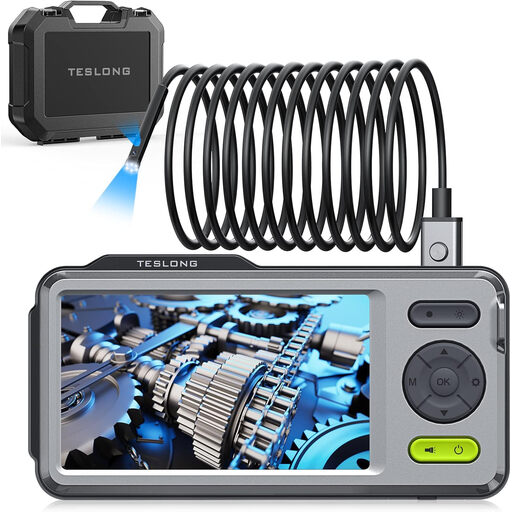
Why This Fits Their Persona: A practical option for homeowners, vehicle owners and occasional maintenance tasks involving engines, walls, pipes or ducts.
The 5mm probe is narrower than many general-purpose models, and the built-in screen avoids dependence on a separate phone or app.
5-inch IPS display, dual-lens design, 32GB TF card, microphone and speaker, plus a 3500mAh battery.
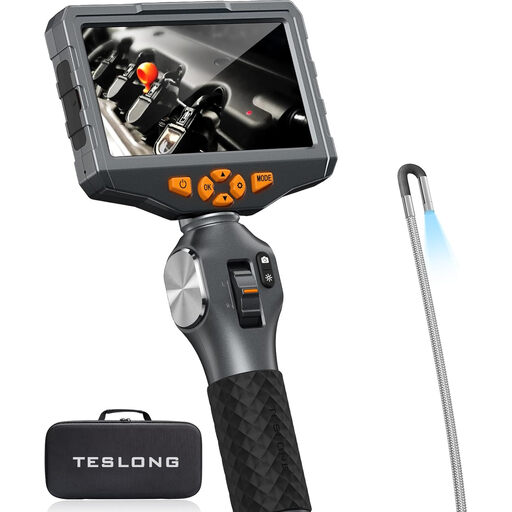
Why This Fits Their Persona: A suitable match for technicians who need narrow access, directional control and high-resolution documentation in a portable format.
Its 3.9mm probe is specified for access holes of at least 4.5mm, helping buyers match the camera to tighter openings before ordering.
5-inch display, 210-degree two-way articulation, 2-megapixel camera, 1920×1080 recording and 32GB TF card.
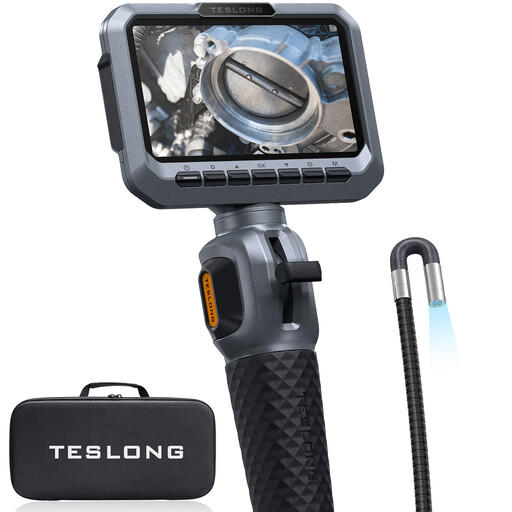
Why This Fits Their Persona: Useful for automotive, HVAC, plumbing and maintenance users who regularly work around corners and behind fixed components.
The 5.5mm articulated probe combines a semi-rigid 5ft neck with 210-degree control, rather than relying on an unsteerable flexible cable.
Six adjustable LED lights, 5-inch IPS display, 1920×1080 image capture and 3000mAh rechargeable battery.
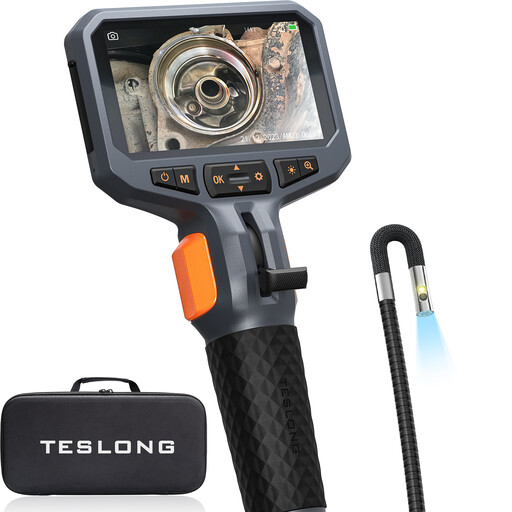
Why This Fits Their Persona: Designed for frequent vehicle, wall, brake and engine inspections where a longer, shape-holding probe is useful.
The 1.55m semi-rigid probe can be formed before insertion, while the control wheel provides up to 210 degrees of tip movement.
Dual-lens camera, 4.5-inch IPS screen, 3500mAh battery, adjustable light and photo/video recording.
We have compiled a complete, real-time list of products that fully satisfy these strict selection criteria and UK safety regulations.
Before using an endoscope inspection camera:
Do not insert a camera into live electrical equipment, moving machinery or hot components unless the product documentation specifically permits it. A pipe inspection camera may be suitable for damp environments only where its stated protection rating supports that use. “Waterproof” should not be assumed for every flexible inspection camera.
Measure the smallest inspection opening first. For spark plug holes and narrow fuel injector passages, a 3.9mm or 5.5mm camera may be more practical. Larger openings can accommodate an 8.5mm model, which may provide a different balance of durability and access. Always compare the required hole diameter listed for the specific product.
It can be worthwhile when the camera must view behind corners, inside engine components or around HVAC obstacles. A steerable tip reduces the need to withdraw and reposition the probe. For simple, straight-line checks, a fixed camera may be sufficient.
Runtime varies according to screen brightness, LED intensity, recording use and battery condition. Models in this selection use 3000mAh or 3500mAh rechargeable batteries. For professional call-outs, charge the camera before travelling and consider carrying a USB-C charging option where supported.