Voice-first meditation creators
You want spoken guidance to remain clear when household hum, traffic or neighbouring activity is audible, and are willing to give up some spacious room sound for a more focused recording.


For guided-meditation narration in a noisy flat, prioritise a microphone close to your voice or a narrow mono pickup aimed at you; neither approach replaces a quiet room. A compatible lavalier offers a close-microphone option, while 32-bit float recording can simplify level management. Treat noise reduction as an aid to test in your own room, not a promise that neighbouring voices or impacts will disappear.
You want spoken guidance to remain clear when household hum, traffic or neighbouring activity is audible, and are willing to give up some spacious room sound for a more focused recording.
You record alone and want a compact setup that makes level setting and retakes easier to manage without a larger microphone rig.
You want some natural room sound around the voice, but need to test microphone direction and placement so that ambience does not overwhelm the narration.
Start with how the recorder will capture your voice in the room. Then consider level handling and how much ambience the finished meditation needs.
| Concern | What to check | Who this matters to |
|---|---|---|
| Voice isolation | Check the exact model for a directional or mono setting, or an input for a compatible close microphone. Test placement against your usual noise. | If neighbouring sounds interrupt my narration, I need the voice to remain clear even if the room sounds less spacious; around 50% of consumers would put voice isolation first. |
| Level management | Check the recording format and whether your editing software accepts it. If you plan to use a firmware feature, check the installed version. | When my delivery moves between soft passages and stronger prompts, I want fewer takes spoiled by level-setting mistakes; roughly 30% of consumers would make level management their main concern. |
| Room ambience | Look for the microphone patterns or stereo positions you need, and listen to a test take before settling on a wider sound. | I want the meditation to retain a natural sense of space without letting room noise distract from the words; about 20% of consumers would prioritise that balance. |
Zoom describes its Essential-series noise reduction as addressing ambient environmental noise and the H2essential’s mono hyper-directional pickup as reducing background noise. Neither claim means every sound in a flat will be removed.
Make a short recording in your intended position when the room is typically noisy. Compare close or directional pickup with a wider stereo take.
Wider stereo pickup can retain room atmosphere, including sounds you would rather leave out. The Zoom H2essential offers stereo patterns as well as a mono hyper-directional setting.
Test the spoken guidance in mono or with a close lavalier first. Keep stereo ambience only if it helps the finished recording.
Zoom lists a 3.5 mm mic/line input for lavaliers on the H1essential, but a suitable connection still depends on the microphone and accessories you choose.
Check the connector, power requirements, cable length and how you will monitor clothing noise before ordering.
A compatible lavalier, adapter, stand or headphones may need to be obtained separately; check what is included.
The Information Commissioner’s Office says the UK GDPR household exemption concerns purely personal or household activity with no professional or commercial connection. Publishing or commercially using a recording calls for a separate assessment, particularly if other people are identifiable.
Listen for identifiable third-party speech before sharing a take, and seek advice relevant to your intended use if privacy is a concern.
Its portable range includes the H2essential for selectable pickup patterns and the H1essential for a compact recorder with a lavalier-ready input.
The DR-07X is a handheld option for recordists who want to adjust the positions of built-in stereo microphones.
The PCM-A10 is a compact option for buyers who value built-in storage and manual recording-level adjustment.
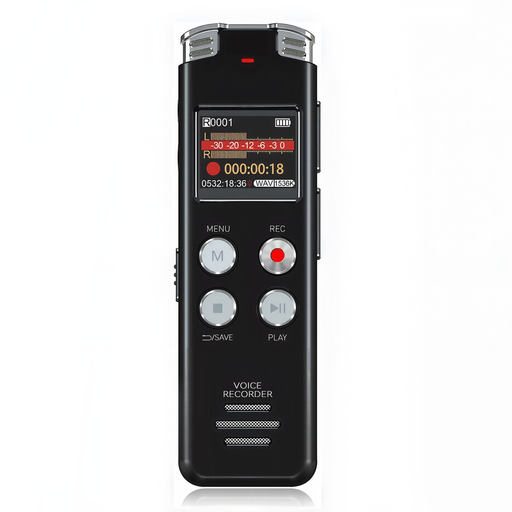
This portable recorder is a choice for spoken meditation takes. If close or directional pickup is essential in your flat, check its microphone options before buying.
 No image available
For spoken meditation takes, check whether this recorder’s microphone options suit the noise and recording position in your flat.
128GB variant with an LCD screen and a grey ABS/aluminium-alloy body.
The product name advertises intelligent noise reduction; test a take in your room rather than relying on it to remove neighbouring sounds.
No. On the Zoom H1essential, 32-bit float recording helps with level management, not sound isolation. Zoom describes its separate Essential-series noise-reduction feature in terms of ambient environmental noise; test it against the sounds that actually occur in your flat.
Start with mono if clear narration is your priority in a noisy room. Zoom says the H2essential’s mono hyper-directional setting reduces background noise; choose stereo when a test recording shows that the extra room ambience works for your meditation.
Yes, if the exact recorder and lavalier have a compatible connection and power arrangement. Zoom lists a 3.5 mm mic/line input for lavaliers on the H1essential; check the microphone’s connector and any adapter requirements before buying.
The Information Commissioner’s Office says personal data processed purely for personal or household activity, with no professional or commercial connection, falls outside UK GDPR scope. If you publish or commercially use a recording containing identifiable other people, do not assume that household exemption applies; seek advice for that use.