Who is this for?

Solo learners dealing with room echo

If speech recorded in your bedroom, kitchen or study picks up too much room sound, start by considering how close you can place the microphone. Shure’s recording guidance recommends close placement when unwanted room sound is a problem.

Learners making frequent short recordings

For repeated pronunciation drills, straightforward recording and playback may matter more than a long feature list. Zoom and Tascam describe 32-bit float as a way to reduce routine input-level adjustment; you will still need a workable microphone position.

Learners planning a closer microphone setup

If the recorder cannot sit conveniently near your mouth, look for an input compatible with the microphone you intend to use. Options described by Zoom and Tascam include 3.5 mm connections for certain external microphones and XLR/TRS inputs on some models.

What matters when choosing a recorder?

For language exercises in an untreated room, work out where the microphone can sit before deciding which recording and playback features you need. The concerns below reflect different primary priorities among consumers making that choice.

ConcernWhat to checkWho this matters to
Room sound Check whether you can place the recorder close to your mouth, or connect a compatible lavalier or separate microphone. If the room is audible in my practice clips, I want to move the microphone closer without making recording awkward; around 45% of consumers put control of room sound first.
Recording levels Check the exact model’s recording modes, including whether it offers 32-bit float, and whether its controls suit short, repeated takes. When I alternate between quiet and louder exercises, I want to start another take without repeatedly adjusting levels. Roughly 33% of consumers prioritise avoiding level-setting mistakes.
Review and transfer Check playback navigation, storage and how files move to the device you use for review. If I compare several attempts or share selected recordings, I need to find and transfer the right files without fuss; about 22% of consumers place review and transfer first.

Mistakes to avoid

  • Choosing on 32-bit float alone

    Zoom and Tascam associate 32-bit float with easier level management, not with removing room reflections. A recording can still contain unwanted room sound when its levels are well managed.

    Decide where the microphone will sit, then choose a recorder with built-in microphones or an external input that fits that position.

  • Assuming all built-in microphones offer the same control

    Tascam specifies omnidirectional built-in microphones for the DR-05XP and adjustable unidirectional stereo microphones for the DR-07XP. Their arrangements give you different placement choices, although neither replaces getting the microphone close enough.

    If positioning is difficult, check the exact model’s microphone arrangement and external-input compatibility before buying.

    Using a separate microphone may also mean carrying and setting up a cable or stand.

  • Confusing DR-05X with DR-05XP

    Tascam Europe identifies the DR-05X as discontinued; the DR-05XP has its own product information. Do not assume the two suffixes describe the same feature set or current model.

    Check the full model name against the specifications for the recorder you intend to buy.

Recorder brands to consider

Zoom

Zoom’s Handy Recorder range includes compact models with built-in microphones and models intended for external microphone inputs.

  • Zoom specifies 32-bit float for the H1essential, H1 XLR and H4essential. The H1essential accepts a 3.5 mm lavalier, while the H1 XLR and H4essential have XLR/TRS inputs; Zoom specifies phantom power for the H4essential.
  • With its built-in microphones alone, the H1essential still needs a suitable position near the speaker. Recording resolution does not change the room’s acoustics.

Tascam

Tascam’s DR-05XP and DR-07XP are portable recorders with 32-bit-float modes and USB audio-interface functions.

  • Tascam specifies omnidirectional built-in microphones for the DR-05XP. The DR-07XP offers adjustable A-B or X-Y unidirectional stereo microphones; both models have a mini-jack route for compatible external microphones.
  • The DR-07XP offers more built-in microphone orientation choices, but those choices do not establish clearer speech in every untreated room. Placement still matters.

Sony

Sony positions the ICD-UX570 as a slim voice recorder for spoken-word recording and playback.

  • Sony specifies direct USB connection, 4 GB of internal storage and microSD expansion. Its Auto Voice Recording setting is described by Sony as adjusting capture settings for vocal frequencies.
  • If close microphone placement depends on a particular external input or directional setting, check the ICD-UX570’s current manual before choosing it for that setup.

Joybuy recorders for language practice

This digital voice recorder is an option for solo language exercises when you can place the recorder close to your voice. Check its microphone arrangement if your room makes close placement especially important.
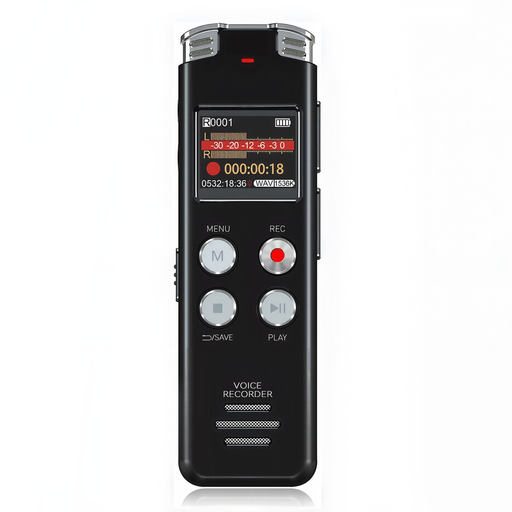
Grey Rexsun L357 128GB digital voice recorder

Rexsun L357 128GB Digital Voice Recorder, Grey

Consider it for solo practice if you can position the recorder close to your voice.

This variant has 128GB storage and an LCD screen. If you need to use a separate microphone, check the exact input and microphone compatibility before buying.

View on Joybuy

Questions about recording language practice

How should I position a recorder in an untreated room?

Place its microphone close to your voice, keep the recorder steady and make a short test recording before a full exercise. Shure’s recording guidance recommends close microphone placement where unwanted room sound is a problem; listen to the test to judge whether the position works for your speech.

Will 32-bit float remove room echo?

No. Zoom and Tascam describe 32-bit float in terms of recording-level management; it does not treat the room or change where the microphone picks up sound. Decide on placement separately from recording resolution.

When is an external microphone worth considering?

Consider one when you need the microphone nearer your mouth than you can comfortably place the recorder. Zoom specifies a 3.5 mm lavalier option for the H1essential and XLR/TRS inputs for the H1 XLR and H4essential; Tascam specifies mini-jack external-input options for the DR-05XP and DR-07XP. Match the microphone and its power requirements to the exact recorder.

What helps when I want to compare many practice takes?

Look for playback controls, enough suitable storage and a transfer method that works with your review device. Sony specifies direct USB transfer and microSD expansion for the ICD-UX570; check the workflow of any other model you are considering rather than choosing on storage capacity alone.

What if my language exercises record other people?

Check which privacy requirements apply to the people, setting and intended use before recording or sharing their voices. The UK Information Commissioner’s Office gives lawful-basis guidance for organisational surveillance under UK GDPR, but that guidance is not a blanket ruling on every private language-practice recording.