
24/7 Customer Support

Free returns

Same-day & Next-day Delivery

Quality Guaranteed

Unlock Your Welcome Offers: FREE Delivery | Up to 80% OFF | Free 30-day JoyPlus trial
Download the APP
An automatic self-cleaning cat litter box can reduce daily scooping, litter tracking and unpleasant odours. However, the right choice depends on more than attractive app screenshots or claims about going scoop-free for weeks.
For UK cat owners, the main buying mistakes usually involve ignoring litter compatibility, underestimating the unit’s size and trusting safety or health-monitoring claims without checking how the system actually works. This guide explains the specifications that matter and matches several options to different household needs.
Many automatic litter trays require clumping litter so the mechanism can separate waste from clean litter. Some accept bentonite, tofu or mixed litter, while crystal-litter systems may use disposable trays instead.
Using the wrong litter can affect clump formation, cleaning performance and internal components. Always check:
A low purchase price may become less appealing if replacement consumables are difficult to source or cost more than standard litter.
Waste-bin capacity depends on the number of cats, their size, litter habits and cleaning frequency. A stated capacity of seven, ten or 13 litres does not guarantee the same number of days between emptying for every household.
A single indoor cat may use a waste drawer for longer than a multi-cat household. Larger cats can also produce larger clumps. Look at the waste-bin capacity, not only the globe or internal litter-box capacity.
A large automatic cat litter box can occupy substantial floor space and may need clearance around the opening, waste drawer and power cable. A high entrance may also be unsuitable for senior cats or cats with limited mobility.
Measure the intended location before ordering, including:
A self-cleaning litter tray may offer automatic, timed and manual cleaning. Some models also include an emptying mode or a setting for softer stools.
Check whether the system waits until your cat has left before cycling. A sensible design should use weight, infrared, radar or other sensors to detect occupancy and pause operation when a cat approaches. These features support safer operation, but initial supervision is still advisable.
A multi-cat litter box should have enough internal space for each cat to turn around comfortably and a waste drawer suited to household usage. Product specifications should state a recommended weight range. Do not assume that an “extra-large” label automatically suits a Maine Coon or other large breed.
For example, the CATLINK BayMax SE Lite lists a 70-litre litter-box capacity, a seven-litre waste tray and suitability for cats weighing approximately 1.59–9.98 kg. The CATLINK Pro-X Luxury lists a 57-litre globe, a 13-litre waste bin and a stated cat range of 1.5–10 kg. Always compare the actual dimensions with your cat’s size and preferred posture.
An app-controlled cat litter box may record usage times, visit frequency and weight changes. Some models also include an AI cat camera litter box function for remote viewing or image-based monitoring.
These tools can help owners notice changes in routine, but app records are not a veterinary diagnosis. Consider whether you need:
An odour-control cat litter box may use activated carbon, deodorising gel, sealed waste drawers or multi-layer filtration. These features can reduce smell escaping into the room, but they do not remove the need to empty the drawer and clean the unit.
Check whether filters or gels need regular replacement. Also confirm that electronic parts must remain dry and that the device should be unplugged before deep cleaning.
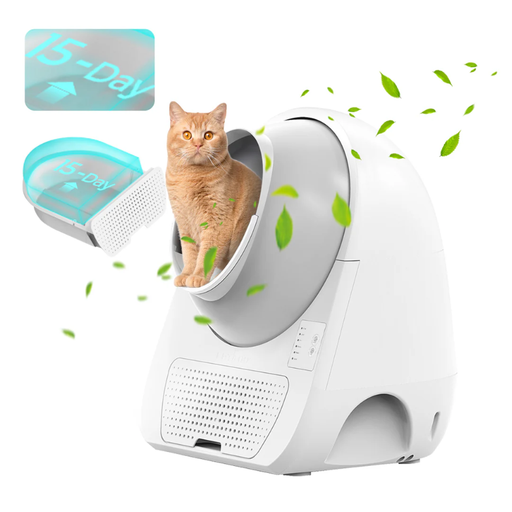
Why This Fits Their Persona: A straightforward option for owners who want automatic cleaning without depending on Wi-Fi or app controls. It is suitable for cats between 3.5 and 22 lb, subject to the stated product guidance.
Its setup does not require complicated app pairing, while infrared sensors and anti-pinch features are listed for pause and protection functions.
57-litre interior, dual filtration system and included litter-trapping mat.
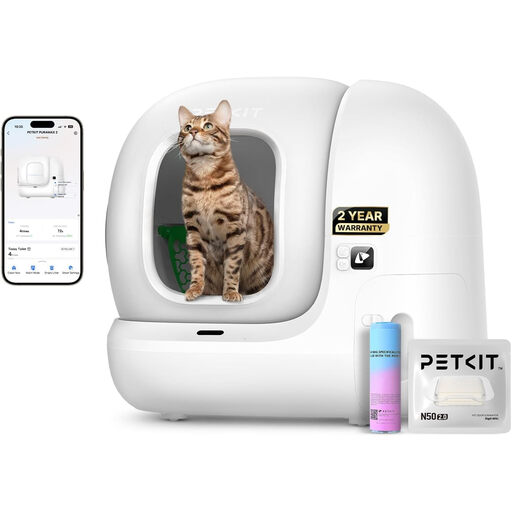
Why This Fits Their Persona: Suitable for owners wanting app controls, a low entrance and usage information in one connected system for an adult cat or smaller multi-cat setup.
The specification states a 76-litre internal capacity, a seven-litre waste bin and an entrance measuring 25.5 cm wide by 20 cm high, making comparison easier.
Three cleaning modes, 2.4 GHz Wi-Fi app control and listed weight and usage monitoring.
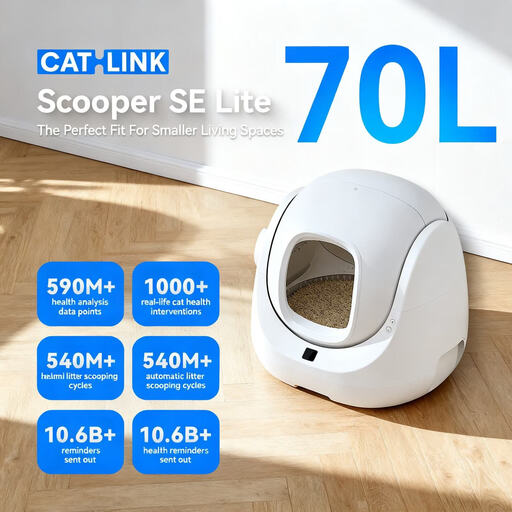
Why This Fits Their Persona: Its 70-litre format and low-entry design suit multi-cat homes or owners looking for easier access for senior cats, provided each cat falls within the stated weight range.
The product specifies eight safety components, four cleaning modes and compatibility with bentonite, mixed and tofu litter.
Low-entry construction, multi-cat app monitoring and automatic, scheduled, manual and emptying modes.
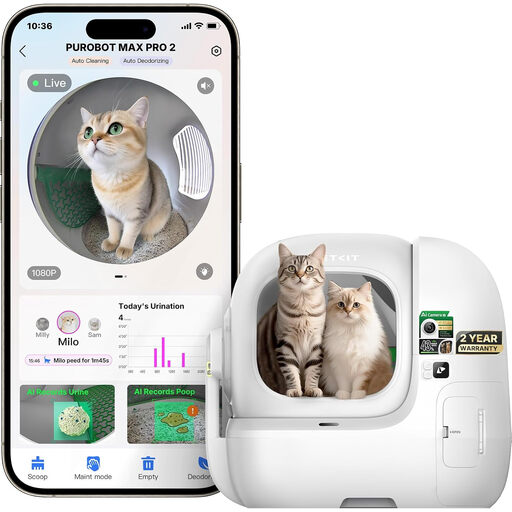
Why This Fits Their Persona: A connected option for owners who want remote camera viewing, app controls and recorded usage information for a larger or multi-cat household.
It lists infrared and anti-pinch protection, a sealed waste bin and an open-ended entrance. Health alerts should be treated as prompts to observe your cat, not medical conclusions.
5G Wi-Fi is listed, alongside a camera, activated-carbon filter and app-based cleaning schedules.
We have compiled a complete, real-time list of products that fully satisfy these strict selection criteria and UK safety regulations.
Place the unit on a hard, level surface rather than a soft carpet, and allow your cat to investigate it before enabling automatic cycles. Some cats adapt more easily when a small amount of their existing litter is added.
Budget for more than the initial purchase price. Ongoing costs may include:
A model with a larger waste drawer may reduce emptying frequency, but regular cleaning remains necessary. Sensors should be kept free of litter dust, and the main electrical base should not be immersed in water.
A safe automatic cat litter box should include occupancy detection, such as infrared, weight or radar sensors, and should pause when a cat approaches. Supervise initial use, follow the supplied weight and age guidance, and never bypass safety systems. Many models are not suitable for kittens below a specified age or weight.
Lifespan varies according to construction, cleaning frequency, litter type and motor usage. Regularly remove obstructions, empty the waste drawer, clean sensors and replace consumable filters as directed. Stop using the unit if it makes unusual noises or shows signs of damage.
No automatic litter tray can guarantee that odours will disappear entirely. Sealed drawers, activated carbon and deodorising systems may reduce escaping smells, while prompt emptying and routine cleaning remain important, particularly in multi-cat homes.