
24/7 Customer Support

Free returns

Same-day & Next-day Delivery

Quality Guaranteed

Unlock Your Welcome Offers: FREE Delivery | Up to 80% OFF | Free 30-day JoyPlus trial
Download the APP
Whether you're a seasoned DIY mechanic changing your own oil or just starting to build a reliable DIY tool kit for home and car repairs, the world of automotive tools can be a minefield. Marketing claims often promise professional-grade quality, but the reality can be a toolbox full of tools that rust, break or simply aren't fit for purpose.
As a Joybuy Product Recommendation Officer, my role is to help you see past the hype. Before you invest your hard-earned money, let's look at the common pitfalls that catch out many UK buyers and how you can avoid them.
mechanic tool set bundles boast hundreds of pieces. However, a closer look often reveals that a significant portion consists of low-value filler like tiny screwdriver bits or single-use fixings. The core components—the ratchets and sockets—are often made from inferior materials that can't handle the torque needed for car maintenance, leading to stripped bolts and snapped tools.trolley jack, many focus solely on the tonnage (e.g., 3 tons). This is a mistake. A jack might be rated to lift your vehicle, but if its minimum height is too high for your car's chassis or its maximum lift height is too low to get the wheel off the ground, it's useless. Poorly made castors and slow, inefficient hydraulic pumps are other hidden flaws.To ensure you're buying tools that are safe, effective and built to last, focus on these non-negotiable specifications.
For any tool that will be under stress, such as a socket set or spanner set, the material is critical. Look for tools made from Chrome Vanadium (Cr-V) steel. This alloy is heat-treated to provide a combination of hardness, strength and resistance to abrasion and corrosion. It's the established standard for reliable garage tools. For screwdriver and Torx bits, S2 steel is an even better choice, offering superior hardness and wear resistance, which prevents the bit from camming out or stripping screw heads.
When selecting a hydraulic car jack, look past the lifting capacity and check these three things:
The mechanism inside a ratchet spanner determines how it performs in tight spaces. The tooth count dictates the swing arc needed to engage the next tooth. A basic ratchet might have 36 teeth, requiring a 10-degree swing. A 72-tooth or 90-tooth ratchet, however, only needs a 5 or 4-degree arc, respectively. This small difference is a game-changer when you're working in a cramped engine bay with minimal room to move your hand.
Instead of a generic list, we've matched specific products to the people who will get the most value from them.
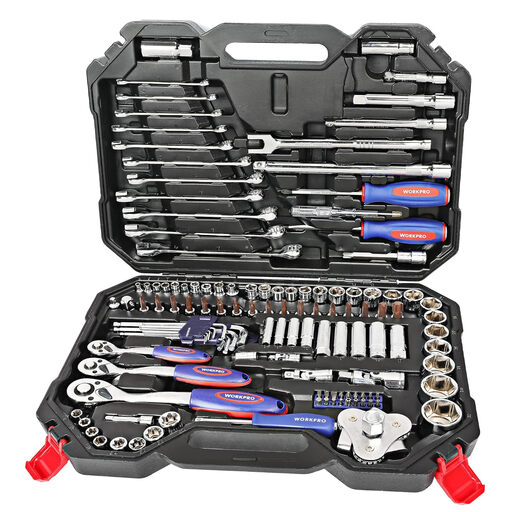
Why This Fits Their Persona: This set provides a solid foundation for most common car and home repair tasks without overwhelming a new user. It includes the essential drive sizes (1/4", 3/8", 1/2") and a practical selection of spanners and bits, making it a versatile first `car repair kit`.
It avoids the "inflated piece-count" trap by focusing on genuinely useful tools. The core sockets and spanners are made from heat-treated, chrome-plated steel for corrosion resistance and durability.
Includes three different drive size ratchets for versatility. Comes in a durable blow-moulded case that keeps every tool organised and secure.
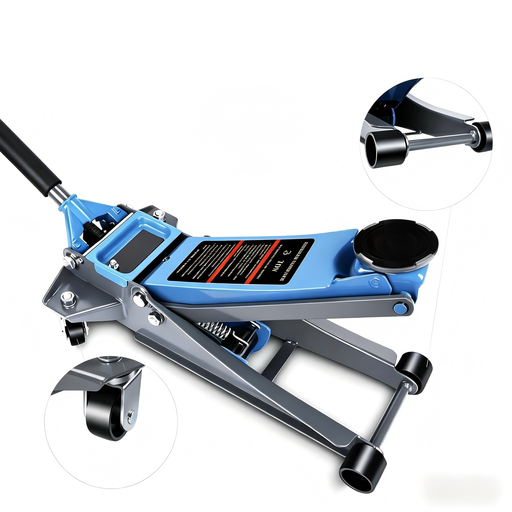
Why This Fits Their Persona: An enthusiast working frequently on their own vehicle needs a reliable and efficient `trolley jack`. This model is built for performance, easily lifting everything from low-slung sports cars to family SUVs, making tyre changes and underbody work much faster and safer.
It directly counters the "misleading jack" trap. Its excellent lifting range (approx. 73mm - 500mm) offers great versatility, while the dual-piston pump provides a quick lift, saving time and effort.
Constructed from heavy-duty steel for durability. The low-profile design makes it suitable for performance cars that other jacks can't fit under.
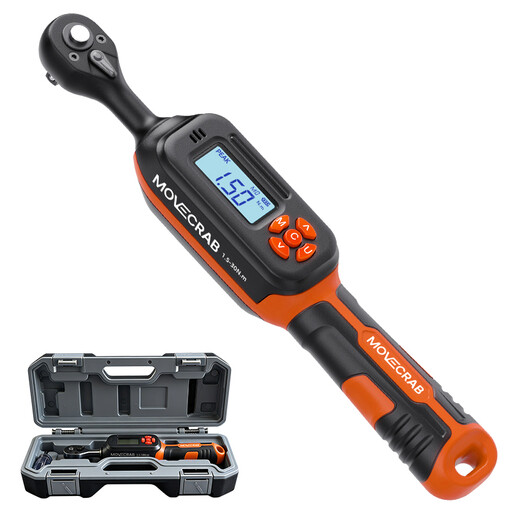
Why This Fits Their Persona: For critical jobs like tightening engine components or wheel nuts, precision is not optional. A digital `torque wrench` removes the guesswork. This model is ideal for mechanics who need verifiable accuracy to prevent over-tightening and component damage.
It replaces the ambiguity of mechanical "click" wrenches with clear, digital feedback. The triple-alert system (LED, sound and vibration) ensures you never miss the target torque, even in a noisy workshop.
High accuracy of ±2%. The digital display shows real-time values and supports multiple units (N.m, ft.lb, in.lb, kgf.cm), making it easy to follow manufacturer specifications.
We have compiled a complete, real-time list of products that fully satisfy these strict selection criteria and UK safety regulations.
Chrome Vanadium (Cr-V) is an excellent all-round steel for tools like sockets and spanners. It's strong, tough and resists wear. S2 steel is a shock-resistant tool steel that is even harder than Cr-V. This makes it the preferred material for screwdriver and Torx bits, as it is less likely to deform or "cam out" of a screw head under high torque.
There is no fixed replacement schedule, but safety is paramount. You should inspect your jack before every use. Check for hydraulic fluid leaks, bent frames or damaged wheels. If the jack struggles to lift a load it previously handled, or if it "sinks" under load, it must be taken out of service immediately for repair or replacement. Always use jack stands for safety once the vehicle is lifted.
Both are significant upgrades over older 36-tooth designs. A 90-tooth ratchet requires a smaller swing arc (4 degrees) than a 72-tooth (5 degrees). While a 1-degree difference seems small, it can be the deciding factor in whether you can turn a bolt in an extremely confined space, like behind an engine block or near a firewall. For general use, a 72-tooth is excellent, but for professionals or those who frequently work in tight spots, a 90-tooth ratchet offers a distinct advantage.